As I have mentioned and you certainly know, this year has been a hard year for every living thing. Water and food are not as plentiful for our wild friends.
So, while I have lots of extra water stations, I also have put out extra bird food.
Black oil sunflower seeds are my favorite for most of the feeder birds, along with dried mealworms for the bluebirds and phoebes. Live mealworms are the best, but even more expensive than the dried ones.
I have spent way over my budget this year, so I need to win the lottery soon. Like me, the birds will have to be careful with our funds.
I took these photos this morning of first-year bluebirds sitting on one of my platform feeders eating mealworms I had just set out. They must fight the cardinals for them. The eastern phoebes also like the mealworms.
The bluebirds were born this spring, so they look a bit rough. They will look better in their second year.
It’s nice to do something for the birds. It’s nice to do something nice for anyone.
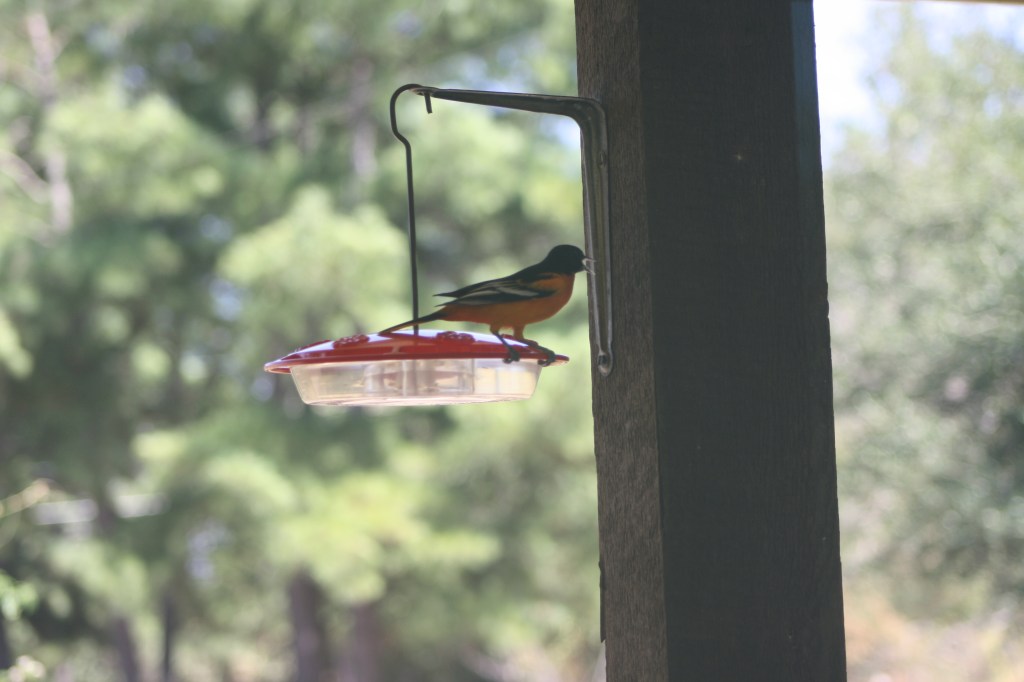
This morning I looked out our front window to check on one of my hummingbird feeders. I went oh, what is that big orange thing! It was a male Baltimore Oriole!!
It was trying to drink the sugar water from the hummer’s stash. I rushed to see if I could take a photo through the window. I got a few that were good enough to clearly identify the bird. He was not there long because a couple of attacks to his head by one of my male ruby-throated hummers ran him off.
I had the bottom of an old feeder, so I got it out. I placed some grape jelly, pineapple chunks, and some Mandarin oranges in it and mixed a little sugar water in it also. An orange cut in half would have been better, but I had to use what I had on hand.
I took the feeder out to my garden and hung it on a shepherd’s hook.
In about an hour the Oriole found it. But so did the other hummers. Not so fast they cried.
Those little rascals simply think they own the garden. I have seen them run the butterflies off too. I love them all, so they will have to work it out amongst themselves.
I have noticed that for the past three years, I have had just one of these beautiful birds show up here at our place.
So why is it alone? No one will ever know, he’s not talking.
The world is full of beautiful little nature events like this; you just have to pay attention.
Today I went out to my garden to fill all the bird baths and containers I have with fresh water for all the birds, bunnies, and assorted little creatures that call our place their home. After all, we are in their hood. I have to fill everything twice a day.
I have tried to get a photo of all the Cardinals. I must have 80 to 100 of them, by far more than I have ever had at one time. We have feeders out for them, so I am thinking that the weather was not kind to insects this year (or anyone else) and that the birds are hungry and thirsty. I can understand that. They cannot run over to the store and pick something up like we do. Asking them to sit still while I take a picture of them has not been easy. They fly up as soon as I approach them.
They are at Mother Natures and humans’ whim.
There are lots of first years in the garden. You can always tell the new babies because their feathers are not as beautiful, not as colorful, and pretty ruffled up. They look like they are having a bad hair day!
I was able to get one photo with several first-year Cardinals and two first-year Blue Birds. I bet they will remember sitting next to their bird pals during a drought year and sharing a cool drink. There are always good times if you look for them.
I left Texas for a couple of weeks and looked for birds in South Carolina. I was surprised at how few I saw, though looking up and seeing an osprey floating outside my window scanning for prey was a pretty cool highlight.
I have no bird photos, so I’ll share other summer survivors. This beauty is a checkered setwing (Dythemis fugax). I love its stance. We have lots of them now, but I’d never observed one before.
Back here in northern Milam County, Texas, I’ve had the same experience. Before I left, the drought was just getting started, and I still saw scissortail flycatchers, large flocks of starlings and grackles, paintd buntings (heard, not seen), a few dickcissels, and my buddies the bug-eating barn swallows. When I returned, those birds were long gone. In fact, because I slept in a bit the first few days that I was home, I didn’t see or hear many birds at all.
The ground cherries (Physalis cinerascens) are only blooming in the shady areas.
Since I’ve been getting up earlier to hang out with my horses before it gets stifling hot (108 at my house yesterday), I found that the birds make their forays early. For example, this morning I saw three of my pond bird friends, the blue heron, the green heron (it chided me for making it move), and the upland sandpiper. What? Yep, every year a few of them show up and run up and down the “beach” created by the ponds losing water. I often get a yellowlegs or two but have not seen one this year.
We usually have lots and lots of prairie broomweed (Amphiachyris dracunculoides) but this year there isn’t very much.
I turned on my trusty Merlin Bird ID app to see what was out there while I walked around this morning, as well. The red-shouldered hawk was declaring its presence loudly, while the American crows (which I can now distinguish from fish crows by their calls) were answering. I enjoyed that dialog, only to have them joined by my trusty friends who never leave, the Carolina wren (at full volume), the tufted titmouse, and the cardinals. I didn’t hear the woodpecker, but I hear them often, so I believe Merlin on that one. It sounded pretty good there for a while, and I was happy to learn that my woods still had some residents.
What Merlin heard from 8:30-8:40 am this morning.
Other birds that are still hanging around are the house sparrows (much fewer in number now than they were), vultures (black and turkey), and nighthawks who show up promptly at dusk every evening.
These camphorweed (Heterotheca subaxillaris) are pretty perky in areas that get some shade.
It’s nice to know there are still some birds of summer out there. We have lots of water sources, which help a lot, and plenty of seeds and bugs for them to eat. What birds are you seeing where you live?
Feverfew (Parthenium hysterophorus) is popping up near my house. It’s extra poisonous, so it’s going to get cut down.
PS: my photos aren’t of birds, because I haven’t been close enough to photograph any.
I have yet to identify the mysterious sea monster in the pond behind my innocent horse.
Lately, I keep hearing on the news about West Nile Disease and that you should dump out any standing water. While there is some merit to this statement, it also makes people think they should not have bird baths out. Wrong…
Bird baths also add beauty to the garden
Many items that hold standing water like old tires or things laying around in junk yards that can hold water probably should be addressed.
Please do not include bird baths in this category! We are in a severe hot weather event and birds could use our help. Putting out as many containers that hold water as possible could save the life of a bird, a bunny, or any living creature. I am also including your pets if they must be outside.
I have many different types of bird baths on our property. Some sit directly on the ground for bunnies and the birds.
Different kinds of bird baths
It is simple to keep the water safe for humans and the wild things. Note that it takes about 10 days or so for mosquitoes to hatch from a standing water source. Running water does not generally pose a threat, because the larvae or eggs are washed away if the water is running.
Of course, bird baths, which don’t have running water, CAN be a target for mosquitoes. BUT it is so easy to keep that from happening.
First, in this heat, shallow water will evaporate long before 10 days is up. But we probably don’t want to let our water for our friends dry up.
The easiest thing to do to stop mosquitoes is to just dump the water out every day and fill it with fresh water. Problem solved. How hard can that be? Fresh water is good for the birds and animals, anyway.
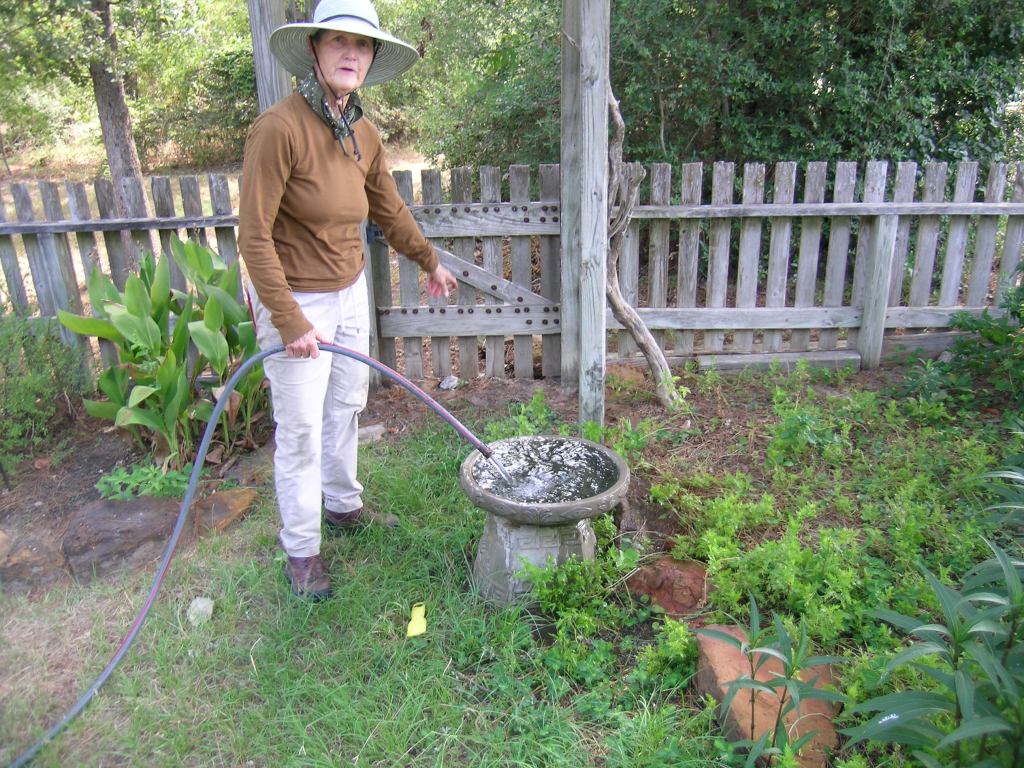
Rinsing
You also buy mosquito dunks at the hardware store. These work well but can cost a lot.
Other Birdbath Maintenance Recommendations
If you have a lot of algae, you can easily clean it with a plastic putty knife. No cleaners are needed. Or you can just rinse it out, the animals don’t care. if there’s algae in their water. Think of it from their perspective.
Scraping excess algae
The water is safer for the smaller birds when it is no deeper than four inches.
If you can put the water container under a tree or have some shade over it, that will be better, and the water won’t get as hot.
A shady bird bath
Yes, cats can be a problem for the birds if the container is near a tree or bush. They love to hide and then pounce. It’s their nature. Cats need water also, and love to get a drink and a snack at the same time. So be cautious where you put your containers.
A bird bath with plenty of space around it
With just a small effort on your part, our wild things can be helped during this extreme weather. All things need water.




 Nature Along the El Camino Real