The Birds of Summer

by Sue Ann Kendall

I left Texas for a couple of weeks and looked for birds in South Carolina. I was surprised at how few I saw, though looking up and seeing an osprey floating outside my window scanning for prey was a pretty cool highlight.

I have no bird photos, so I’ll share other summer survivors. This beauty is a checkered setwing (Dythemis fugax). I love its stance. We have lots of them now, but I’d never observed one before.

Back here in northern Milam County, Texas, I’ve had the same experience. Before I left, the drought was just getting started, and I still saw scissortail flycatchers, large flocks of starlings and grackles, paintd buntings (heard, not seen), a few dickcissels, and my buddies the bug-eating barn swallows. When I returned, those birds were long gone. In fact, because I slept in a bit the first few days that I was home, I didn’t see or hear many birds at all.

The ground cherries (Physalis cinerascens) are only blooming in the shady areas.

Since I’ve been getting up earlier to hang out with my horses before it gets stifling hot (108 at my house yesterday), I found that the birds make their forays early. For example, this morning I saw three of my pond bird friends, the blue heron, the green heron (it chided me for making it move), and the upland sandpiper. What? Yep, every year a few of them show up and run up and down the “beach” created by the ponds losing water. I often get a yellowlegs or two but have not seen one this year.

We usually have lots and lots of prairie broomweed (Amphiachyris dracunculoides) but this year there isn’t very much.

I turned on my trusty Merlin Bird ID app to see what was out there while I walked around this morning, as well. The red-shouldered hawk was declaring its presence loudly, while the American crows (which I can now distinguish from fish crows by their calls) were answering. I enjoyed that dialog, only to have them joined by my trusty friends who never leave, the Carolina wren (at full volume), the tufted titmouse, and the cardinals. I didn’t hear the woodpecker, but I hear them often, so I believe Merlin on that one. It sounded pretty good there for a while, and I was happy to learn that my woods still had some residents.

What Merlin heard from 8:30-8:40 am this morning.

Other birds that are still hanging around are the house sparrows (much fewer in number now than they were), vultures (black and turkey), and nighthawks who show up promptly at dusk every evening.

These camphorweed (Heterotheca subaxillaris) are pretty perky in areas that get some shade.

It’s nice to know there are still some birds of summer out there. We have lots of water sources, which help a lot, and plenty of seeds and bugs for them to eat. What birds are you seeing where you live?

Feverfew (Parthenium hysterophorus) is popping up near my house. It’s extra poisonous, so it’s going to get cut down.

PS: my photos aren’t of birds, because I haven’t been close enough to photograph any.

I have yet to identify the mysterious sea monster in the pond behind my innocent horse.

Mosquitoes in the Birdbaths

by Donna Lewis

Lately, I keep hearing on the news about West Nile Disease and that you should dump out any standing water. While there is some merit to this statement, it also makes people think they should not have bird baths out. Wrong…

Bird baths also add beauty to the garden

Many items that hold standing water like old tires or things laying around in junk yards that can hold water probably should be addressed.

Please do not include bird baths in this category! We are in a severe hot weather event and birds could use our help. Putting out as many containers that hold water as possible could save the life of a bird, a bunny, or any living creature. I am also including your pets if they must be outside.

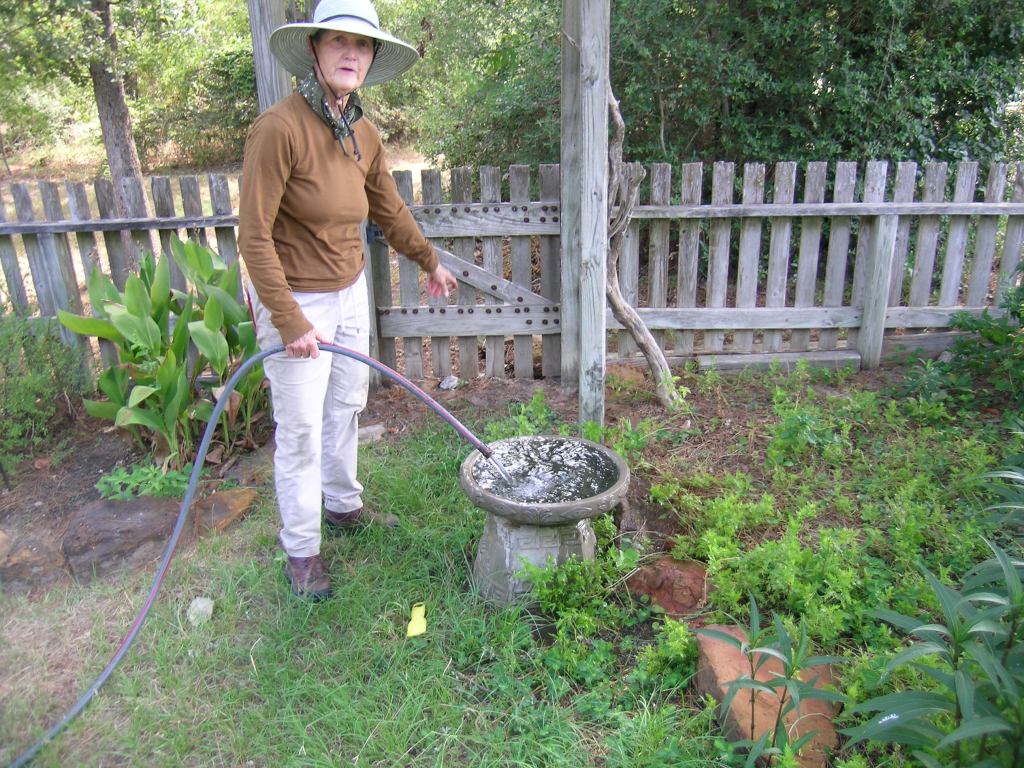
I have many different types of bird baths on our property.  Some sit directly on the ground for bunnies and the birds.

Different kinds of bird baths

It is simple to keep the water safe for humans and the wild things. Note that it takes about 10 days or so for mosquitoes to hatch from a standing water source. Running water does not generally pose a threat, because the larvae or eggs are washed away if the water is running.

Of course, bird baths, which don’t have running water, CAN be a target for mosquitoes. BUT it is so easy to keep that from happening.

First, in this heat, shallow water will evaporate long before 10 days is up. But we probably don’t want to let our water for our friends dry up.

The easiest thing to do to stop mosquitoes is to just dump the water out every day and fill it with fresh water. Problem solved. How hard can that be? Fresh water is good for the birds and animals, anyway.

Rinsing

You also buy mosquito dunks at the hardware store. These work well but can cost a lot.

Other Birdbath Maintenance Recommendations

If you have a lot of algae, you can easily clean it with a plastic putty knife. No cleaners are needed. Or you can just rinse it out, the animals don’t care. if there’s algae in their water. Think of it from their perspective.   

Scraping excess algae

The water is safer for the smaller birds when it is no deeper than four inches.

If you can put the water container under a tree or have some shade over it, that will be better, and the water won’t get as hot.

A shady bird bath

Yes, cats can be a problem for the birds if the container is near a tree or bush. They love to hide and then pounce. It’s their nature.  Cats need water also, and love to get a drink and a snack at the same time. So be cautious where you put your containers.

A bird bath with plenty of space around it

With just a small effort on your part, our wild things can be helped during this extreme weather. All things need water.

Lisa’s Watering Hole

by Lisa Milewski

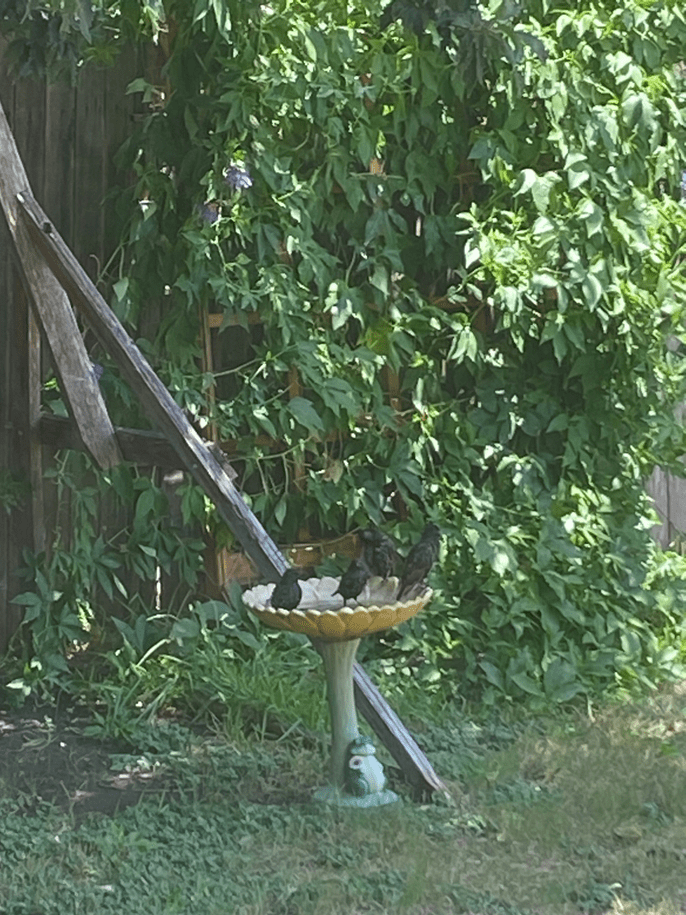
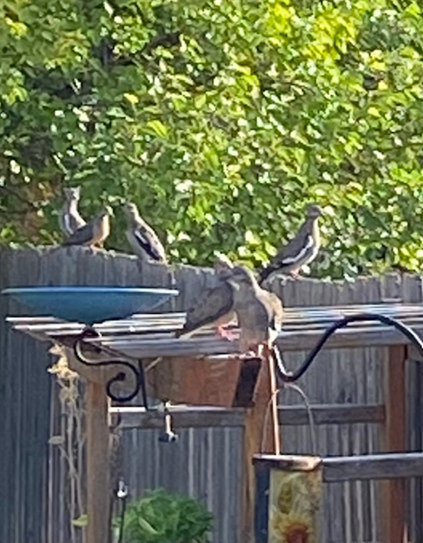
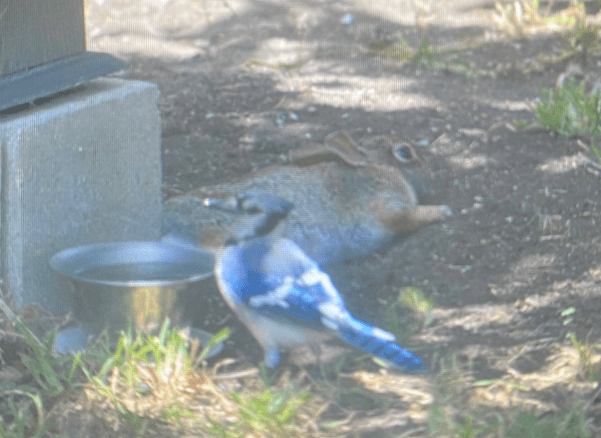
During this heat, I have been filling the bird baths once or twice a day while enjoying watching the birds drink, splash, and bathe. So far, the birds I mostly see are cardinals, blue jays, northern mockingbirds, finches, house sparrows, mourning doves, white-wing doves, European Starlings, ruby throated hummingbird. Even the fox squirrel, cottontail rabbit, and bees seem to appreciate the water left out for them. Here are just a few that I have been able to get pictures of so far.

European Starlings

You don’t want to know my nickname for the doves. Let’s just say that I have to wash my driveway and car often.

“Peter” the cottontail rabbit in his favorite spot sharing his water with “Jay” the blue jay
“Peter” getting a drink

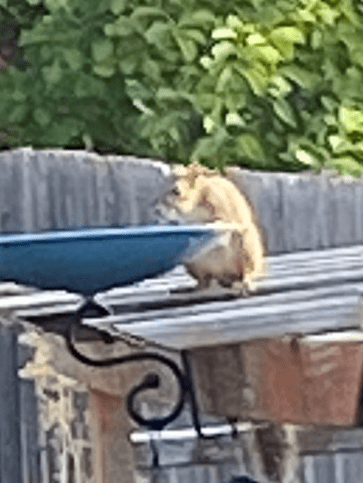
Here’s “Rocky” the fox squirrel getting a good drink

I found that with these larger bird baths, it’s easier to fill them with rocks and top with soil and then place smaller bowls in them. This makes it a lot easier to clean them out daily and refill.

And here’s my favorite, “Ruby” the ruby throated hummingbird drinking from the hummingbird feeder.

Remember to wash out the bird baths and change hummingbird feeders daily or every other day in this heat. We want to help our friends, not make them sick.

Out-of-Sight Parasite

by Lisa Milewski

Why Do Birds Sunbathe?

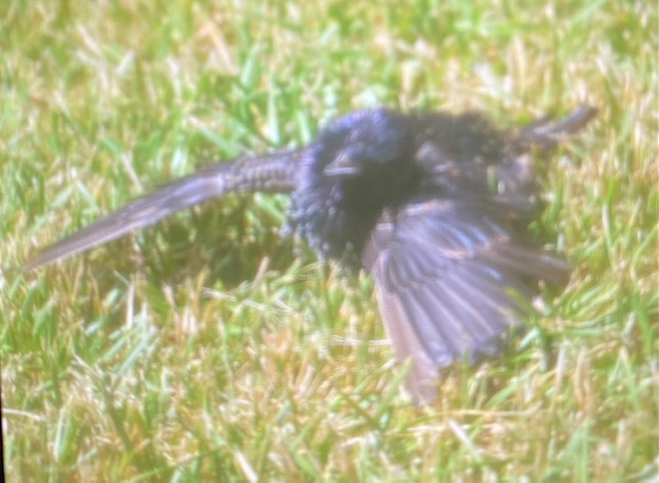
As I look out the window, as I often do to bird and butterfly watch, to my surprise, I see these European Starlings all laying on the ground with their wings spread out. At first, I thought they fell to the ground due to the extreme heat and were in trouble. 

Photos were taken through a window, to not frighten the birds, so they are a little blurry.

I then looked up why the birds would do this and if intervention was needed and I found this:

According to an online Audubon Society article called “Hot, Bothered, and Parasite-free: Why Birds Sun Themselves,” when it is hot enough, they do this not only for warmth and dryness but to rid themselves of parasites living on their skin and feathers. 

It’s not known exactly how sunlight might kill the parasites; however, scientists believe that short blasts of heat, UV radiation, or some combination of both from the sun’s rays is likely the cause. The researchers found that even in a relatively short time in the direct sunlight, around 10 minutes, heated the wings to 140 to 160 degrees Fahrenheit, which far exceeds the temperatures required to kill bedbugs, for example, which die at around 120 degrees. According to another study, 84% of other parasites, such as lice, died in direct sunlight at 140 degrees Fahrenheit in three minutes. At 158 degrees they all perished. 

There are birds from more than 50 families that sunbathe, including birds of prey, rails, doves, larks, swallows, thrushes, finches, buntings, and more, though they may bathe for different reasons and different times.  

There Are Still Birds Nesting Right Now

by Donna Lewis

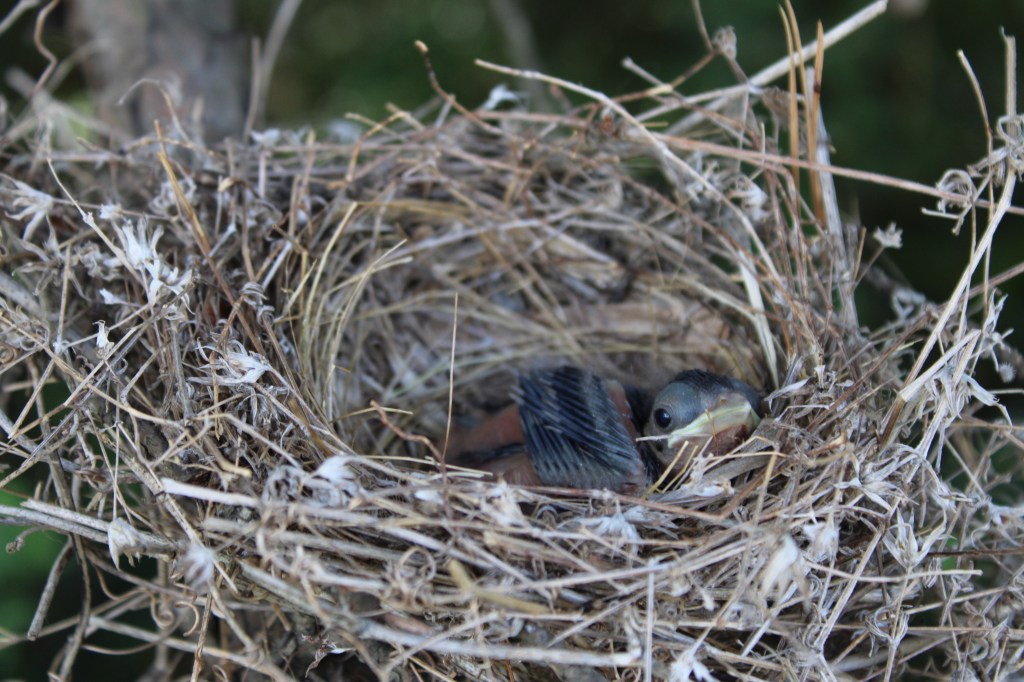
Yes, I thought most of our local birds had finished with having babies still in the nest. It is way too hot to tend to them. I was very surprised when my Linda cut a branch off that she kept heading her head on, to find a Cardinal nest about ten inches from the cut.

Now the nest is pretty much open to the elements. I cannot move it; it is too fragile.

There is one baby in it. I have been watching it with my binoculars for three days now, and thankfully the baby is still safe. The mother is still feeding it. I pray every night that a predator doesn’t find it.

So, keep in mind while you trim branches, there are still babies in their nests now in late July.

Be watchful.