Hummers Have Arrived

by Donna Lewis

At last, our tiny hummingbird friends have returned from down South ole Mexico way. It is hard to believe these little jewels are real living beings. A miracle for sure.

Tiny, but mighty. The two main species that visit Central Texas are the Black-Chinned and the Ruby-Throated. Both only weigh 0.1 ounce each. There are several other species that can be in our area also, but these are the most prevalent and easy to identify. They can beat their wings approximately 75 times per second! Yes, I said second, not a minute. WOW!!! I can’t move anything that fast.

Black-chinned Hummingbird. Photo by Mike Kit on Pexels.com

The males usually arrive first and get ready for the ladies to arrive soon after.

These birds drink nectar and eat insects. The plant they like the most for me is the Coral Honeysuckle. Turk’s Cap is another favorite bush.

Ruby-throated Hummingbird. Photo by Skyler Ewing on Pexels.com

Let’s talk about the human feeders we love to put up so we can watch them and assist in times of stressful weather events. There are some rules to follow so the nectar is safe.

Use regular white cane sugar. One part sugar to four parts water. I use our well water because I am in the country. No need for me to boil anything. If you are in the city, you probably should boil it. The feeders are usually red; do not use dye.  You can tie a red piece of cloth or ribbon if you need to. Year to year in the same place, the hummers will remember where they are.

Here is the MOST important thing of all.  Always change out the sugar water every three or four days in hot weather, or simply every time. The sugar water will ferment, and the bird will become drunk, and many will fly into a window or door and break their neck.  Very sad.

If you can place the feeder under some cover to shade it, that helps.

Cats and snakes like to get our friends, so try to keep them where they cannot be reached. Everybody has to eat.

So get your feeders up, clean them with soap and water every few times and watch a little amazing bird show off its flying skills for you.

Remember who you garden for.

Cedar Waxwing Visitors

by Donna Lewis

Recently I had several large flocks of these very sleek looking birds in my oak trees.

These beautiful migratory birds, Cedar Waxwings, like to stay in flocks and will go all the way to Canada during the warmer months.

A sleek crest with a black mask and red wax-looking tips on their secondary wings make these birds easy to identify. The feathers on their chests are short and look slicked down.

Photo by Skyler Ewing on Pexels.com

They mostly eat fruit, berries, flower petals, some insects, and occasionally sap.

I love the fact that when they are courting male and females will sit side by side and pass flower petals back and forth, share a meal and rub beaks. How romantic!  The babies are even fed by both parents.

They will drink from bird baths and sometimes eat raisins from bird feeders. But more often Cedar Waxwings keep to the wild things for food.

Photo by AE Rudd

If you see some birds with a crest and look like Zorro, then they’re probably Cedar Waxwings.

Remember who you garden for.

So Many Grackles

By Pamela Neeley

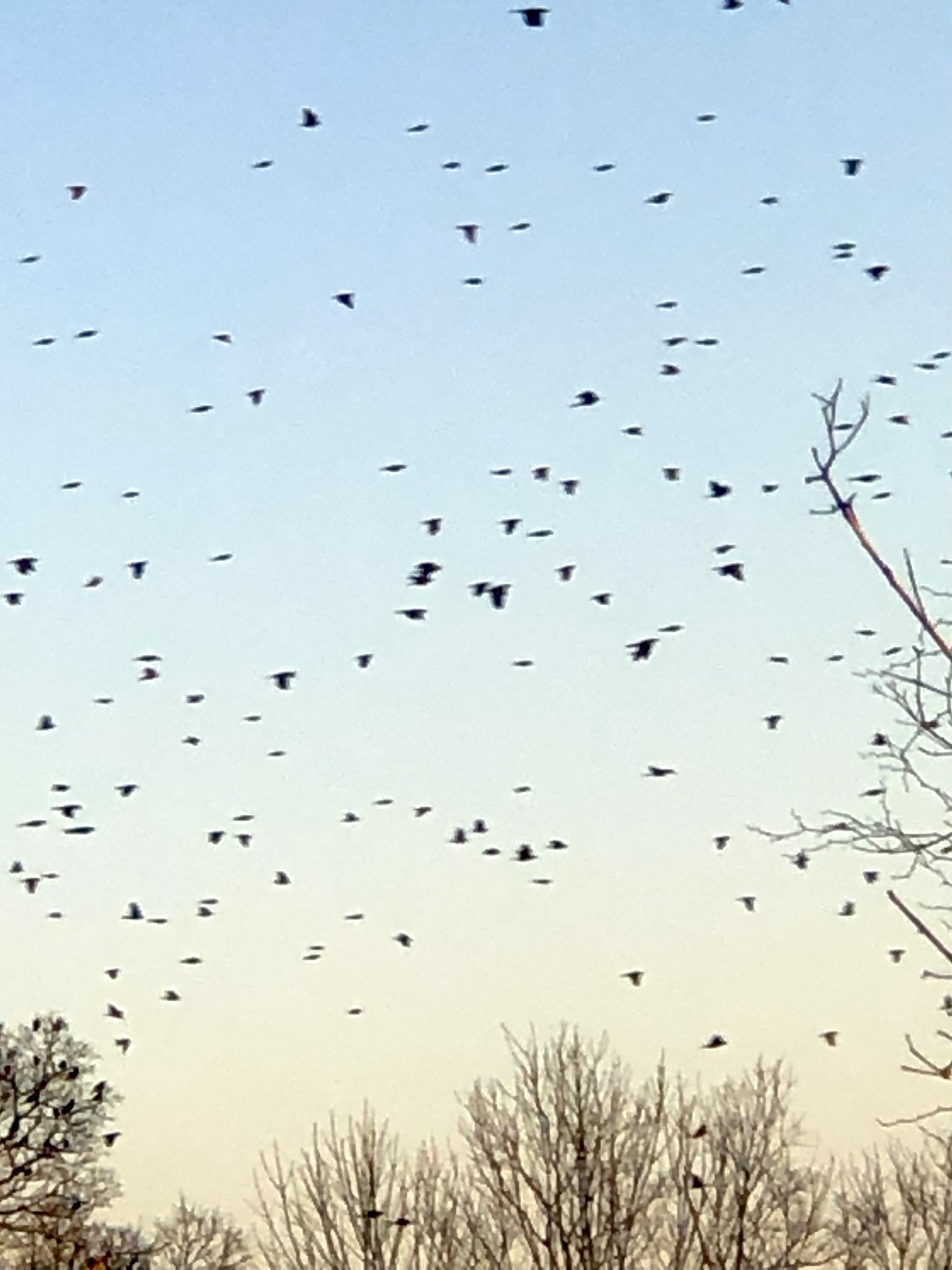
On February 2, 2025, I was working in my studio with the doors open when I heard chattering coming from the sky.

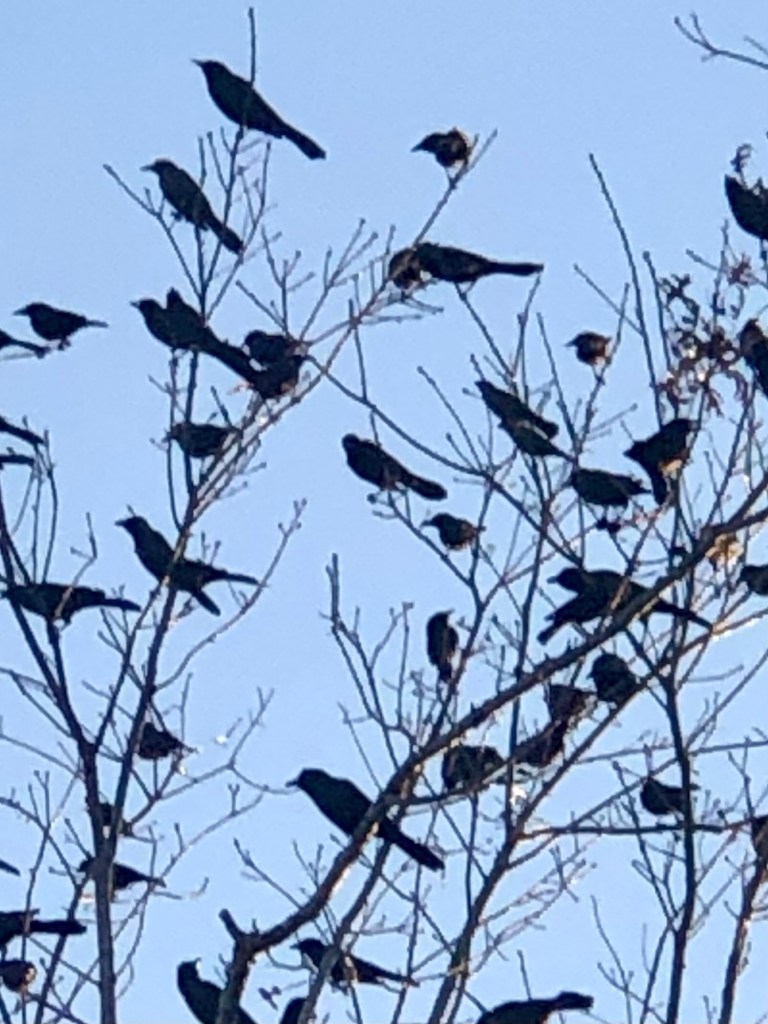
Grackles with bonus Black Vultures

The Common Grackles were flying over.

I witnessed three waves of hundreds of birds soaring overhead from east to west, around 5:30 pm. Some stopped briefly in the treetops, while others kept going.

Each group flew over slightly south of the previous group.

It’s Purple Martin Time… Are You Ready?

by Donna Lewis

Yes, it is already that time when our Purple Martin friends will start their migration from Brazil back to North America.  Yes, the early ones will still face freezing and other harsh weather events.

I wish I could ask them to wait a little longer, but instinct is urging them onward.  The scouts (who are not the youngest birds) hope to find the best housing first…

As of today,  1/30/2025, sightings have been called in for San Antonio, Austin, Houston, and a few more Texas sites. Central Texas does not have a certified sighting as yet. I hope that myself or our Landlord in Buckholtz will win that honor.  We’ll know soon. I am watching for them all day..

First of all, your houses (gourds, or apartments) should be cleaned, and with added pine-needles if you do that. I also added pine-needles to my Blue-bird houses.  The openings should be blocked off so no sparrows, other birds, or insects can get in them.  You need to check yourself. Do not open the housing until the first scouts land on the houses.  If you are looking for the Martins you will see or hear them.  Then open a few of the cavities, not all of them. I usually will pick four to open. 

You do not want the non-native birds (House Sparrows or Starlings) to get in the houses. These birds will kill the Martins for the nests. Trust me, it is not a pretty thing to see. I think keeping predators and non-native birds out is the hardest thing landlords have to deal with.

Right now my gourd rack is lowered and ready to open.  This coming week I will get the apartment house ready to raise up.

I have had back issues this past year, so I will have to have some help caring for my friends this year..  But I will help them out as long as I can. Their song is so addictive that most Landlords that love and care for these native birds will do it until the end of their life.  A gift from Mother Earth.  Their songs are like no other.

Here are some photos showing me stuffing the gourds with fresh pine-needles that will help keep the birds warm and give them a start on nest building that will come later.

We can expect to have Martins here with us for about six months, until they leave for their winter home in Brazil. again.

Birds can lift a sad spirit. No matter what the world is going through, every day they go about their business with joy and sing to us. How lovely.

Remember who you want to call to your home, and furnish what they need. They will come.

A New Toy Wizard

by Ann Collins

I have a new toy! And my life has changed forever! Not sure if it’s for the better, but it lets me be totally lazy. My phone is my window on the world. Living on a downward slope almost to a deep gully, service here is sketchy, often not available at all. Anyway, my new toy is the Merlin phone app, which identifies birds by sound and records a list for me. I’m excited to see what the Wizard has found and I question frequently his ability.

Is it Merlin the Magician or a Merlin bird, or both? (Thanks, AI)

For instance, it has always been a bit of undeserved pride that I’ve never seen a house sparrow on my property. I still haven’t, but Merlin hears them every day or so. House sparrows can be a major pain if they camp out in large enough numbers. They really are considered invasive. They were brought over by some well-meaning moron who thought they would be a nice addition to our native birds. Ironically, in their native England they are becoming quite rare while they have become a real pest here. It’s never a good idea to introduce a plant or an animal you think is cool. Example: the Burmese pythons in the Everglades.

I can’t believe Ann doesn’t want me pooping all over her birding area. Photo by Miriam Fischer on Pexels.com

As I sit inside my cozy sunroom drinking hot, spicy tea on this deliciously cool early autumn morning,* Merlin is busily making a nice list for me. I take my phone out to the deck and conjure up the Wizard and he eagerly gets to work. I’m glad for that, because with encroaching old age many things don’t work like they did in my youth! For istance the high-pitched frequency of many bird sounds simply don’t register in my increasingly deaf ears. Merlin is a relatively new app, so his hearing hasn’t failed him yet – probably just a matter of time.**

Example of Merlin’s observations (Walkers Creek, Texas, October 15, 2024)

I wonder what Merlin’s range is? Are the birds he hears actually in my yard or can he hear the ones a mile away? Just up the driveway? Does that depend on my service or just how he’s programmed? Who knows? Guess I could ask him.

Don’t ask me. I’m Merlin the Bird. Photo by Sethulakshmi Sajeev on Pexels.com

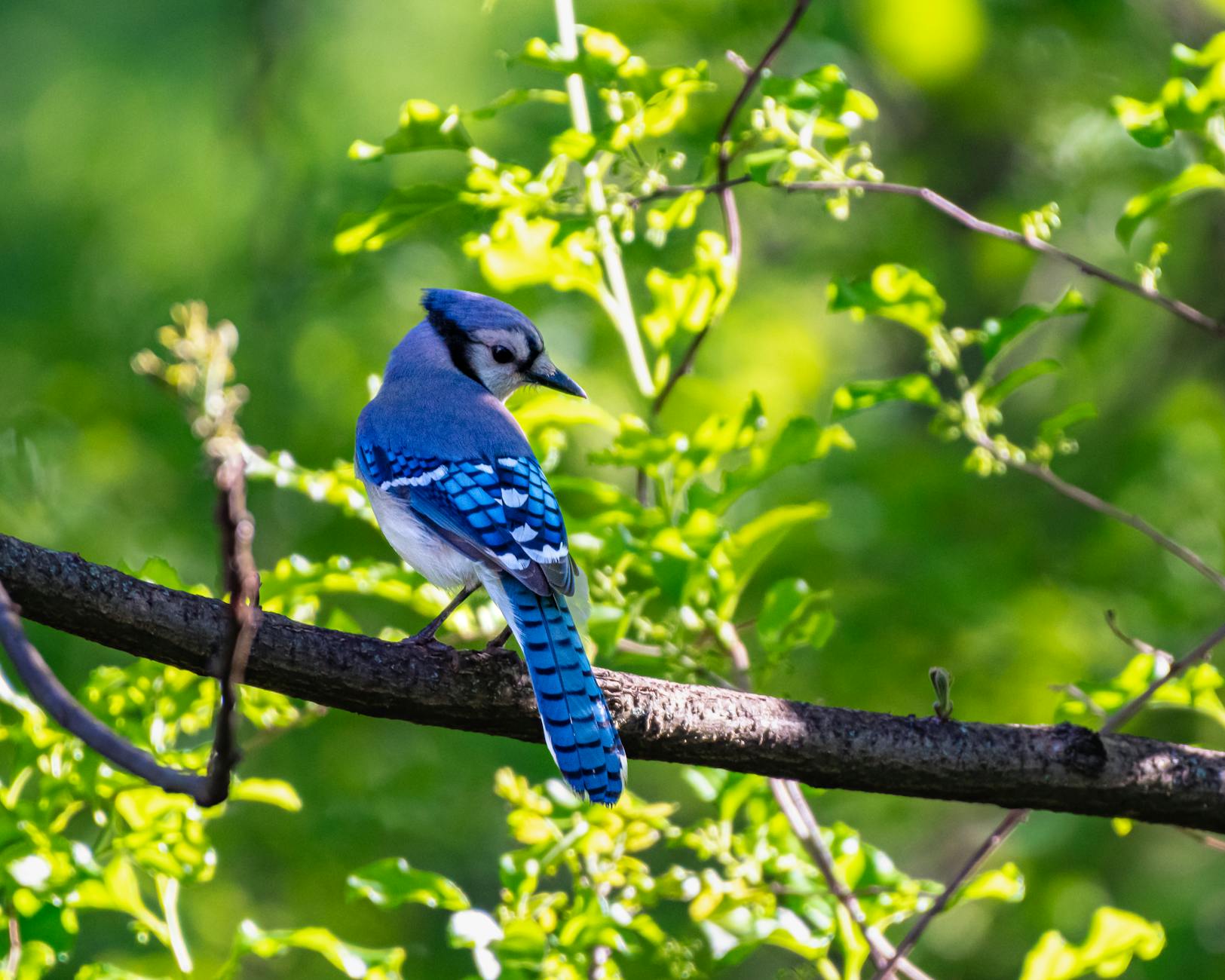
It’s kind of hard for me to trust technology. I didn’t grow up with it like so many of the younger folks. When Merlin IDs a Blue Jay and the next bird is a Red-shouldered Hawk, my skeptical nature questions, was it really a hawl? Some of the calls of these two birds really sound alike. Blue Jays are pletiful here at Chimney Hill and I do have Red-shouldered Hawks regularly. The hawks might even breed here or at least close by.

Blue Jay. Photo by Robert Jakubowski on Pexels.com

House sparrows? Never seen one here. I can thank my lucky stars for that. They can be a real nuiscance. How about a Blue Grosbeak or a Dickcissel or an Indigo Bunting? I did have a number of them a few years back but haven’t seen them in quite a while. I don’t doubt the Merlin reports of Red-winged Blackbirds or the grackles (Common and Great-tailed). Large flocks are not uncommon, so the Red-winged Blackbirds could be traveling with them.

Who knows what kind of birds are in this flock. Photo by Mehmet Suat Gunerli on Pexels.com

In spite of my skepticism and questions I still love my new toy. It really gives a new dimension to my census and wildlife evaluation. I love it!

Thanks to my buddy Suna for programming the app for me!


*This was written during the September cool spell.

**Suna points out that Merlin often has trouble with low sounds like owls and doves.