Summer Hummers

by Donna Lewis

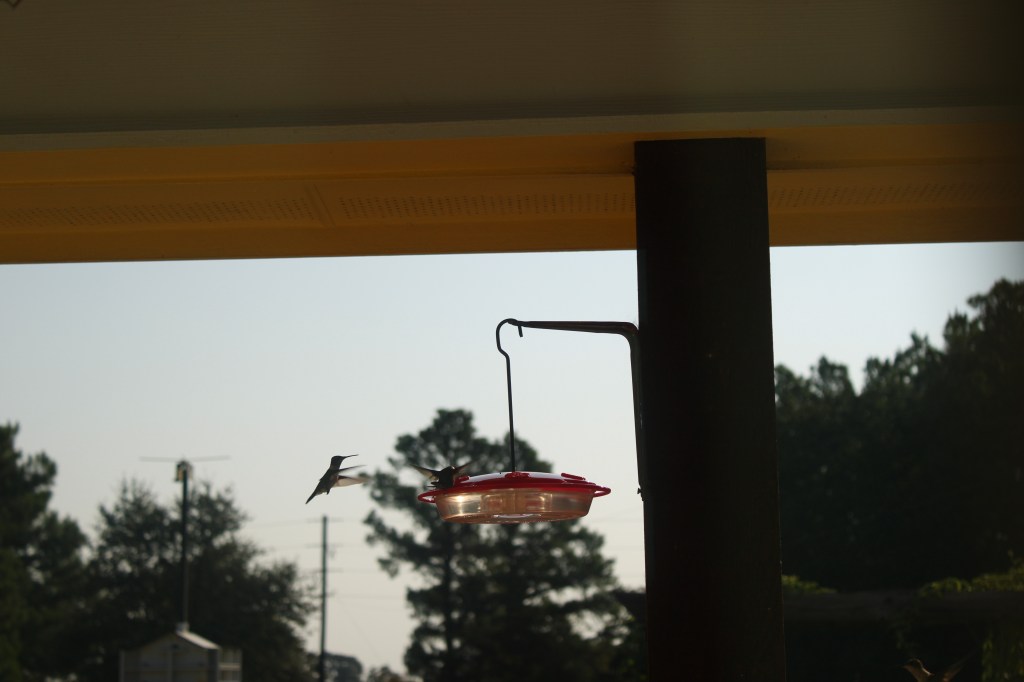
Here we are at the close of summer and we still have 100-degree temperatures. I maintain my hummingbird feeders year-round. In this heat, I change out the sugar water every third day.

This morning I had a nice surprise!  I looked outside on our front porch and saw about 8 Ruby-throats trying to run each other off the feeder. Hummingbirds do not share very easily.  They must have to talk to each other first and come to an agreement before they all land and take a meal together.  Always competitive.

Out in the yard there are not many plants with nectar that are still alive. This drought has been very hard on all our wild friends, not just on us.
We have air conditioning and grocery stores; they have whatever didn’t die or dry up. Somehow, they manage each year to survive another season in Texas. I hope they always will. Need will find a way.

Remember to clean the feeders, change the water often and put the feeder under shade if possible.  If the water is not changed and is left out under the sun, it will become more like a hot toddy than a cool refreshing drink. Just a little care by humans will go a long way to helping out our tiny little winged friends.

I was lucky enough to attend a hummingbird banding years ago.

I paid the fee to adopt one at the event.  So, when a hummer was being released after it received the tiny lightweight band it was placed in my open hand. It stayed in my hand for a few seconds and flew up and away.

I have to say, it was so moving that I actually cried from the experience.

Its heartbeat and it felt like a bond was forged at that moment. I am sure it was scared, so I hope it got over that quickly. I would never harm an animal. Its band will help scientists follow their journey through Mexico.

Remember who we garden for…

Summer Friends

by Donna Lewis

Today I went out to my garden to fill all the bird baths and containers I have with fresh water for all the birds, bunnies, and assorted little creatures that call our place their home.  After all, we are in their hood.  I have to fill everything twice a day.

I have tried to get a photo of all the Cardinals. I must have 80 to 100 of them, by far more than I have ever had at one time. We have feeders out for them, so I am thinking that the weather was not kind to insects this year (or anyone else) and that the birds are hungry and thirsty.  I can understand that.  They cannot run over to the store and pick something up like we do. Asking them to sit still while I take a picture of them has not been easy. They fly up as soon as I approach them.

They are at Mother Natures and humans’ whim.

There are lots of first years in the garden. You can always tell the new babies because their feathers are not as beautiful, not as colorful, and pretty ruffled up. They look like they are having a bad hair day!

I was able to get one photo with several first-year Cardinals and two first-year Blue Birds. I bet they will remember sitting next to their bird pals during a drought year and sharing a cool drink. There are always good times if you look for them.

Remember who we garden for.

The Birds of Summer

by Sue Ann Kendall

I left Texas for a couple of weeks and looked for birds in South Carolina. I was surprised at how few I saw, though looking up and seeing an osprey floating outside my window scanning for prey was a pretty cool highlight.

I have no bird photos, so I’ll share other summer survivors. This beauty is a checkered setwing (Dythemis fugax). I love its stance. We have lots of them now, but I’d never observed one before.

Back here in northern Milam County, Texas, I’ve had the same experience. Before I left, the drought was just getting started, and I still saw scissortail flycatchers, large flocks of starlings and grackles, paintd buntings (heard, not seen), a few dickcissels, and my buddies the bug-eating barn swallows. When I returned, those birds were long gone. In fact, because I slept in a bit the first few days that I was home, I didn’t see or hear many birds at all.

The ground cherries (Physalis cinerascens) are only blooming in the shady areas.

Since I’ve been getting up earlier to hang out with my horses before it gets stifling hot (108 at my house yesterday), I found that the birds make their forays early. For example, this morning I saw three of my pond bird friends, the blue heron, the green heron (it chided me for making it move), and the upland sandpiper. What? Yep, every year a few of them show up and run up and down the “beach” created by the ponds losing water. I often get a yellowlegs or two but have not seen one this year.

We usually have lots and lots of prairie broomweed (Amphiachyris dracunculoides) but this year there isn’t very much.

I turned on my trusty Merlin Bird ID app to see what was out there while I walked around this morning, as well. The red-shouldered hawk was declaring its presence loudly, while the American crows (which I can now distinguish from fish crows by their calls) were answering. I enjoyed that dialog, only to have them joined by my trusty friends who never leave, the Carolina wren (at full volume), the tufted titmouse, and the cardinals. I didn’t hear the woodpecker, but I hear them often, so I believe Merlin on that one. It sounded pretty good there for a while, and I was happy to learn that my woods still had some residents.

What Merlin heard from 8:30-8:40 am this morning.

Other birds that are still hanging around are the house sparrows (much fewer in number now than they were), vultures (black and turkey), and nighthawks who show up promptly at dusk every evening.

These camphorweed (Heterotheca subaxillaris) are pretty perky in areas that get some shade.

It’s nice to know there are still some birds of summer out there. We have lots of water sources, which help a lot, and plenty of seeds and bugs for them to eat. What birds are you seeing where you live?

Feverfew (Parthenium hysterophorus) is popping up near my house. It’s extra poisonous, so it’s going to get cut down.

PS: my photos aren’t of birds, because I haven’t been close enough to photograph any.

I have yet to identify the mysterious sea monster in the pond behind my innocent horse.

Hummingbirds: Feeders Aren’t Necessary to Attract Them

by Carolyn Henderson

The only time that I find being outside tolerable during this long heat wave/drought is early morning or late evening. I think Hummingbirds agree with me. And I don’t feed them intentionally. 

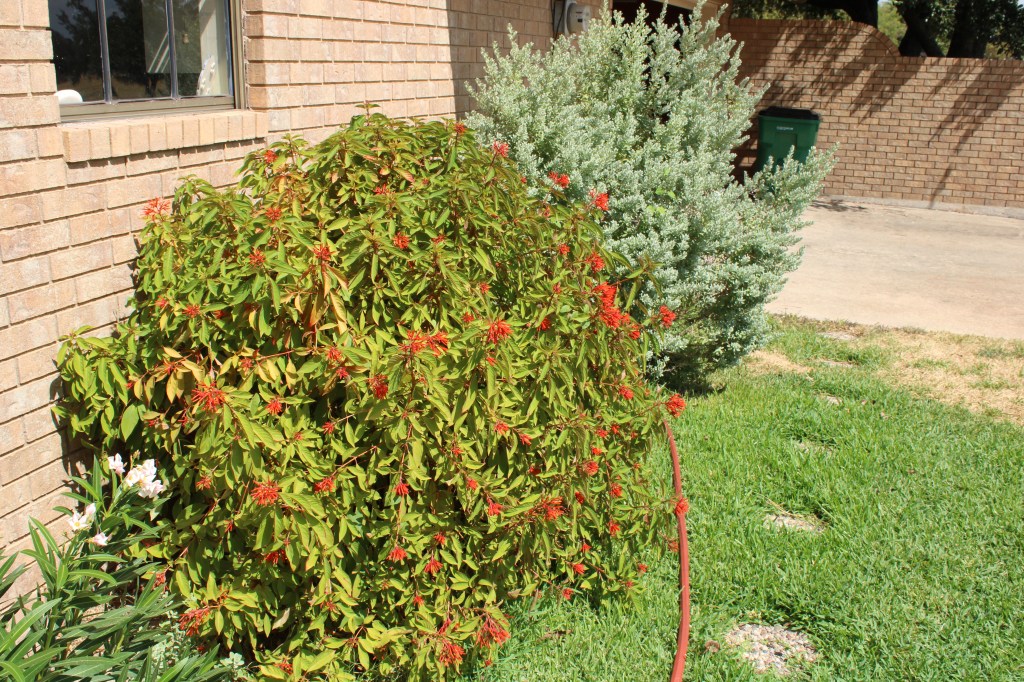
I stopped putting out bird food of any sort several years ago after I saw my sometimes-outside cat, with a Hummingbird then a Yellow Rumped Warbler in his mouth. I decided to limit his pickings as much as possible. However, I did plant a Mexican Honeysuckle bush from the El Camino Real Texas Master Naturalist Wildscape, and I also have a Fiery Hummingbird Bush (also called a Fire Bush) that was here when I bought the house. They both are in full bloom now, and Hummingbirds and several types of butterflies are very fond of feeding on them. The multitude of wasps that I have nesting at my house like them, too. 

These two bushes, my Crape Myrtle and a couple of Mexican Hats are all in bloom now. These plants are heat wave tolerant, feeding birds, butterflies, Western Honeybees, and three types of wasps. I only see the Hummingbirds in the very early morning and evening. They come in groups of three to four. I believe they are the Ruby Throated version. Three of them have white undersides and one, that I finally got a photo of this morning, looks to be Ruby Throated (according to iNaturalist). I’ve been trying to get photos of them for a few weeks, but I never have my camera ready at the right time. It seems that if they see that I have seen them, they head for the tallest trees. 

Hummingbird zooming in on Fiery Hummingbird Bush

The Crape Myrtle, which bloomed late this year, attracts mostly wasps and honeybees. I normally have a Texas Purple Sage in bloom that the bees really like, but it has not put out more than 5 or 6 blooms a few times. The Mexican Hats are just about done for the year. Luckily for the feeders, the Mexican Honeysuckle Bush and Fiery Hummingbird Bush bloom until it freezes – which may not occur this year. 

I must say, being able to watch the birds and butterflies eat without having to frequently clean out the feeder is nice. They really like my new bird bath, too. They, along with Robins, Blue Jays, Doves, Cardinals, and Mockingbirds have become very fond of it. They drink it and cool themselves off in it. 

Deep Thoughts on Johnson Grass

by Eric Neubauer

Johnson grass, in greener times. Photo by SA Kendall.

You’d think the hard dry soil would add to the difficulty of pulling up plants, but some of the plants are coming up easily. I’ve often marveled at how fast new shoots can come up.

Just about every Master Naturalist knows that Johnson grass uses stored energy in its rhizomes to do this. There is a cost because the rhizome shrivels up as the new shoot advances. Johnson grass appears to be exceptionally adept in moving its resources around. Even as the water becomes scarce, the shoots keep coming. There is a point when the grass has to stop growing, as it did last summer.

Anyhow, I am amazed that the grass has been undeterred so far except for giving up on inflorescences and at least nothing is presently being added to the seed bank. But I shouldn’t be. As the plants use their stored resources for continued growth, they are metabolizing. The products of metabolism are carbon dioxide (plenty of that around) and water, a scarce commodity. All the plant needs to do is relocate that water to the advancing shoot. Growth can still occur.

Johnson grass doing what it can’t do in the current drought. Photo by SA Kendall.

Meanwhile, the rhizomes are invisibly shrinking under the surface and the plants can end up being anchored by only a few measly roots. That explains why some plants are easier to pull up now. It also means that rather than digging for rhizomes, it’s only a matter of waiting until they magically turn into shoots and then pull those.