The last week in November, I found this bumblebee on a fall aster in my garden.
After looking at the bee chart, I believe it to be a Bombus variabilis.
If someone is better at identifying bees, let me know if I am incorrect.
I asked it to move its wings so I could look at its body, but I guess I can’t speak bee language. Anyway, it was a beauty as far as bees go.
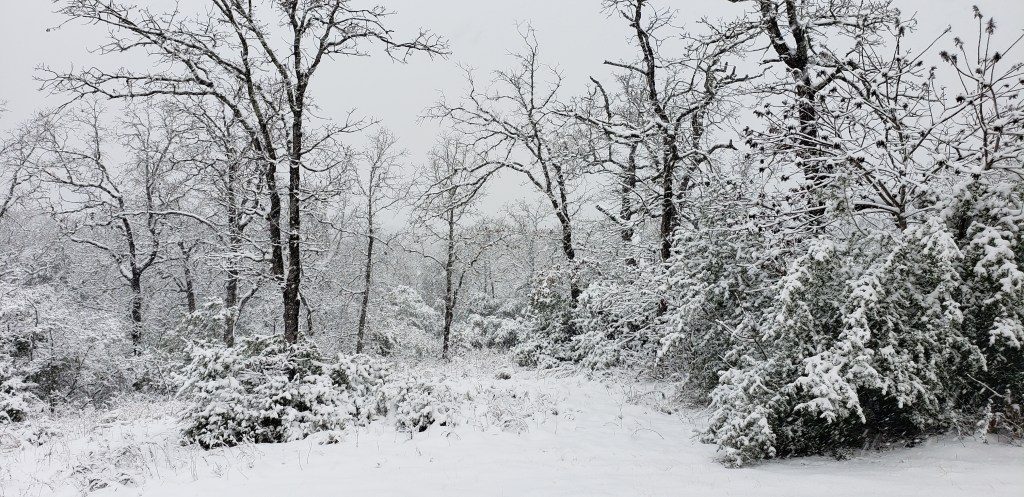
It has since gotten cooler, so I am only seeing honeybees right now. I have been putting out some sugar water for them, since there are no flowers still in the pasture or my garden. They are also in need of water, since we are still in a drought.
Honeybees enjoying their treats
All creatures need water. So just the simple act of keeping water out can help our nature friends. We are all charged with caring for the wild things.
As you’re no doubt aware, the COVID-19 pandemic is still raging in Texas. The Texas Master Naturalist program’s advisors and administrators are concerned for the safety of the members of our program, so they have had to come to some difficult decisions this month.
I attended the monthly meeting for Chapter Presidents yesterday, and it was a hard one. Mary Pearl Meuth and Michelle Haggerty patiently shared with us the data they have put together about COVID risks in the counties where there are Master Naturalist chapters. It didn’t look good. They divided the counties into red, yellow, and green, by relative risk, and there were only two counties with chapters that were green, and four yellow as of last Friday.
Milam County was yellow as of then, but it’s predicted to be red by next Friday, when they will update the map again. What does that mean? Here’s what Texas Parks and Wildlife says for red counties:
Counties with two of three factors pertaining to positivity rate of greater than 8% or more, OR a rapid rise in cases OR a hot spot: • No face to face Extension-hosted or Extension-sponsored events. • No guest speaking or presenting at other entities’ events. • No overnight events.
Many attendees at the meeting asked about whether drive-by events, outdoor activities, or solo activities would be okay. The answer was a reluctant, “No.”
No one was happy about this turn of events, but the current guidelines are set until the end of the year. It sounded doubtful that anything would change after that, but we will keep checking.
Implications for Our Chapter
Last night we held a meeting with some of the El Camino Real board who have worked directly with our recently graduated training class, to figure out how to do the graduation event we’d planned for this Saturday (December 12). After I explained what I’d learned earlier in the day, we had no choice but to conclude that we have to cancel the event, even though it was going to be as safe as we could make it.
Even if Milam County stayed in the yellow, we’d have more than ten attendees, and that’s all allowed in yellow counties. Plus, since we would have Board members living in Bell and Williamson Counties at the meeting, we’d have to abide by red county rules, anyway. Well, that was no fun.
Plan for Graduates
Of course, we want to celebrate our new members! Here’s what we will be doing right now:
I will send certificates out as soon as I can get Floyd Ingram’s signature on the graduation certificates. These go to our fine new members:
1) Connie Anderle
2) Marian Buegeler
3) Carolyn Henderson
4) Samuel Jolly
5) John Montgomery
6) Kaitlyn Montgomery
7) Eric Neubauer
8) Alan Rudd
9) Debra Sorenson
I’ll also sign the certificates for those who have passed their initial certification, which include:
1) Connie Anderle
2) Carolyn Henderson
3) Debra Sorenson
Kathy Lester will send everyone their Chapter t-shirts.
Lisa Milewski will send pins to the new graduates and nametags to those who get them, as well.
We will wait to give new members their gift made by Pamela Neeley later, since the are delicate and expensive to mail.
Plan for Chapter Meetings and Activities
Since we don’t have any idea when we can resume in-person meetings, we will continue with our Zoom Chapter Meetings. Don Travis will send all our members the registration link, which will work for all 2021 meetings. They’ll still be the second Thursday of the month!
We will be sending links to TMN activities that can get us our Advanced Training and volunteer hours virtually, such as TMN Tuesdays and the upcoming Virtual Volunteer Fair. Keep your eyes open for the weekly email!
I just want to thank all of you for sticking with us this year. I know some of us are unable to do virtual meetings, and that means we miss being together. Let’s hope things will turn around with the new year and slowly but surely we will be able to get outdoors and do some community science work together again!
I’m one of the members of our Chapter who’s visiting various city parks in Milam County on Tuesdays. Here’s what I found at Bridge Park in Rockdale, which is an area full of some of the famous bridges of Milam County. I was hoping to add to my goal of documenting all the grasshoppers in the county.
As I expected, the very first grasshopper I picked up was one I’d hoped to run across for a long time. I knew instantly what it was, but somehow expected it to be larger.
Aztec spur-throated grasshopper Aidemona azteca
Regarding the Aztec grasshopper, it was only about a ¼” long and pretty lively. I got three photos and it was gone. Looking at other images at iNat suggests it’s a tiny grasshopper and overlooked for that reason. I can’t find anything about sizes on the internet. I was looking through the fallen leaves behind the calaboose at Bridge Park.
Then there was a peculiar looking nymph I never saw before. I didn’t necessarily think it was a species I hadn’t seen. This was correct, but it was the first time I’d encountered a nymph. I think I identified it correctly.
In looking at the satellite views at google maps, I realized that an abandoned railroad once ran through Sumuel Park, one of the other parks we visited. It was the one that came up though Deanville and continued on through Cameron.
This was a great visit, definitely another case of the Linda Jo’s time-to-get-off our-butts initiative. There are several sites I’ll be sure to visit again on a regular basis.
How I’m Doing on My Grasshopper Quest
I’ve seen 27 Acrididae species in Milam County. There are a total of 31 observed. Of the four I don’t have, two observations are bogus (wishful thinking applied to nymphs), one is Schistocerca lineata, which I’ve seen in Burleson County, and the other is Melanoplus punctulatus which Sue Ann has seen. Since the common name is Pine-tree Spur-throat grasshopper, I think I need to go somewhere there are pine trees.
On Tuesdays for the past month, several El Camino Real Texas Master Naturalist members have met to explore nature in several public locations in Milam County. The sites have ranged from a roadside historical marker to a manicured downtown lot. We’ve been careful to follow current guidelines, by wearing masks when we are closer than six feet apart, and not gathering in numbers over ten.
We have not made an earth-shaking discovery, but we have seen some interesting organisms. The past week, we observed at four Rockdale locations: Veterans’ Park, Skate Plaza, George Hill Patterson Civic Center, and the Fair Park.
Catching an elusive insect.
On a large “spineless” cactus, we found dozens of cactus bugs (Hesperolabops gelastops). A large Chinese tallow tree had a leaf-footed bug (Leptoglossus sp.) resting on its bark. An elusive beetle had to be ferreted out from the vegetation to which it had escaped during a photo session. It turned out that Catherine Johnson is a tenacious and successful bug hunter.
Cactus bug
Leaf-footed bug
Several in the group are interested rocks and geology. Debra Sorenson noted the iconic petrified rock and sandstone pillars at the Fair Park entrance.
Deb enjoys petrified wood used at Fair Park.
Farther into the park, I observed my first gomphrena weed (Gomphrena serrata) and Spanish gold (Grindelia ciliata) in Milam County.
Spanish gold
Gomphrena weed
However, our park investigations are not just about nature. It is not just about recording and sharing the species we see. Our gatherings during the past month have been bright spots: Time I spent outdoors with other folks who find joy in learning and exploring new and old places.
We shared our time, thoughts, and experiences with each other. My most memorable moment of our last park survey session was not a bug or a plant, but was when we paused at the new recently dedicated granite markers installed at Veterans’ park next to the city swimming pool.
War is hell.
Our thoughts turned to those who had served in wars. One shared their father’s experiences during the D-day invasion. Another shared their father’s thoughts about the atomic bomb. My own father never spoke of the war. The time we spent at the site was solemn and memorable. That semi-circle of granite markers fulfilled its purpose. We had paused and honored our veterans.
So, I repeat. It is not just about nature. It is also the social (yet physically distanced) sharing of thoughts and experiences among a community of folks who appreciate the wonder and glory of our world. It is a reason I am a Texas Master Naturalist.
This beautiful falcon (American Kestrel, Falco sparverius) was sitting on top of my Martin House pole this past week. It was cold and windy. He hovered over the ground and came up with a small rodent and then perched on the fence to have lunch. When I went outside to get a better photo, he took off.
Vigilant sparrow hawk
American kestrel (sparrow hawk). (c) chrisvt used with permission
However, he has been back every day this week. Must like the mice here.
The nickname of Sparrow Hawk is a misnomer. He is not a hawk and rarely eats sparrows. The kestrel prefers rodents, reptiles, frogs, insects and the smaller bats like the Mexican Free Tailed Bat.
If you can get a closer look at him, he is beautiful!!! Some of the Egytian drawings on tombs show many hawks, cranes, ducks and falcons. One God was Re-Horakhty the lord of the sky; he looked like a Falcon.
This bird is common all over the US and likes open fields.
Right now you can see them perched on the overhead wires looking for a meal.