Yes, it has been raining lately. And yes, it has been HOT! So let’s talk about our wild friends during the hot summer.
At Sue Ann’s house, they got 8.11′ of rain last night. Frogs are very happy.Photo by Sue Ann Kendall.
We love to put out bird seed, and other goodies for our friends, but the most important thing is water. Sometimes the closest water can be a great distance for the animals to travel. This means that providing a close water source is immelsely helpful. Keeping fresh water nearby could save the life of a baby bird, a baby bunny, and all of the wild things.
A good example of water with a place to perch. Photo by Janice Carriger on Pexels.com
Another thing to remember is that birds need a perch to light on. An especially important thing in wildscaping is to provide an arbor, a fence, or even a cattle panel propped up. I have been quite successful in bringing birds to our place, so I know what they like, which is water, a perch, food, and some shelter near all of these items. Shelter can be an evergreen bush or small tree. Safety from cats should also be considered.
Be creative, like we have at the Milam Wildscape! Photo by C. Johnson.
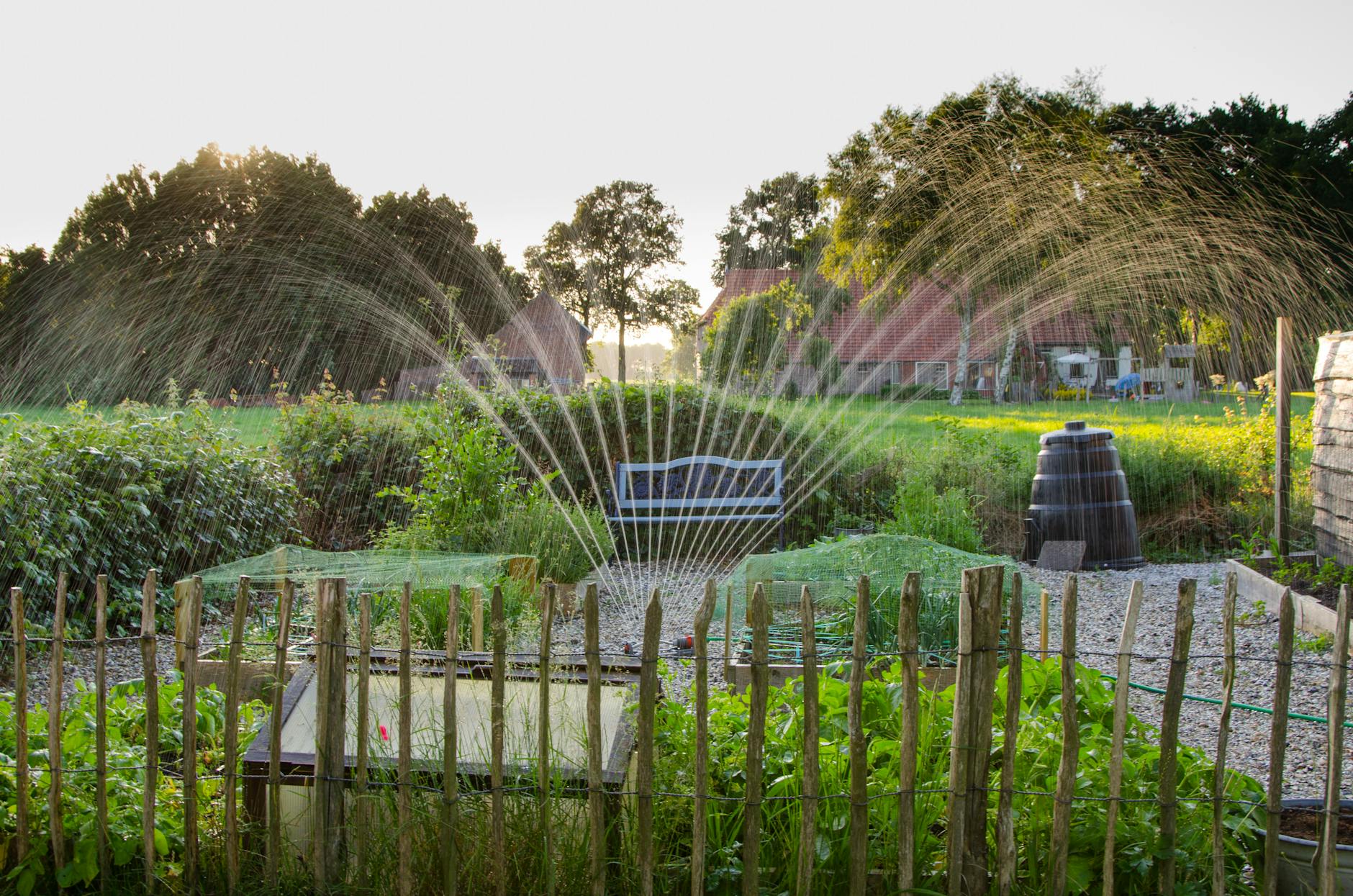
A sprinkler put out is heaven for my little hummers. I place the sprinkler near a fence lined with vines and they go crazy.
Maybe we don’t need as much rain as some of us got last night, but it is ALL appreciated. This is Walker’s Creek at County Road 140, now more like a river. Photo by Sue Ann Kendall.
A week ago, two members of the El Camino Real Chapter, Texas Master Naturalist were invited to scope out the property of a third member to see if there were any interesting plants, birds, or other organisms there. Ann Collins and I made many discoveries at Carolyn Muller’s Burleson County property.
Ann and I experiencing species overload.
It’s always a privilege when private landowners allow you to catalog what’s on their land, so we’re very grateful to AD and Carolyn for their hospitality. We enjoyed finding out what thrives in this sandy soil with a nice mix of hardwood forest and untouched prairie-like fields.
A stand of Lemon Beebalm leads to the woods.
While Ann and Carolyn worked on bird observations from a guest cabin porch, I ran off and checked out the woods and open area under electric lines. There are often great flowers in those areas.
I then found a nice wide path through the woods with many Halloween decorations on it. While they weren’t great for iNaturalist, I’m sure little kids love it. And I found my first interesting milkweed, Tayalote (Cynanchum unifarium).
Too bad it wasn’t in bloom.
After I got back and we practiced entering sightings into iNaturalist, Carolyn took us on a ride around all the impressive paths that wind around to various outbuildings and such. There we found interesting mosses and fungi.
Pale Cow-hair Moss (Ditrichum pallidum) was interesting Coral-pink Merulius (Phlebia incarnata)Meadow pink (Sabatia campestris)Not sure Ringless Honey Mushroom (Desarmillaria caespitosa)
The highlight of the visit was the magical wildflower patch. It grows in a strip where a neighbor had erected a tall wildlife fence about ten feet behind regular cattle fencing. This strip doesn’t get mowed or grazed. It was spectacular.
Wildflowers galore!
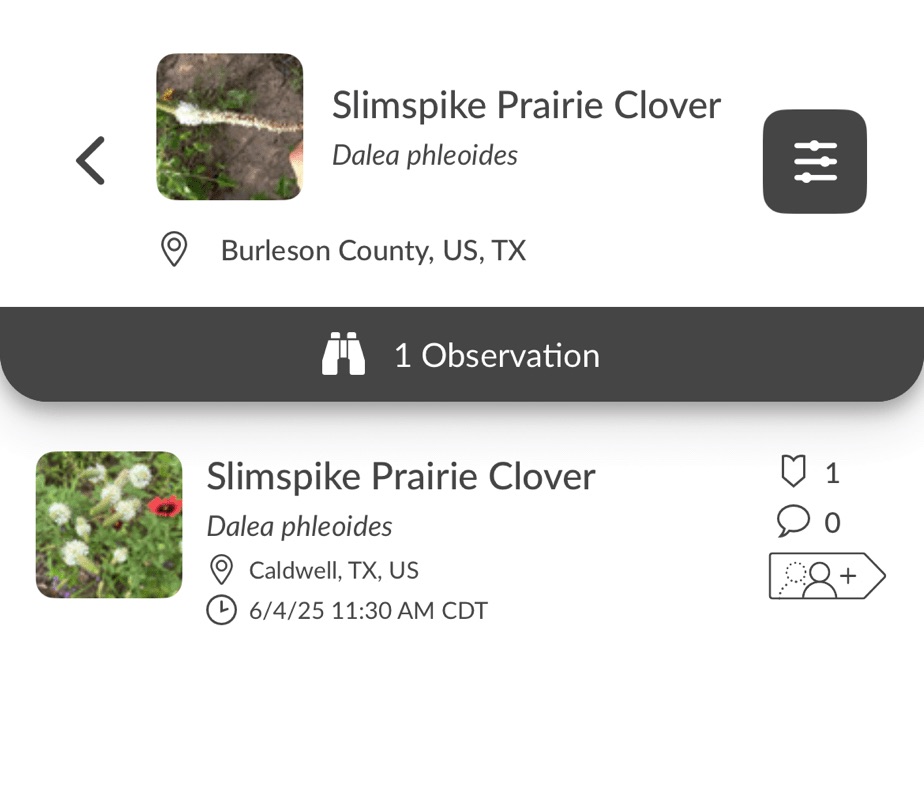
This area also contained plants neither Ann nor I were familiar with. Upon investigating, I found some of these natives have very few sightings in Milam or Burleson Counties. In fact, this Slimspike Prairie clover was the first observation in Burleson County. There are only 4 observations in Milam, all but one by a chapter member!
They are so prettyJust one observation in Burleson CountySlimspike Prairie Clover (Dalea phleoides)
Other interesting rare plants were these. Maybe they’re not spectacular, but they’re not observed often.
Ann and I were pretty hyped up about all these new plants, and Carolyn was thrilled to find out her property had plants we got excited about. As we looked around the property more, we also found yellow passionflower and the beautiful propeller flower, purple pleatleaf or Alophia drummondii. I stuck in some scenery so you can see the big picture!
Yellow passionflower, a favorite of mine (Passiflora lutea)Alophia
After another fun ride through the paths, we headed out, but I had my brain full of new-to-me plants, and Ann enjoyed hearing and seeing Swainson’s Warblers, Summer Tanagers, and two vireos (white-eyed and yellow-throated).
What a varied place to investigate.
We’d all love to return, and we plan to arrange friend trips. The presence of air conditioned rest facilities with refrigerators and water will make this a great place for our chapter’s naturalists to explore and learn about the amazing variety of ecosystems in this part of Texas.
I went out to Wild Wings Bird Sanctuary yesterday to see what birds were out there and to take some new resources for visitors.
Oops! Lost a tree.
I joined Ann Collins, who was as happy as I was to see new bluebird houses have been put up, one in the sanctuary and two others along the property driveway.
Next year’s Bluebirds will love this!
We appreciated the newly planted native plants and red lantana in the raised beds, and no doubt the hummingbirds will, too.
New plants.
That’s good, because curious heifers have been having too much fun with the official hummingbird feeders. You can’t help but be amused by them, though. Gene Rek found one of them had drunk all the water in the bird bath and was licking the water dripping down the drip chains. That’s just too cute.
Yum!
As we listened and watched for birds, I put two of our new bird sheets in the mailbox for visitors to take. One’s an alphabetical list of birds found in Milam County (an updated version is linked on the Wild Wings web page), and the other is our beautiful color bird sheet to help visitors identify what they may see at Wild Wings. You can also download your own copy on the web page. By the way, there’s also a bird list in taxonomic order in the collection as well. As soon as I can get these printed, you’ll find them in the mailbox as well.
Shady meeting area.
We are still waiting for our signs to arrive, but I did put a few magnets in the mailbox, so visitors will know they’re at the right place.
I forgot to take a picture of the mailbox!
Mornings are a wonderful time to hang out with the birds and squirrels, so check out our growing sanctuary! Enjoy some of the sights we found during our visit.
Very cool grasshopper exoskeleton Bold jumping spiderArmy workCicada exoskeleton Brittlestem?Hard to ID. Pretty cluster. Lots of insects in this spotted horsemintInsect on pokeweedWhite example of usually blue white mouth day flower.
A new invasive plant has made it to Texas. It has only been spotted with verification nine times in the state, and one of them is in Milam County. The other eight are in a small area of Burnet County.
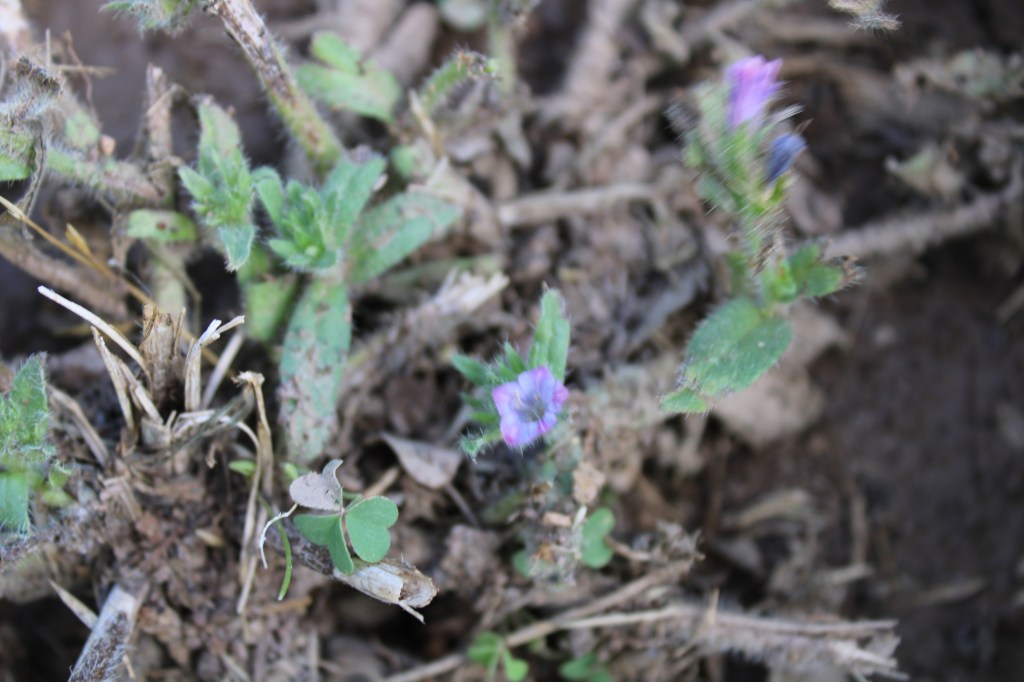
During the field trip to the McCormack Purple Martin conservation place, I took a photo of a flower I had not seen before. Of course I put it on iNaturalist. It got one “favorite”, but it couldn’t be verified as the Viper’s-Bugloss (genus Echium ) I had chosen to identify it. I had noted that I wasn’t sure, but it looked just like it.
My original observation image
Then an iNaturalist ecologist took note of it. He was very concerned about it, and he asked if I would go and take more photos of it for verification purposes. The gentleman has a PhD from the University of Texas and is a retired Wildlife Biologist at Balcones Canyonland NWR.
Mike McCormack said I was welcome to do that. I met him out there last Saturday and we went looking for some. McCormack noted that they had been dying out when I called, so he watered for me where he knew a cluster of them to be growing. They were blooming. The blossoms were smaller than the one I had seen earlier and had different colors.
The ecologist had warned me to wear heavy gloves and not touch them otherwise. They sting severely and cause a rash. You’ll see an ungloved hand in one of the photos. That’s Mike. He had handled them before and he said it wasn’t that bad, but they do cause an uncomfortable rash. I didn’t risk it. Mike said he first noticed them two years ago. He didn’t know their name until now. His theory is that they were transferred here via a pair of Black-bellied Whistling Ducks that were nesting in a tree above the main site of their location.
I posted several more photos, and the ecologist verified that they are Viper’s-bugloss plants.
They are native to Europe and temperate Asia. They are used in landscaping in a few European countries. They have been spotted in the northern United States and some other countries that didn’t use to have them.
These plants are actually harmful to horses and cattle because they produce a type of Alkaline that harms their livers. The ecologist recommended strongly that “the plants should be herbicided and dug out, bagged, and disposed of – being very careful not to drop any seeds.”
Years ago in Asia, they were thought to resemble snakes on some parts and were used to treat snake bites. Needless to say, that practice fell by the wayside. If you see any, it’s advised you remove them quickly – wearing heavy gloves.
On a quest to take more photos for another iNaturalist on a possible Viper’s Bugloss plant, I discover baby Purple Martins and something else. There is always something new to discover in nature.
Purple Martin nests
There are photos of parents feeding the recently hatched Purple Martins. Plenty of the houses at Mike McCormick’s considerable housing for the birds are occupied with hatchlings and eggs.
McCormick says the majority of them will take flight in mid-June. He also noted that the late male arrivals are fighting the older males for housing. This is apparently common. The debate is over whether they are drawn to their nest they were hatched in the year before or they are trying to establish territory.
While standing out among the martins, I noticed a ball on the ground. It was between cow patties, but it was too perfectly round to be that.








 Nature Along the El Camino Real