Birding along Country Roads with Merlin

by Sue Ann Kendall

One of my favorite pastimes is seeing how many birds I can identify in new places. I’ve found that taking along my favorite electronic helper, Merlin Bird ID is very helpful and also allows me to contribute to the eBird database. This may even get me some volunteer hours as a Master Naturalist, though I admit I do it for fun even when I’m on my property or out of state. Want to join me? Here are some hints.

Before You Start

Before you head out, be sure to download Merlin Bird ID onto your phone and get your account set up. It’s free! Charge your phone up, too. Then get your hat, notebook, binoculars, spare batteries, and water. You may spend longer with the birds than you expect to. It’s hard to stop!
bird
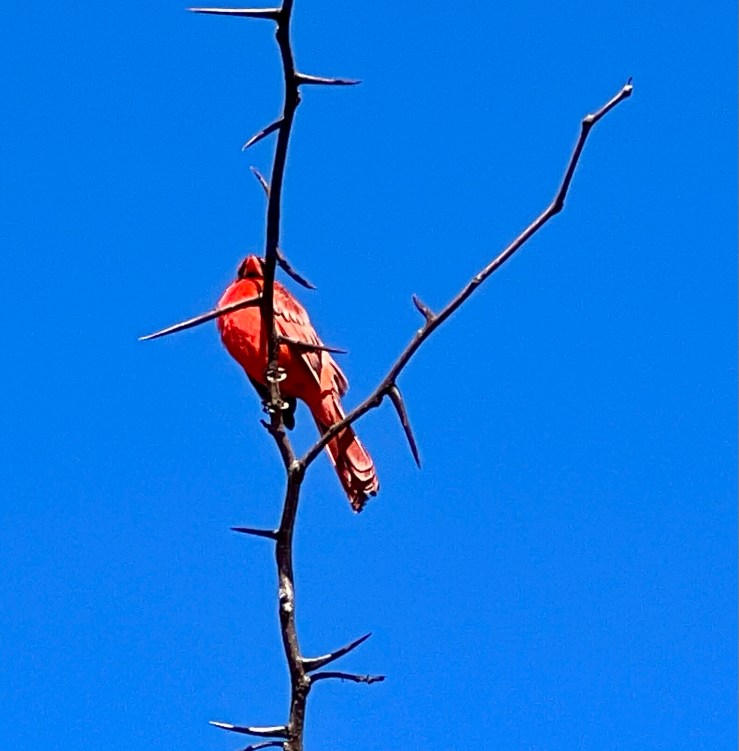
You will probably see a Cardinal if you are in Milam County.

You can go anywhere you want, but I prefer county roads with little traffic and a variety of habitats. Going past water may get you some herons, ducks, or a kingfisher. Fields and prairies are good for sparrows, meadowlarks, starlings, and hungry raptors. Woodlands have woodpeckers, owls, songbirds and more. I find the best birding in places with open space that are near cover (brush or woods). I often park at a friend’s house and take off from there.
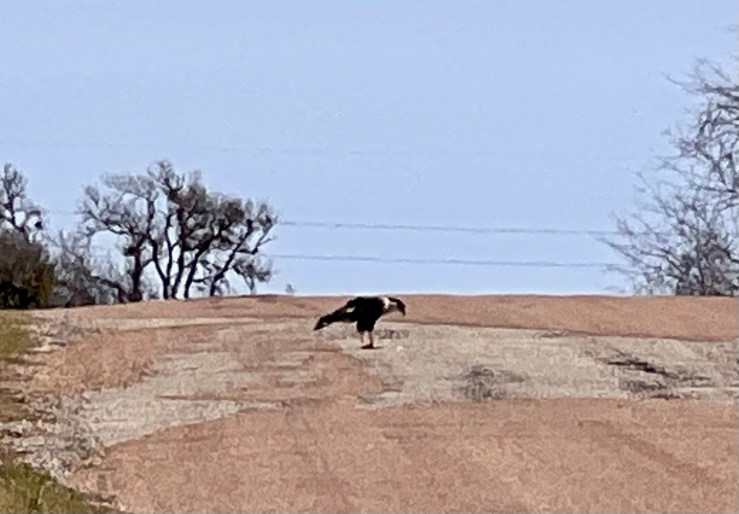
Caracara eating pizza off the road – the middle of the road is a good place to find scavengers.

Once I get to the area where I’ll be birding, I do an important thing in Merlin – I set the location for bird recommendations to where I am. That’s important, because Merlin suggests birds likely to be where you are. That may not matter if you’re just a mile or two from your house, but if you’re in another part of Texas or even farther away, you’ll want to know what’s likely to be there. You can use the list of birds found under the “Explore” option in Merlin to check what’s likely to show up so you’ll know what to look for (for example, does your locale have Ravens or only Crows? Does your area have Tufted Titmice or Black-crested?).* In the example below, I was making sure there are still Sandhill Cranes around this time of year at my house.

Another important preparation is to tell your phone to send your calls to voicemail. Every time you get a call, it stops the Merlin recording. I usually use an iPhone setting that lets important calls through, but not spam. Just save the recording if a call interrupts.

Bird Walking

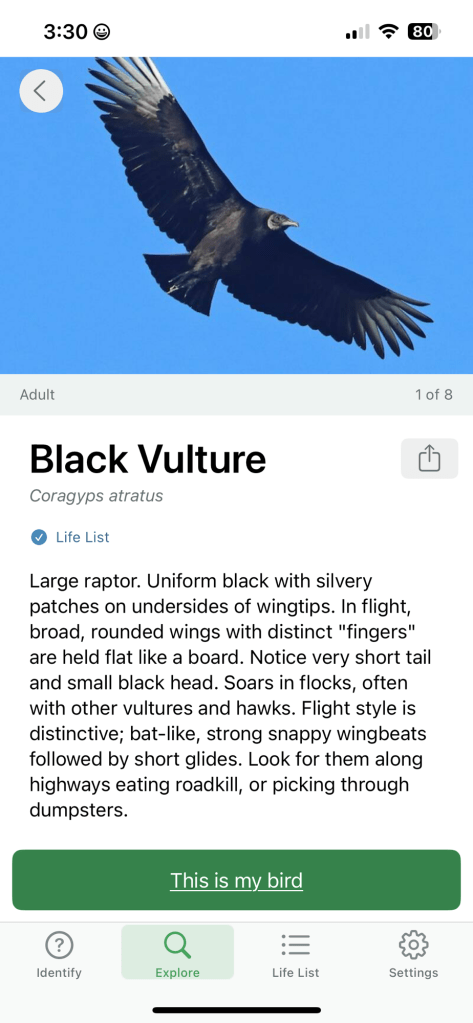
Now you can start your bird walk. Start Merlin on Sound ID as soon as you hear a bird. It’s a good idea to stand still while listening, so your footsteps don’t interfere and so the app can identify sounds more easily. Be ready to photograph any birds you see, because Merlin can identify birds from photos as well as sound. Remember that not every bird is going to make sounds, so be on the lookout for those vultures (Black have white wing tips and Turkey have the “thunderbird” shape on the underside of their wings).

Black Vulture
This is a Black Vulture, which was easier to ID in person.

You may also hear birds that Merlin doesn’t register – for example, I just heard Sandhill Cranes flying overhead, but they were very high in the sky, so they didn’t get picked up by the phone microphone. I did get a photo of them, but even if I hadn’t, I could count them since I know what they sound like. Owls are also notoriously hard for Merlin to identify.

Sandhill Cranes
These Sandhill Cranes were flying high.

What I do on these walks is stop whenever I hear a bird or birds and let Merlin record them. You may not get very far if the birding is good, but move on when you’ve heard everything in the area. It’s so much fun watching birds show up on the app! I also look around to see if I can see or photograph the bird. Soon you will know what birds are around you by their calls and songs with Merlin’s helpful training. I love this in the summer when the trees are leafed out. I finally got to see Painted Buntings last year thanks to Merlin. And I’ll never forget the sound of passing Eastern Bluebirds and Lesser Yellowlegs as they go overhead out of sight.
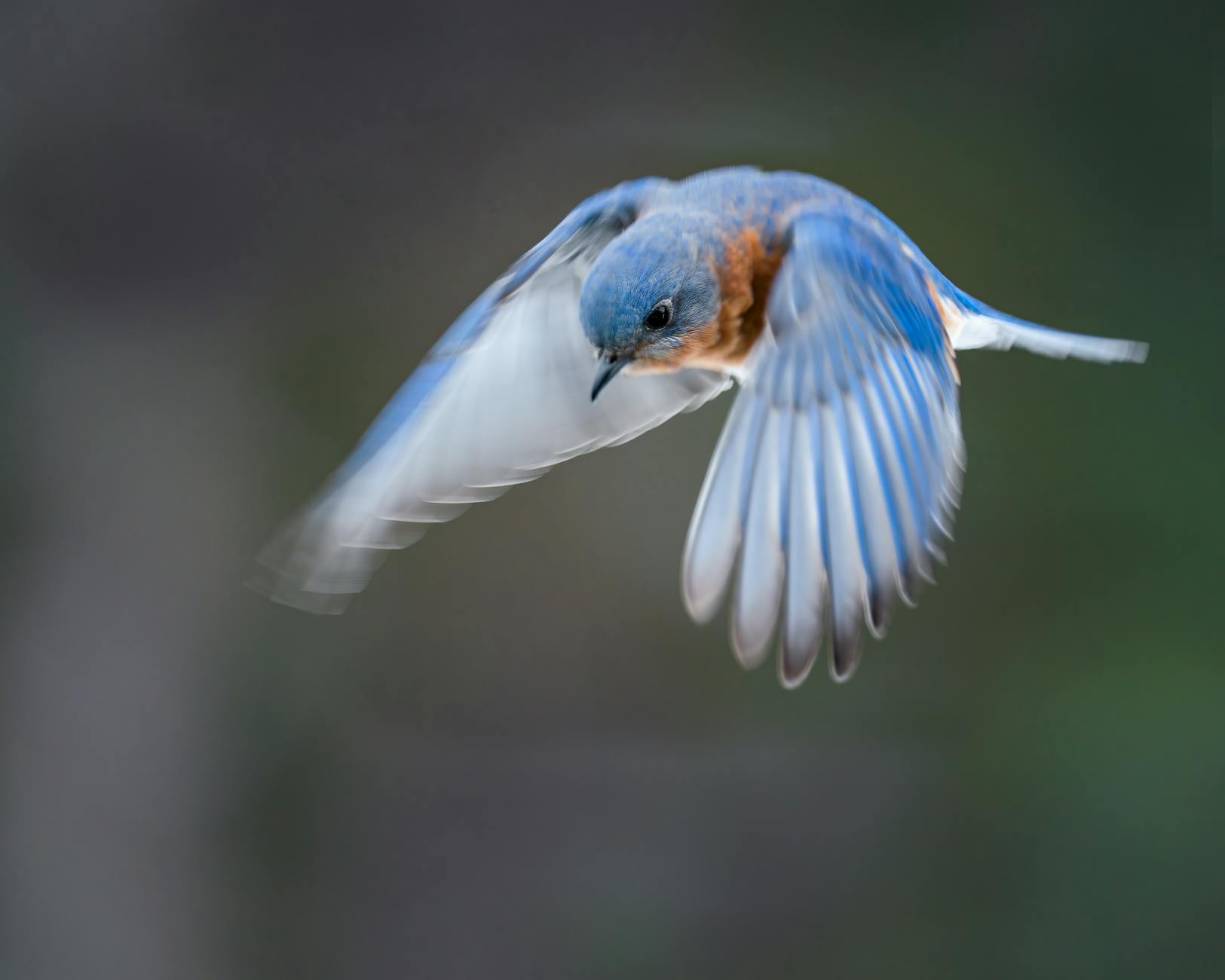
Photo by Skyler Ewing on Pexels.com

I usually listen for 20-30 minutes, then save the recording. Those files aren’t too big and I can review them later to record them. You can select a bird Merlin identifies and click “this is my bird” to save it in eBird. Give the location a good name, so you can later figure out where you were. Good examples are the name of a trail, road name, landmark, state park name, etc. Record them as you see them, because if you try to add them later, you’ll not have the right location and you’ll have to find where you were manually. You can make an eBird checklist when you get home, if you like, though.
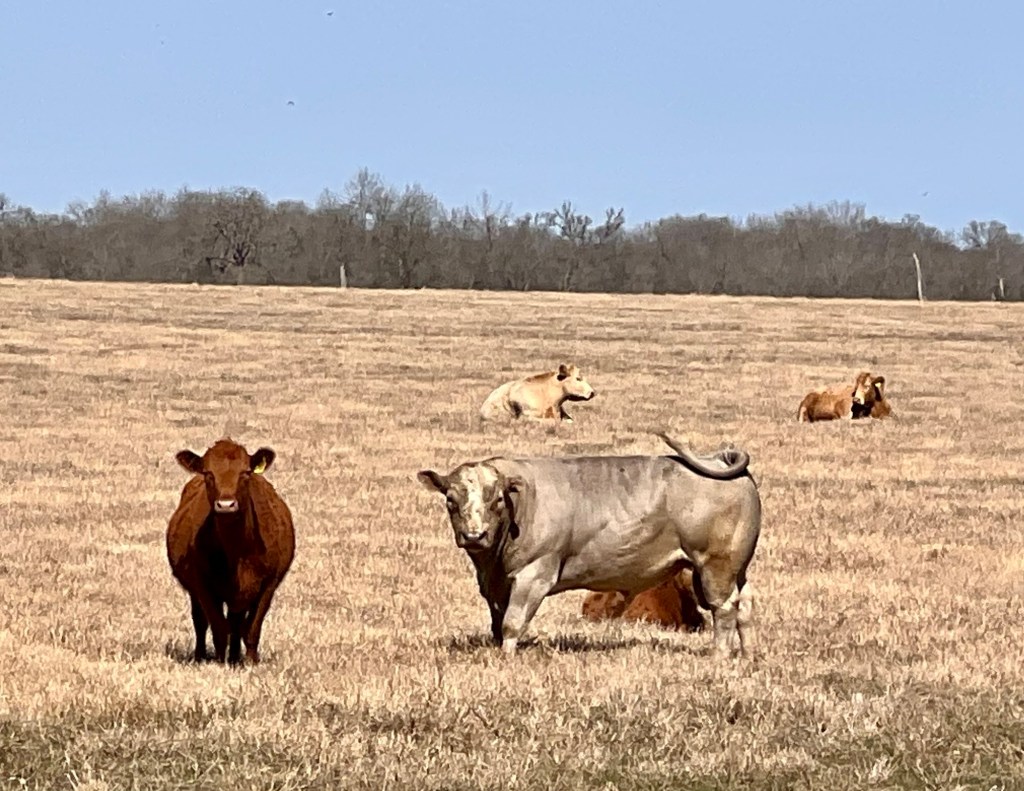
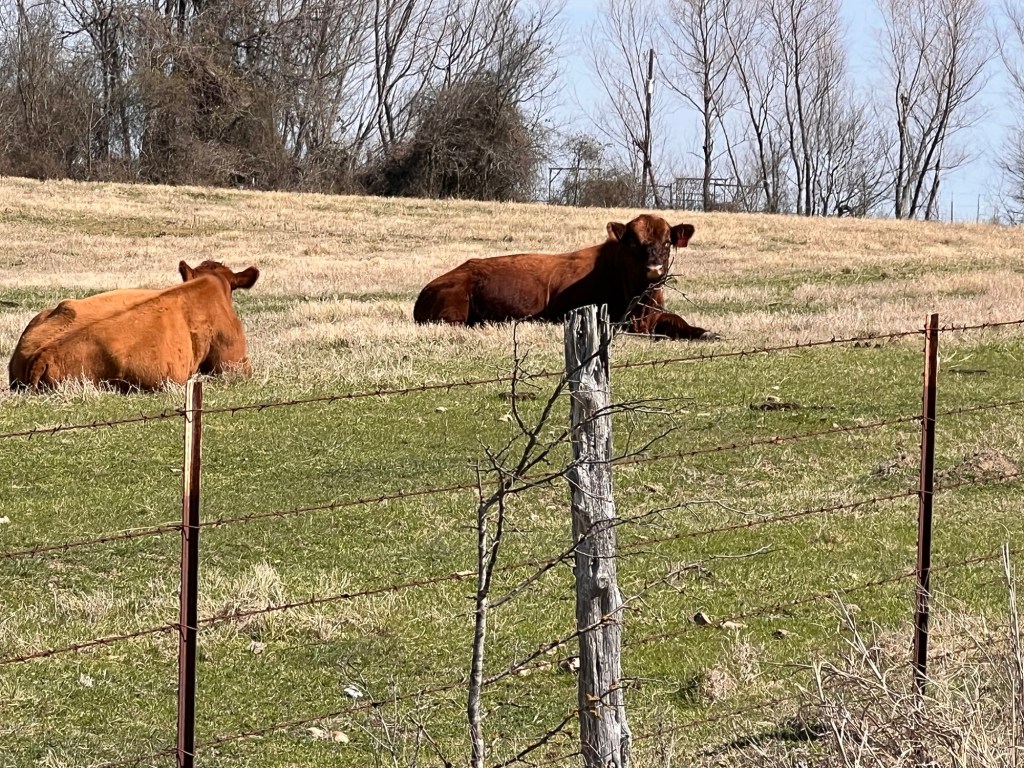
On a long walk you might end up with two or three recordings, and a bunch of photos, which you can put on Merlin or in iNaturalist, too. You might get a surprising number of species if you’re patient. Use Merlin to read more about birds that are new to you. It will describe the bird and show you its range, which can be surprising.
The more you walk around with Merlin open and listening, the more you’ll learn about the birds wherever you are. I’ve learned all about the birds where I travel, and conveniently use Merlin to add them to a life list Merlin tracks. If you’ve got a few minutes to spare, take a walk down a country road with Merlin!

Barn Swallows

Just for your information, here’s what I usually do. At home I only put new birds or birds seen at an unusual time in eBird, since I’ve recorded them many times. I have a notebook where I write down the birds I see and hear on Merlin every day and I track sightings monthly on a spreadsheet, which then goes in my blog. It’s fun to see which birds show up in different seasons. I’m a little obsessed, but everyone needs a hobby, right?

notebook
A page from my notebook listing birds I saw on one day. I do use abbreviations, but I know what they are!

*Be sure to set your location back to your home base when you return. I realized this morning that Merlin was looking for birds at Inks Lake, not Milam County.

It’s Purple Martin Time… Are You Ready?

by Donna Lewis

Yes, it is already that time when our Purple Martin friends will start their migration from Brazil back to North America.  Yes, the early ones will still face freezing and other harsh weather events.

I wish I could ask them to wait a little longer, but instinct is urging them onward.  The scouts (who are not the youngest birds) hope to find the best housing first…

As of today,  1/30/2025, sightings have been called in for San Antonio, Austin, Houston, and a few more Texas sites. Central Texas does not have a certified sighting as yet. I hope that myself or our Landlord in Buckholtz will win that honor.  We’ll know soon. I am watching for them all day..

First of all, your houses (gourds, or apartments) should be cleaned, and with added pine-needles if you do that. I also added pine-needles to my Blue-bird houses.  The openings should be blocked off so no sparrows, other birds, or insects can get in them.  You need to check yourself. Do not open the housing until the first scouts land on the houses.  If you are looking for the Martins you will see or hear them.  Then open a few of the cavities, not all of them. I usually will pick four to open. 

You do not want the non-native birds (House Sparrows or Starlings) to get in the houses. These birds will kill the Martins for the nests. Trust me, it is not a pretty thing to see. I think keeping predators and non-native birds out is the hardest thing landlords have to deal with.

Right now my gourd rack is lowered and ready to open.  This coming week I will get the apartment house ready to raise up.

I have had back issues this past year, so I will have to have some help caring for my friends this year..  But I will help them out as long as I can. Their song is so addictive that most Landlords that love and care for these native birds will do it until the end of their life.  A gift from Mother Earth.  Their songs are like no other.

Here are some photos showing me stuffing the gourds with fresh pine-needles that will help keep the birds warm and give them a start on nest building that will come later.

We can expect to have Martins here with us for about six months, until they leave for their winter home in Brazil. again.

Birds can lift a sad spirit. No matter what the world is going through, every day they go about their business with joy and sing to us. How lovely.

Remember who you want to call to your home, and furnish what they need. They will come.

Transforming My Property into a Modern Prairie

by Eric Neubauer

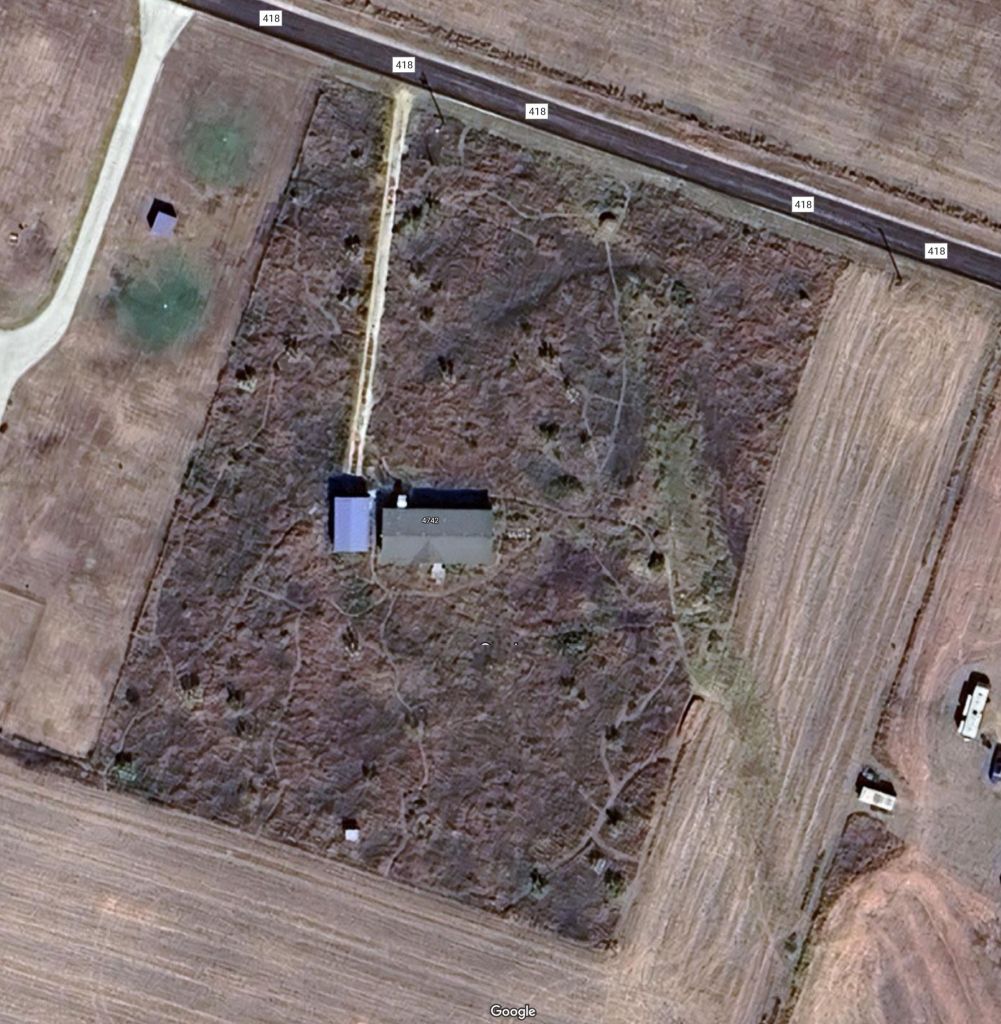
Thanks to google maps updating the satellite view in my neighborhood, I have a recent look at the part of my property that is turning into a three-acre modern prairie with little help from me except for pulling up Johnson Grass.

As you can see, I’ve been wandering all over the place during the last year pulling the damned stuff except for the upper right, where I suspect there was a large rattler about a month ago. I’d also done little in the lower left until recently but have begun expanding and deepening an area prone to flooding. The property is generally flat, and there is a drainage swale running across the northeast corner. The runoff from an eight-acre hay field comes in from the southwest along several terraces.

After a dry spell, about the first 2″ of rain disappears into the Blackland cracks. So, there is little runoff except in winter and early spring, and flooding is rare; it can even skip a year. When they form, vernal ponds last a week to two weeks and make the frogs, toads, and plains crayfish very happy.

I believe the multiple paths have been a plus for wildlife. During the last year I’ve seen the return of jackrabbits, at least three does dropped their fawns in my yard, and at least the pairs of dickcissels have nested. Several other species of birds have brought their fledglings in for foraging. Recently a bobcat has been around at night, although I’ve never gotten a good look at it. Pretty good for a place with no permanent surface water.

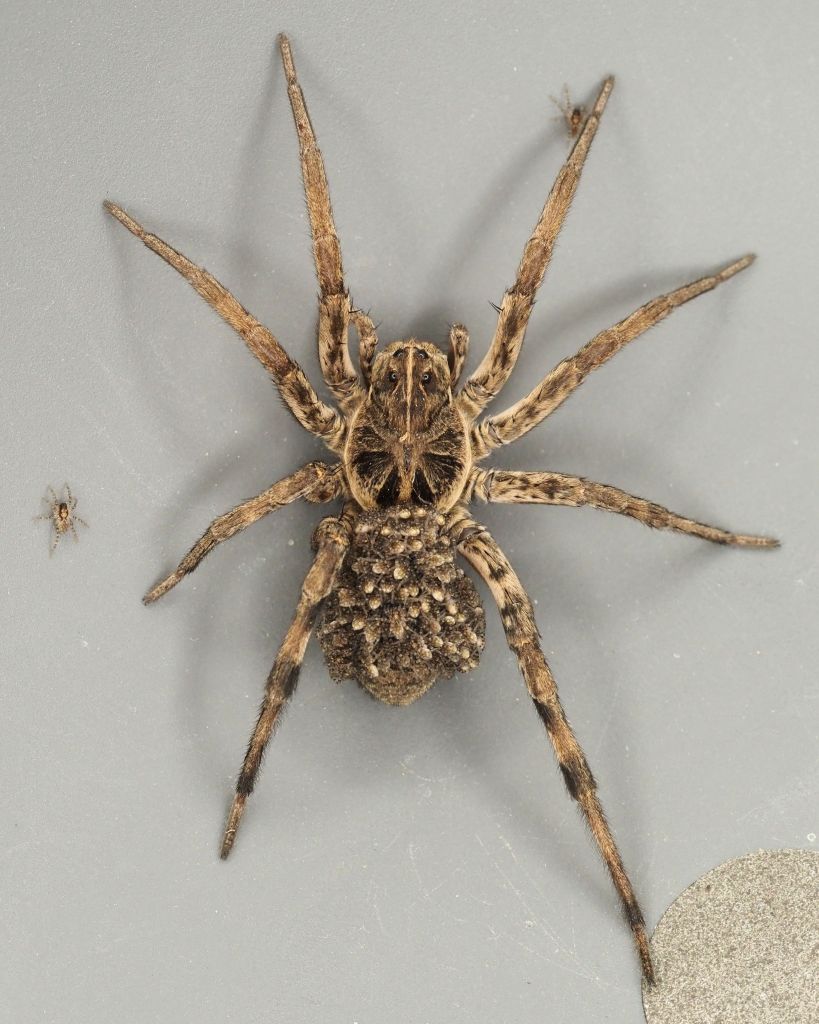
Did I mention how many wolf spiders I host?

Wolf Spider Identification Update

by Eric Neubauer

[Note: our most popular article on this site is Wolf Spider Identification. This article provides a brief update, plus links to Eric Neubauer’s recent presentation at the 2024 Texas Master Naturalist Annual Meeting.]

This material serves as an introduction to a new wolf spider species that is quite common in Texas and Oklahoma. It is also known in nine other states as far away as North Carolina. There is sufficient information to identify both juveniles and adults in the field as well as learn something about its life cycle. This is a departure from tradition in that a tremendous amount of information is made available to the public before publication in a scientific journal and formal acceptance of the species name.

Hogna incognita

Links to slides and explanatory text in lieu of a speaker follow:

I hope the average amateur naturalist and even professional arachnologist will find this more user friendly than the typical scientific paper.

I’m now waiting to see if any adult females make it into November. There were some with babies out there just a week ago. They outlasted my last Argiope aurantia. Someone needs to compose an “End of the Season Blues.”

Not to worry, some other wolf spider species are nearing maturity including the other undescribed Hogna west of the Edwards Plateau and another unknown I saw three adult males of last winter. I don’t want to say it’s an undescribed species until I see some adult females and do a thorough search of the possibilities. Exciting times!

Hogna incognita postscript

There’s always more to know about a species. Based on last year’s observations, adult females last though October. As the class of 2024 dwindled, it looked like some might make it into November in parts of Texas and Oklahoma. I held my breath and went out with my headlamp on as soon as the sun set on November 1st. I found one fairly quickly in the stubble of the hay field out back. She was away from her burrow and I caught her easily.

About a third of her family had already dispersed. Another half dozen or so decided to go off on their own while I did the photography. I collected her and the spiderlings that had disembarked and released them on higher ground next to a crack in the soil for cover if they needed it, and just in case of heavy rain.

More on Eric’s Research

The November 2024 isue of Texas Coop Power magazine features an article on Eric and “his” spider: A Wolf Spider Misidentified for 120 Years Gets Its Due, by Sheryl Smith-Rodgers. Check it out!

A New Toy Wizard

by Ann Collins

I have a new toy! And my life has changed forever! Not sure if it’s for the better, but it lets me be totally lazy. My phone is my window on the world. Living on a downward slope almost to a deep gully, service here is sketchy, often not available at all. Anyway, my new toy is the Merlin phone app, which identifies birds by sound and records a list for me. I’m excited to see what the Wizard has found and I question frequently his ability.

Is it Merlin the Magician or a Merlin bird, or both? (Thanks, AI)

For instance, it has always been a bit of undeserved pride that I’ve never seen a house sparrow on my property. I still haven’t, but Merlin hears them every day or so. House sparrows can be a major pain if they camp out in large enough numbers. They really are considered invasive. They were brought over by some well-meaning moron who thought they would be a nice addition to our native birds. Ironically, in their native England they are becoming quite rare while they have become a real pest here. It’s never a good idea to introduce a plant or an animal you think is cool. Example: the Burmese pythons in the Everglades.

I can’t believe Ann doesn’t want me pooping all over her birding area. Photo by Miriam Fischer on Pexels.com

As I sit inside my cozy sunroom drinking hot, spicy tea on this deliciously cool early autumn morning,* Merlin is busily making a nice list for me. I take my phone out to the deck and conjure up the Wizard and he eagerly gets to work. I’m glad for that, because with encroaching old age many things don’t work like they did in my youth! For istance the high-pitched frequency of many bird sounds simply don’t register in my increasingly deaf ears. Merlin is a relatively new app, so his hearing hasn’t failed him yet – probably just a matter of time.**

Example of Merlin’s observations (Walkers Creek, Texas, October 15, 2024)

I wonder what Merlin’s range is? Are the birds he hears actually in my yard or can he hear the ones a mile away? Just up the driveway? Does that depend on my service or just how he’s programmed? Who knows? Guess I could ask him.

Don’t ask me. I’m Merlin the Bird. Photo by Sethulakshmi Sajeev on Pexels.com

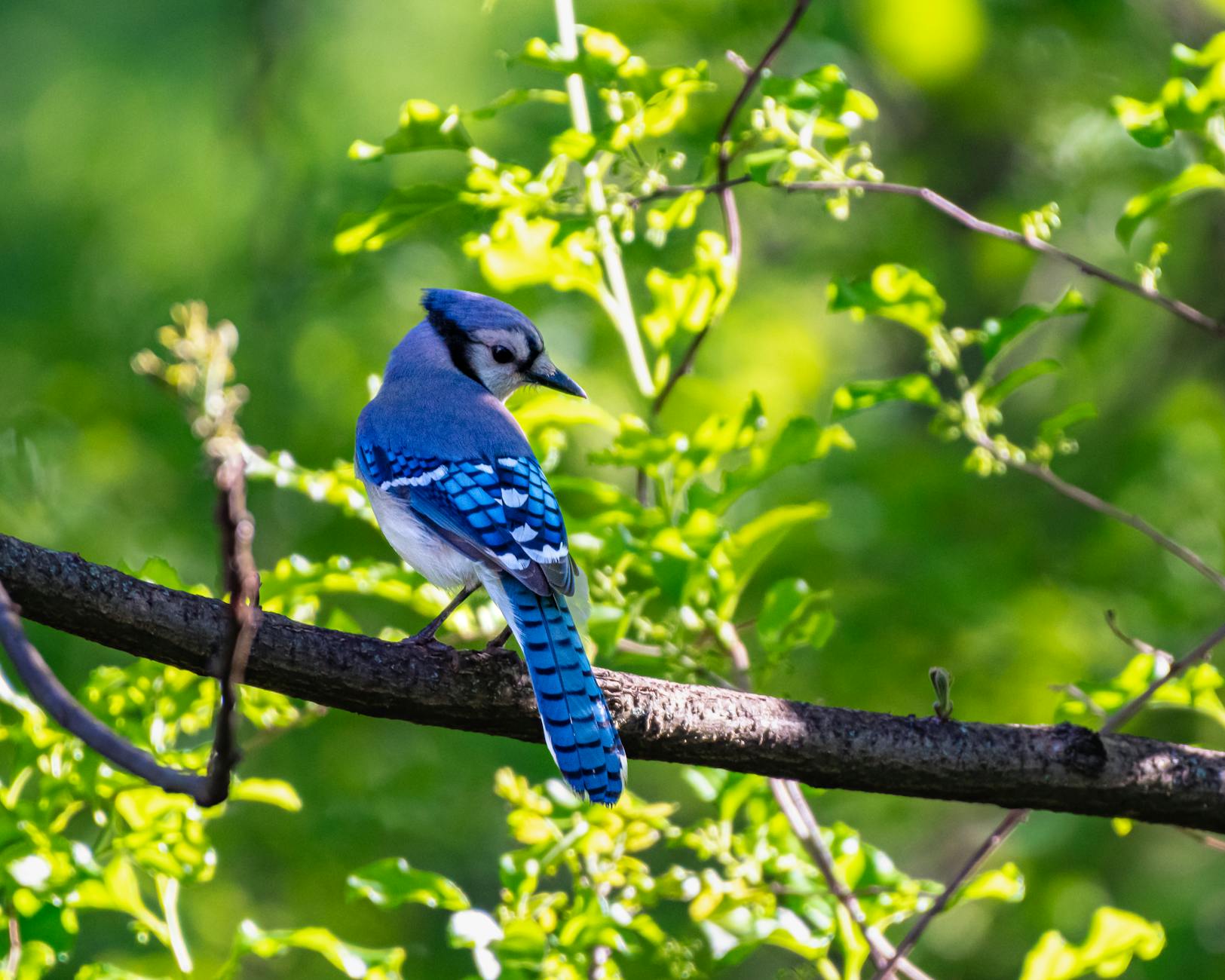
It’s kind of hard for me to trust technology. I didn’t grow up with it like so many of the younger folks. When Merlin IDs a Blue Jay and the next bird is a Red-shouldered Hawk, my skeptical nature questions, was it really a hawl? Some of the calls of these two birds really sound alike. Blue Jays are pletiful here at Chimney Hill and I do have Red-shouldered Hawks regularly. The hawks might even breed here or at least close by.

Blue Jay. Photo by Robert Jakubowski on Pexels.com

House sparrows? Never seen one here. I can thank my lucky stars for that. They can be a real nuiscance. How about a Blue Grosbeak or a Dickcissel or an Indigo Bunting? I did have a number of them a few years back but haven’t seen them in quite a while. I don’t doubt the Merlin reports of Red-winged Blackbirds or the grackles (Common and Great-tailed). Large flocks are not uncommon, so the Red-winged Blackbirds could be traveling with them.

Who knows what kind of birds are in this flock. Photo by Mehmet Suat Gunerli on Pexels.com

In spite of my skepticism and questions I still love my new toy. It really gives a new dimension to my census and wildlife evaluation. I love it!

Thanks to my buddy Suna for programming the app for me!


*This was written during the September cool spell.

**Suna points out that Merlin often has trouble with low sounds like owls and doves.