Last night’s Chapter Meeting was very informative and a lot of fun. We even had a couple of visitors, and that prompts me to remind you that anyone who happens to be in Cameron, Texas on the second Thursday of any month is welcome to join us at All Saints Episcopal Church. Potluck at 5:30, followed by our program. The monthly meeting follows the presentation. At this month’s meeting, we were privileged to learn from a presentation on land trusts and conservation easements and how they work, from Melanie Pavlas and Lauri Mason, Executive Director and Outreach Manager for Pines and Prairies Land Trusts. This was especially relevant, since Milam County is now a part of the area served by Pines and Prairies.
Melanie shared her passion for land trusts with us.
As we were listening to how land trusts can preserve land from being over-developed, yet let the owners live on the land and farm/ranch just as they always had, many ears perked up. I think they’ll be getting a few phone calls from Master Naturalist landowners! Melanie and Lauri both said they love to talk to folks about what they do, and promise they aren’t trying to sell anything. But, honestly, if one’s heirs aren’t interested in preserving land for use by native plants and animals, this sounds like a great idea.
Please visit their website to learn more about how you can enjoy your land and ensure its preservation in the future.
As usual, we had some milestones to mark, and this month we honored Neil Wettstein for achieving his initial certification, as well as Ellen Luckey from our most recent class for also getting in her first year’s certification in addition to the initial one. Whew.
Members Pamela Neeley, Cindy Rek, and Gene Rek were recertified for 2023. Congratulations to all.
Ellen Luckey, Pamela Neeley, Carolyn Henderson (Chapter President), Neil Wettstein, Cindy Rek, and Gene Rek
There was also some fun, as our cheerleader and iNat superhero, Linda Jo Conn, presented Eric Neubauer with a “Big Spider Badge” in honor of his contributions and of the fact that he’s presenting a talk at the upcoming 2023 Texas Master Naturalist meeting.
Eric self designated it, the badge says. That was fun.
After the meeting, we were joined by Dale Kruse, plant expert extraordinaire (especially mosses and bryophytes, he will tell you), held an orientation meeting for the group of folks who are going to take a class on grass identification with him. Having done this twice myself, I know they will learn so much they’ll feel like their heads will explode, but it will be fantastic. We’re lucky to have people so willing to share their time and expertise with us.
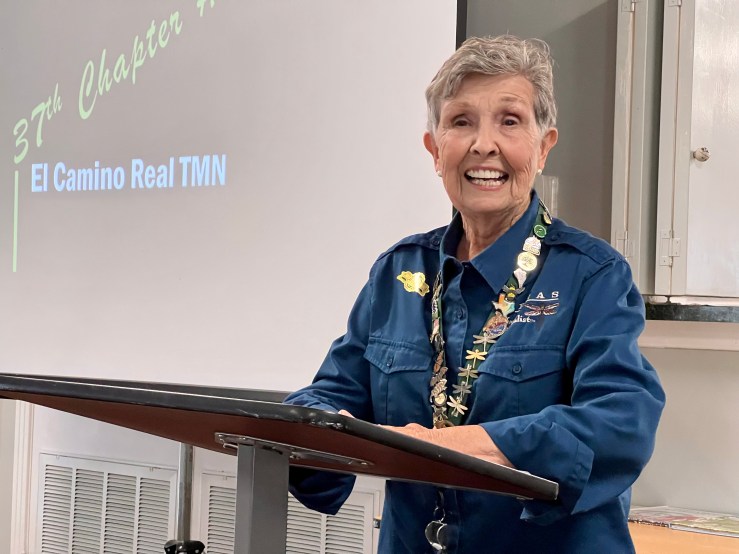
On Thursday, June 8, members of the El Camino Real Texas Master Naturalist had a fabulous time celebrating fifteen years as a chapter. We stuck with it, survived some hard times, dealt with a pandemic, and have emerged strong and active in Milam County. All members and friends, past and present, should give themselves a pat on the back!
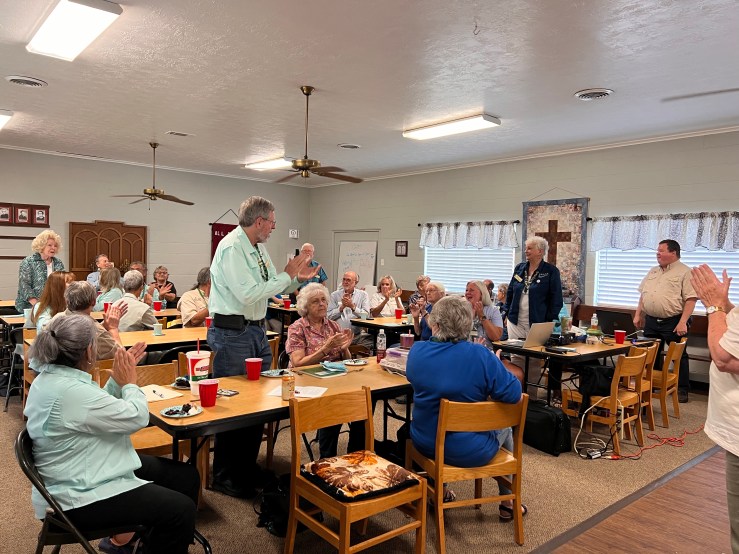
Here we are applauding the original members who joined us as we celebrated.
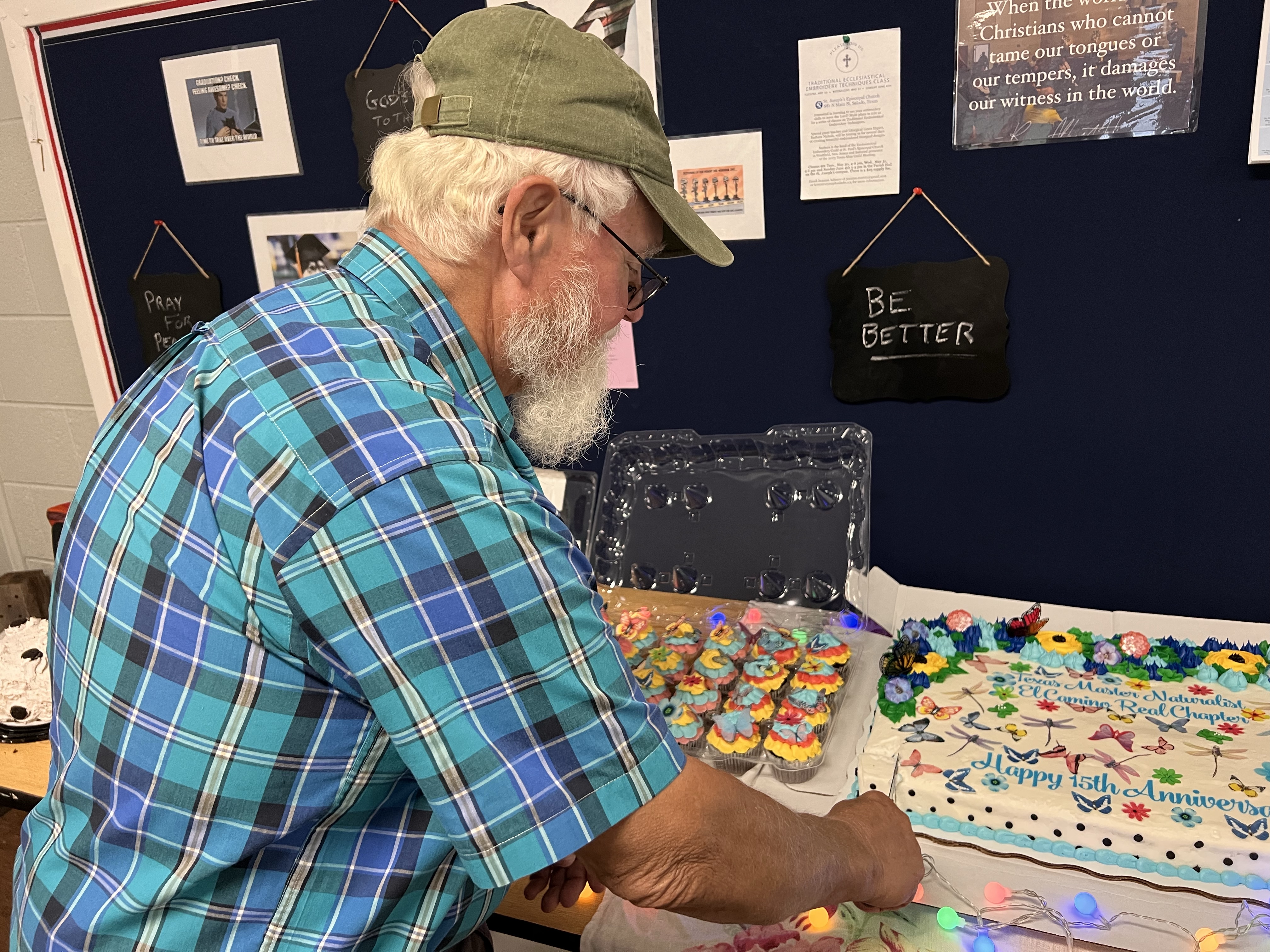
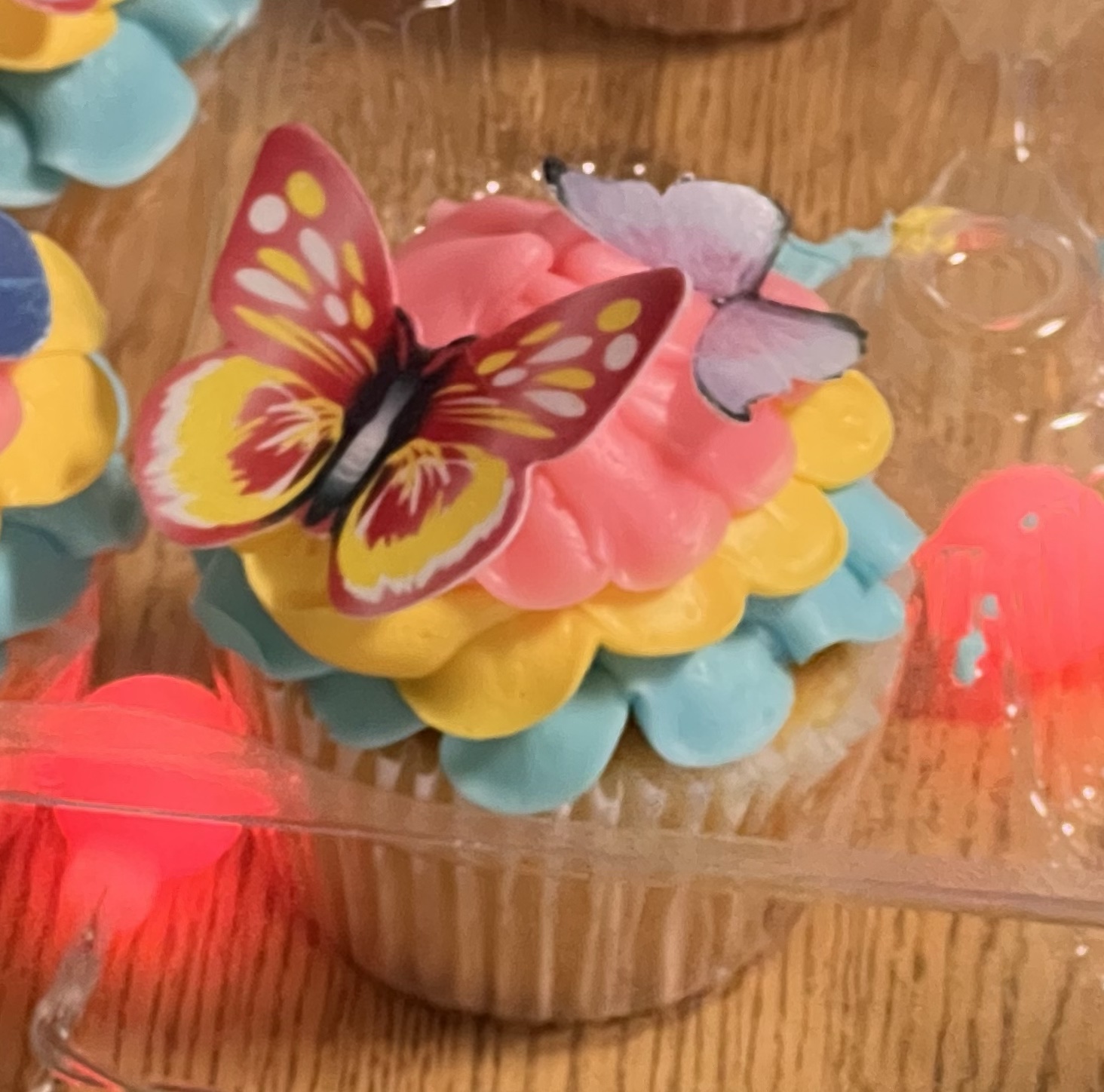
Our hospitality committee outdid themselves in creating a beautiful setting for a combined educational meeting and celebration. We started with a festive potluck mean, followed by a special selection of desserts. The cake was chocolate with cherry filling. and it was covered with flowers, butterflies, and other natural delights. There were also cupcakes that looked like beautiful flowers.
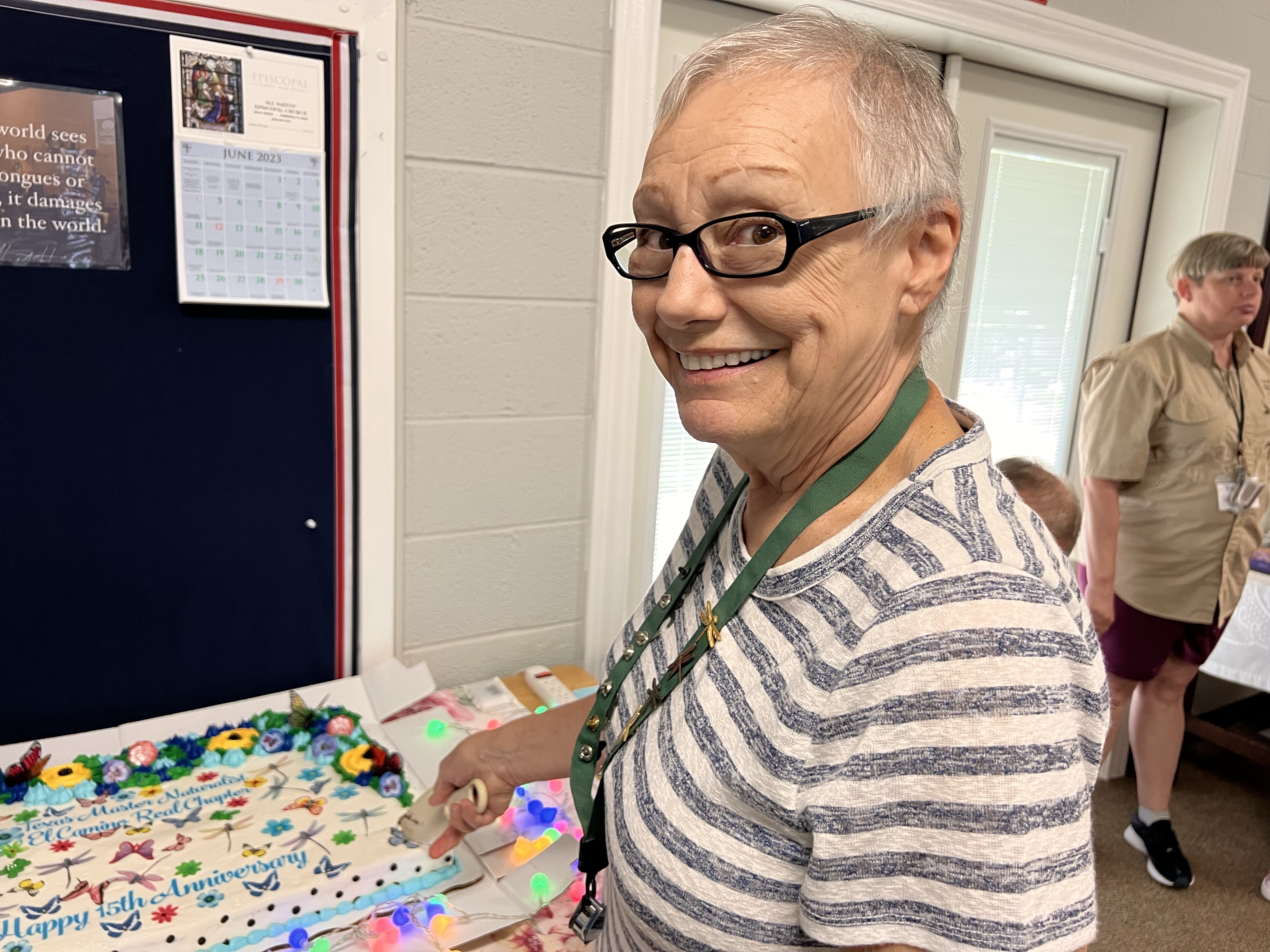
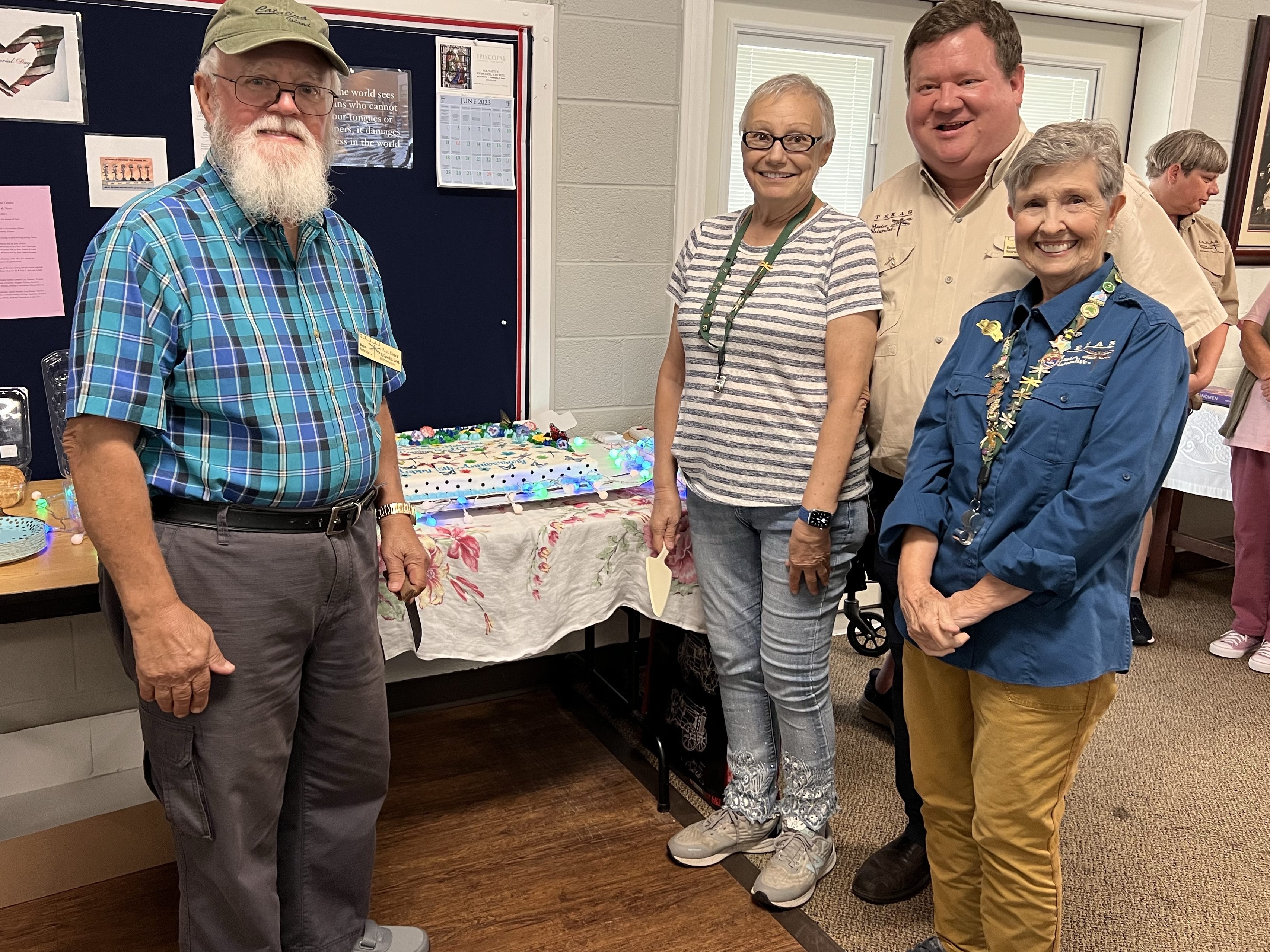
Cake and cupcakesCupcakesPaul Unger, our first chapter president, cuts the cake.Jan Unger helped with the cake cutting
We were honored that Paul and Jan Unger joined us from Fredericksburg, where they are currently living, to help us remember our origins. Paul was the first president of the chapter. He was one of the entertaining and extra educational speakers who told those of us who have joined the program more recently learn how we got to have such a thriving organization.
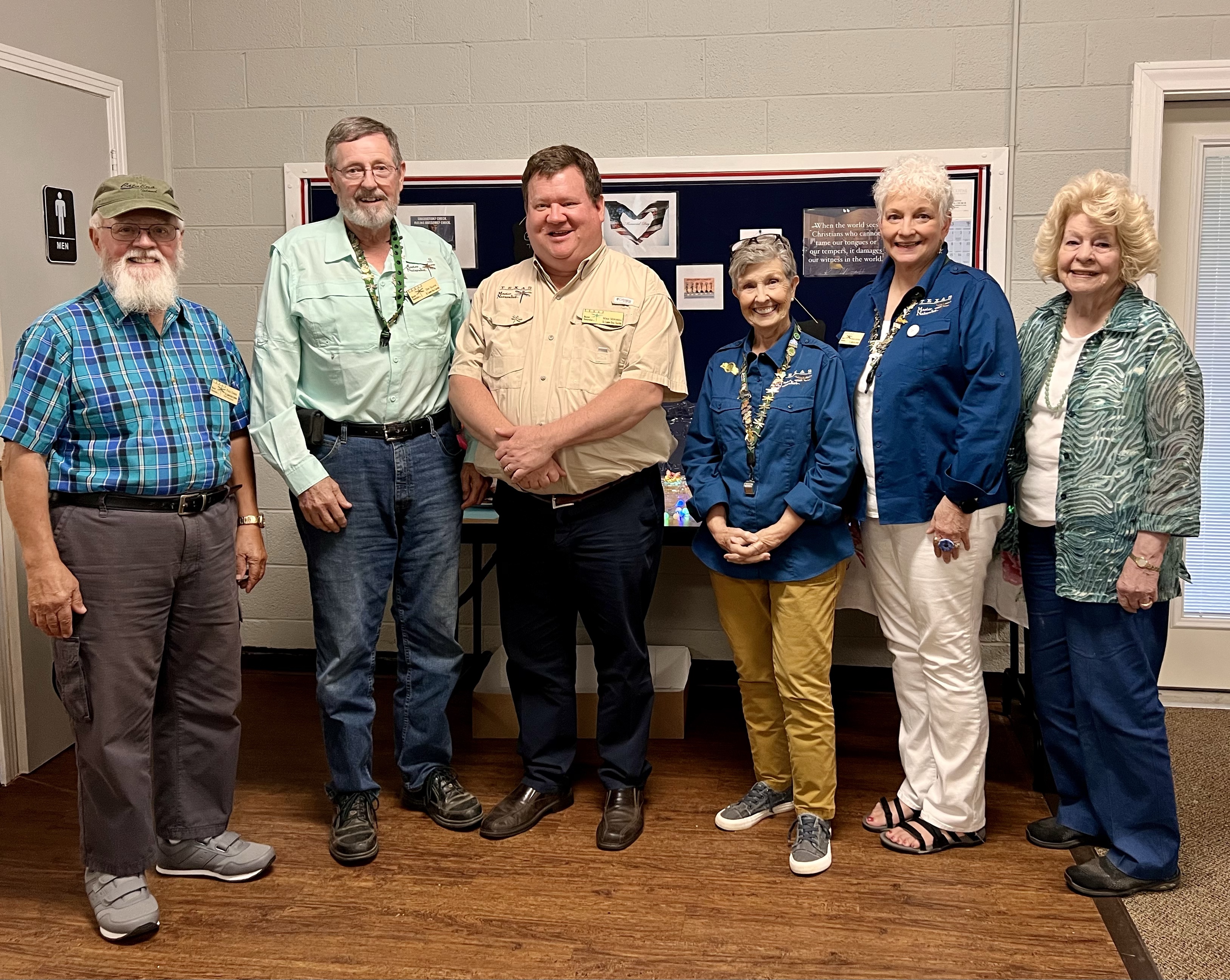
The Ungers are joined by Mike Mitchell and Ann Collins, the masterminds of our chapter.
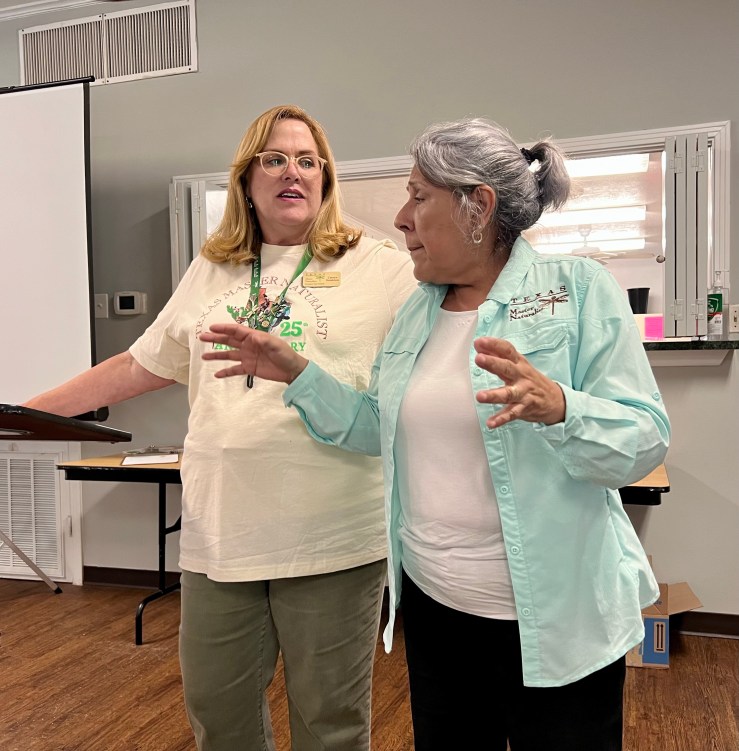
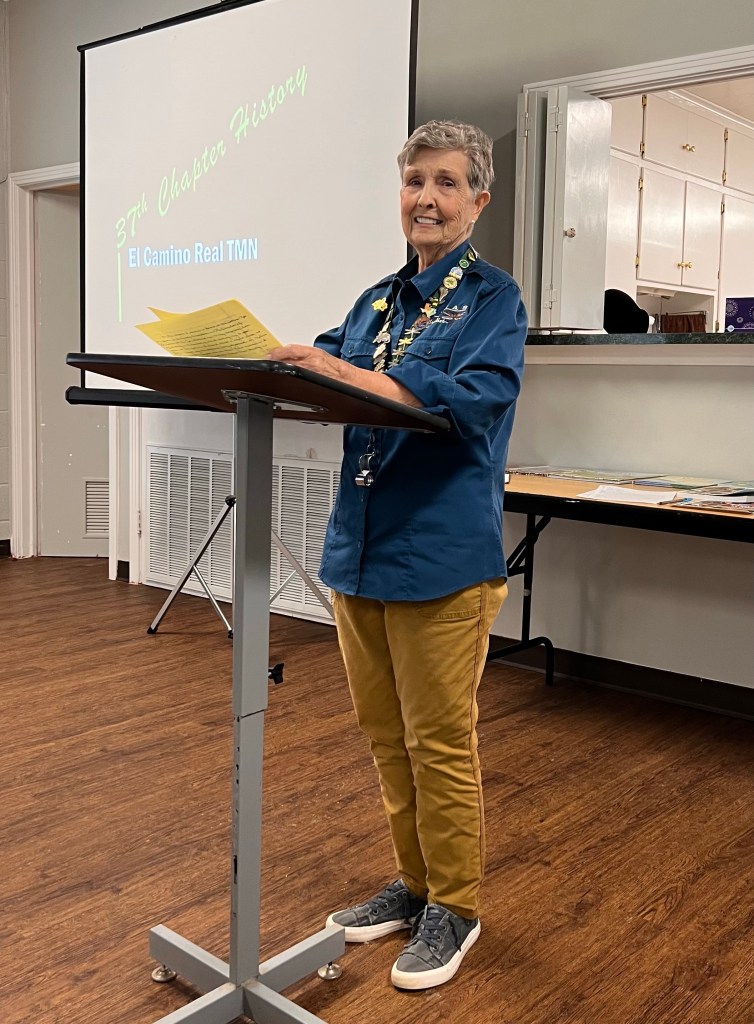
I have to say that I thoroughly enjoyed the speakers at the celebration. I learned so much (not all of it having anything to do with Master Naturalists, but that’s because there was so much good-natured ribbing going on). The evening started out with our current president and vice president, Carolyn Henderson and Liz Lewis, welcoming us all and sharing insights into today’s chapter.
These two had fun!
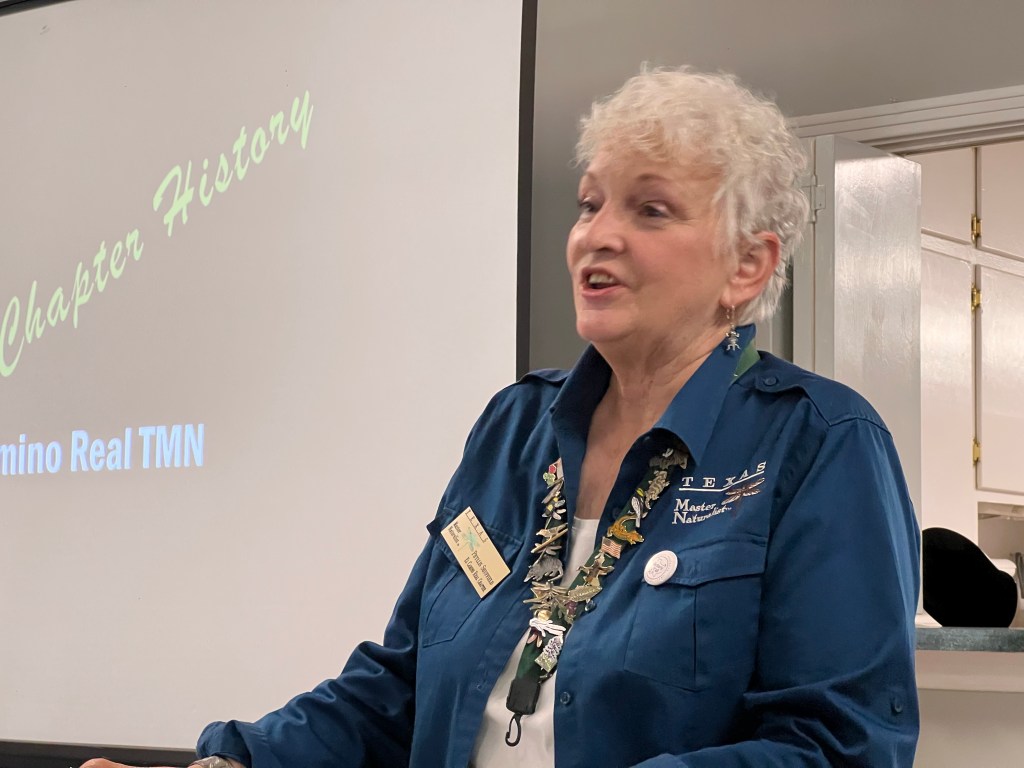
Then Phyllis Shuffield, a member of the first class, who was the president of the chapter when I joined, came up to introduce our founders. Since Phyllis is one of the best story-tellers I know, I really enjoyed finding out how she met Mike Mitchell stalking her property. Spoiler: he was the Game Warden and was looking for poachers. But she got him to turn quite red by the time she was finished. She then welcomed Ann Collins to the stage.
Phyllis, just getting warmed upAnn, preparing to share our origin story
I wish we’d recorded Ann’s talk. Hmm, as I look at the photo above, I see she did write it all down. Maybe she’ll send me her notes and I can write them up. I’ve done it before! Ann’s story of how she became a naturalist reminded me of the protagonist of Where the Crawdads Sing. Ann ran wild and free down by an East Texas creek, educated by her own curiosity and some great mentors. She lived in the Center of Civilization (Cameron) after her girlhood, and just kept learning as she raised her children and moved around Texas. She served as a docent at so many interesting places…and learned from so many great teachers…no wonder she knows pretty much every bird and plant she encounters.
And Ann is STILL excited about nature, every day!
She’s one persistent human, too. The path to getting our chapter started had many stops and starts, including a stint as a Master Gardener (even though she is NOT actually a gardener), and taking a Master Naturalist class in College Station that was full of PhDs who intimidated her until she figured out they were just people, too. Putting Ann together with Mike, our other co-founder, created a dynamic duo who would stop at nothing to get Milam County its own chapter.
Mike explaining some of the chapter treasures he brought along.
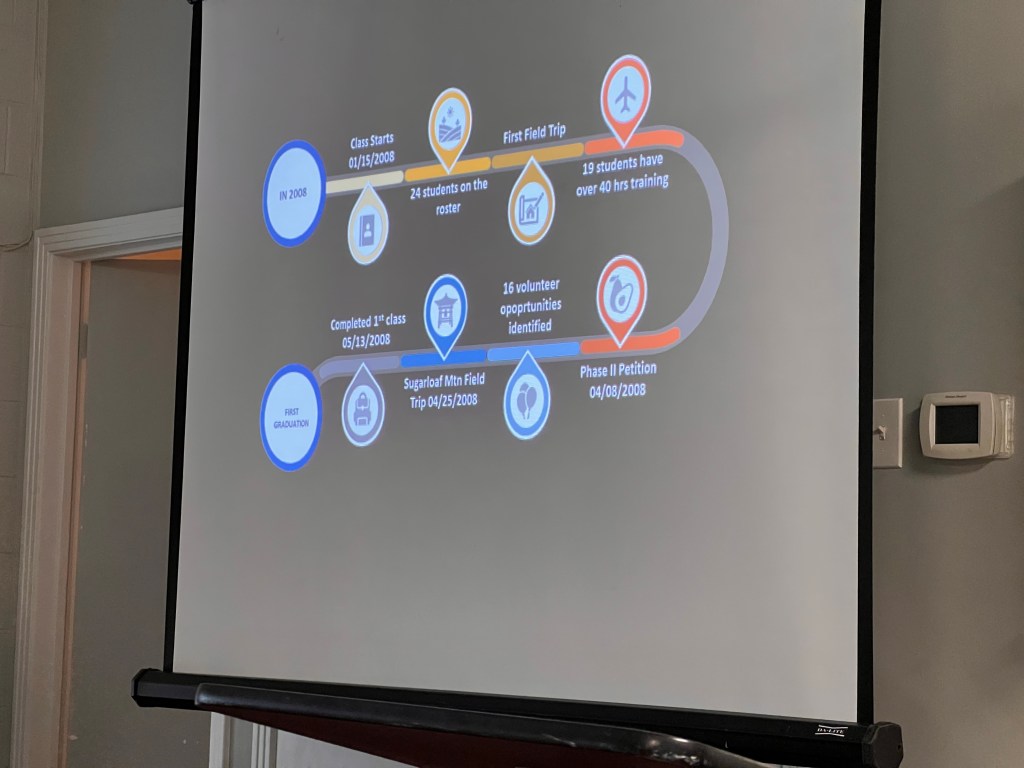
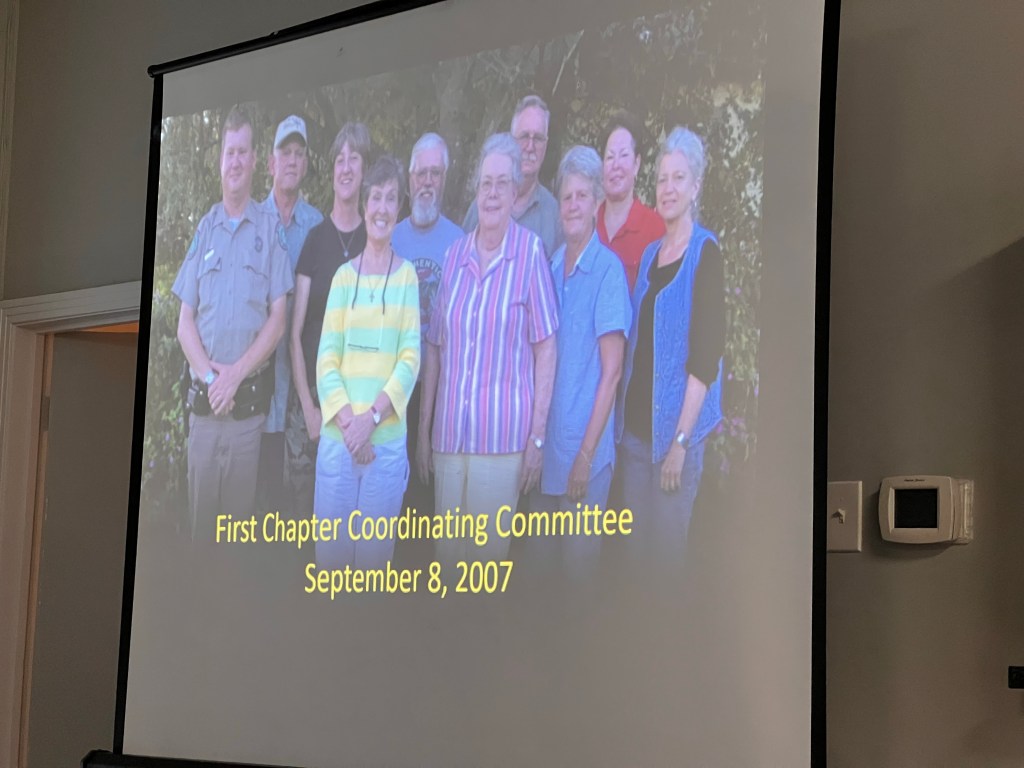
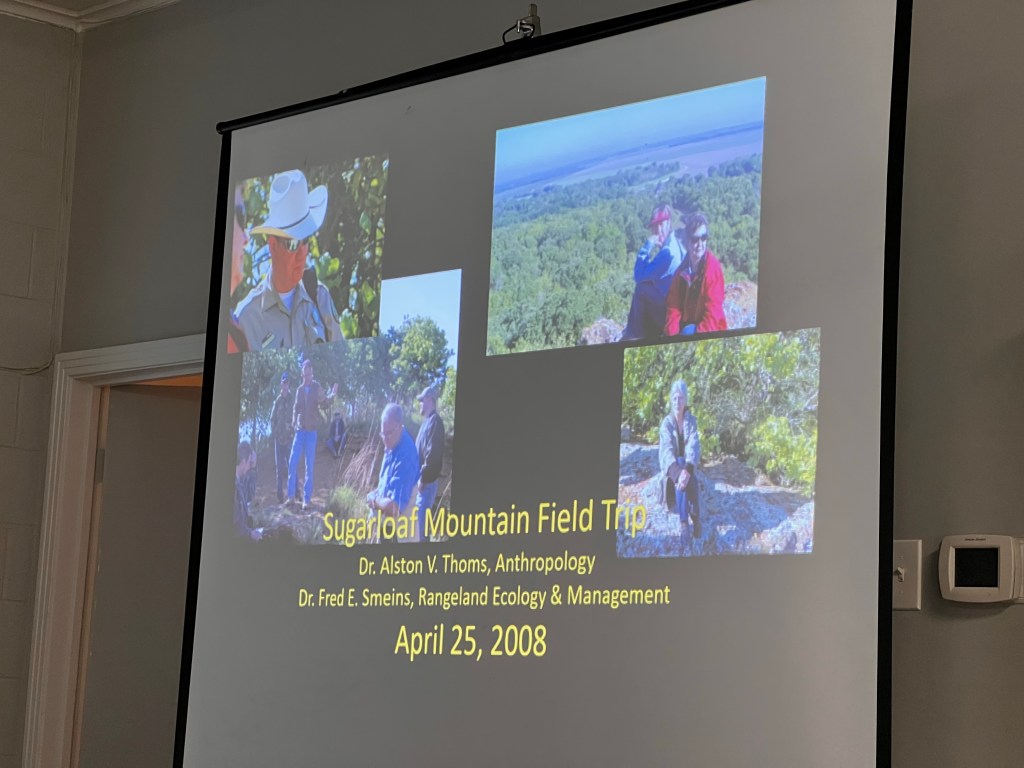
And yes, Mike Mitchell spoke next. He was our first chapter advisor and is proud to point out he is a friend of our chapter, not a member. For some reason, tracking his hours doesn’t appeal to him. But he has a Friend pin! What Mike did do was spend his off-work time and money getting the chapter documents together, creating a curriculum for the first training class, and publicizing El Camino Real Texas Master Naturalist. He still has his first outlines, the first class schedule, and many more amazing artifacts from starting our chapter.
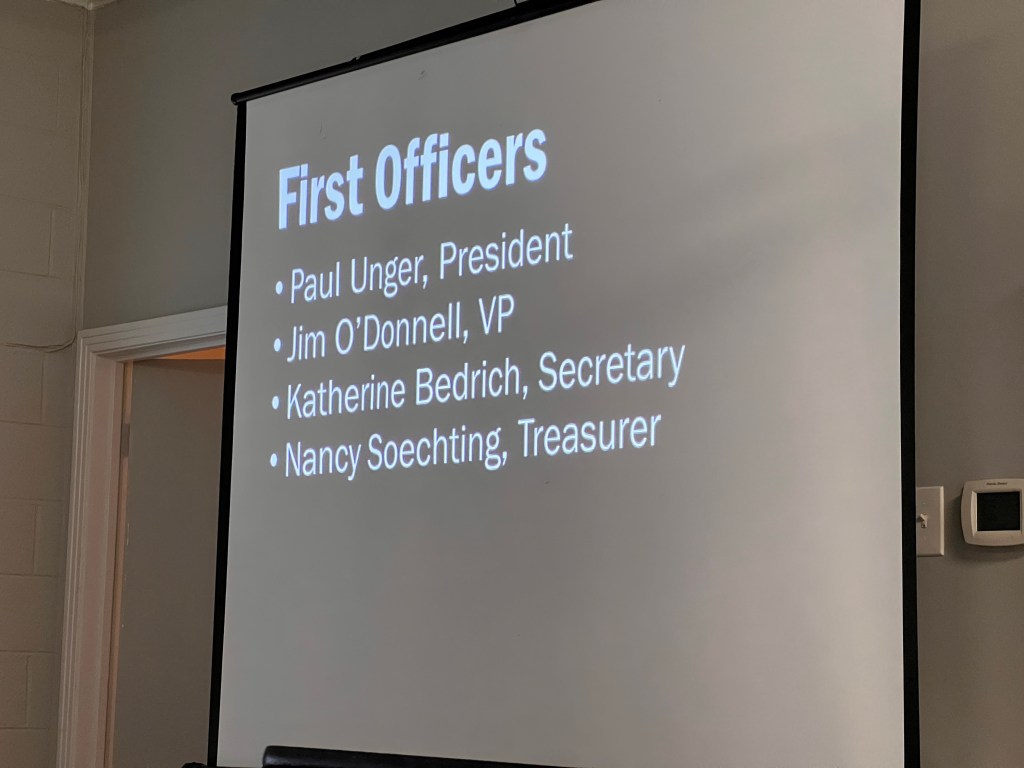
They guys who supported and approved the new chapter.The long and winding process to get the first class graduatedThe rest of the folks who worked hard to create our chapterFirst class field tripFirst officersCelebrating the first class at Apache Pass
Mike also acknowledged Don Travis, our webmaster and record keeper.
Listening to Mike made me truly appreciate the effort those dedicated naturalists had to undertake to get us up and running as well as the pioneer spirit of those first class members. It’s impressive that so many of them are still with us and continuing to actively contribute to the chapter.
We honored those who have passed on, such as Katherine Bedrich, and learned where some of the others now are. I was grateful for the chance to acknowledge those who couldn’t join us
I’m very grateful that Mike’s still our friend, still speaking to dozens of new Master Naturalist classes each year, and planning to present at the next Annual Meeting. He’s a lot of fun to hang out with, as I’ve learned from past meetings.
The work of our chapter does continue, so we took a short time to have a regular meeting. Of course, we honored the latest members to obtain their yearly recertification. Patricia Coombs attained both her initial certification as a new member and her additional yearly certification!
Congratulations on receiving your 2023 pins! Patricia Coombs, Carolyn Henderson (who presented the pins), Janice Johnson, and Debra Sorensen.
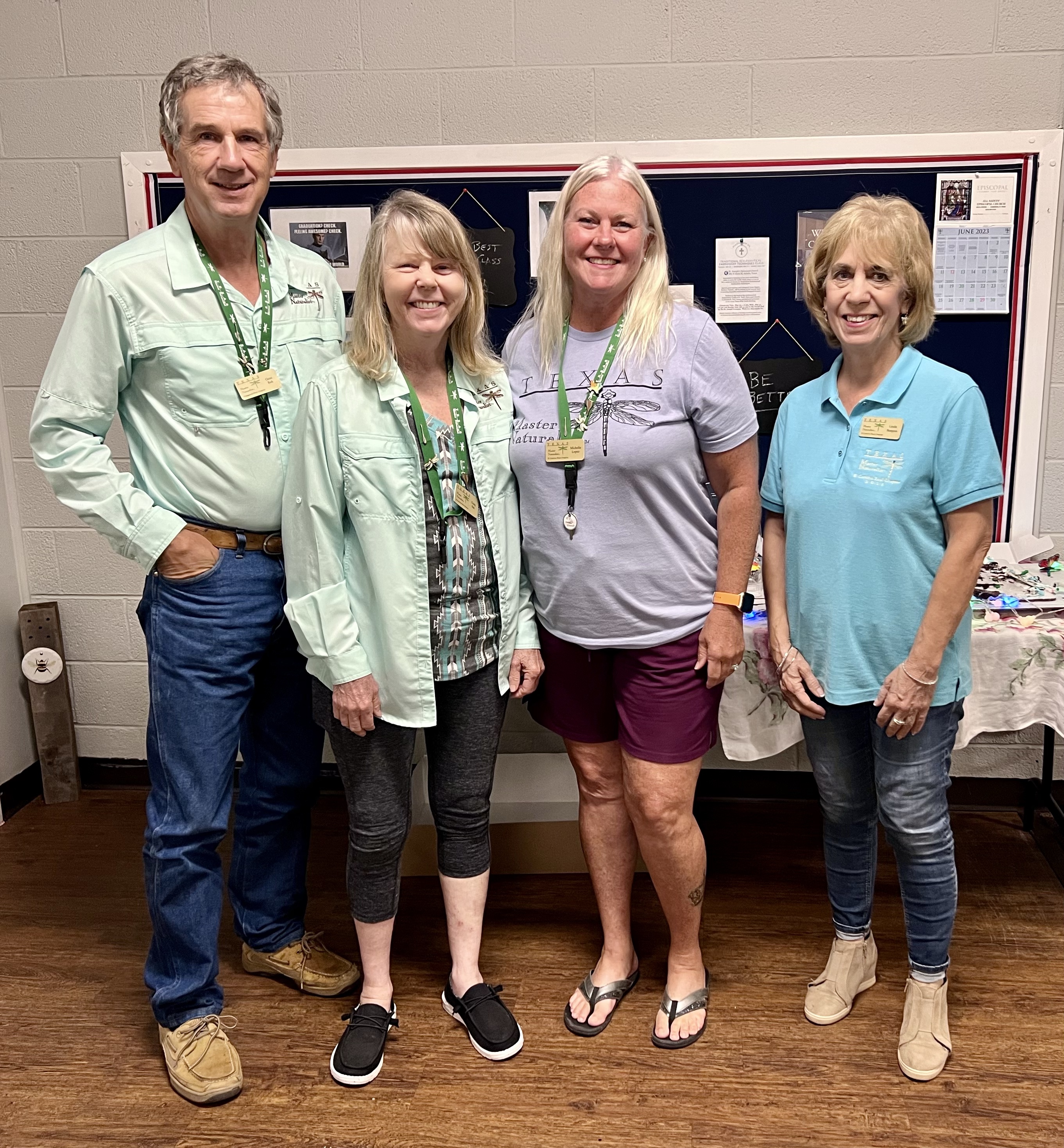
After our meeting, I took pictures of the members of each of our past training classes who were at the gathering. That was a lot of fun, and it was so good to see the legacy of our chapter as it continues. Click on any picture to enlarge it.
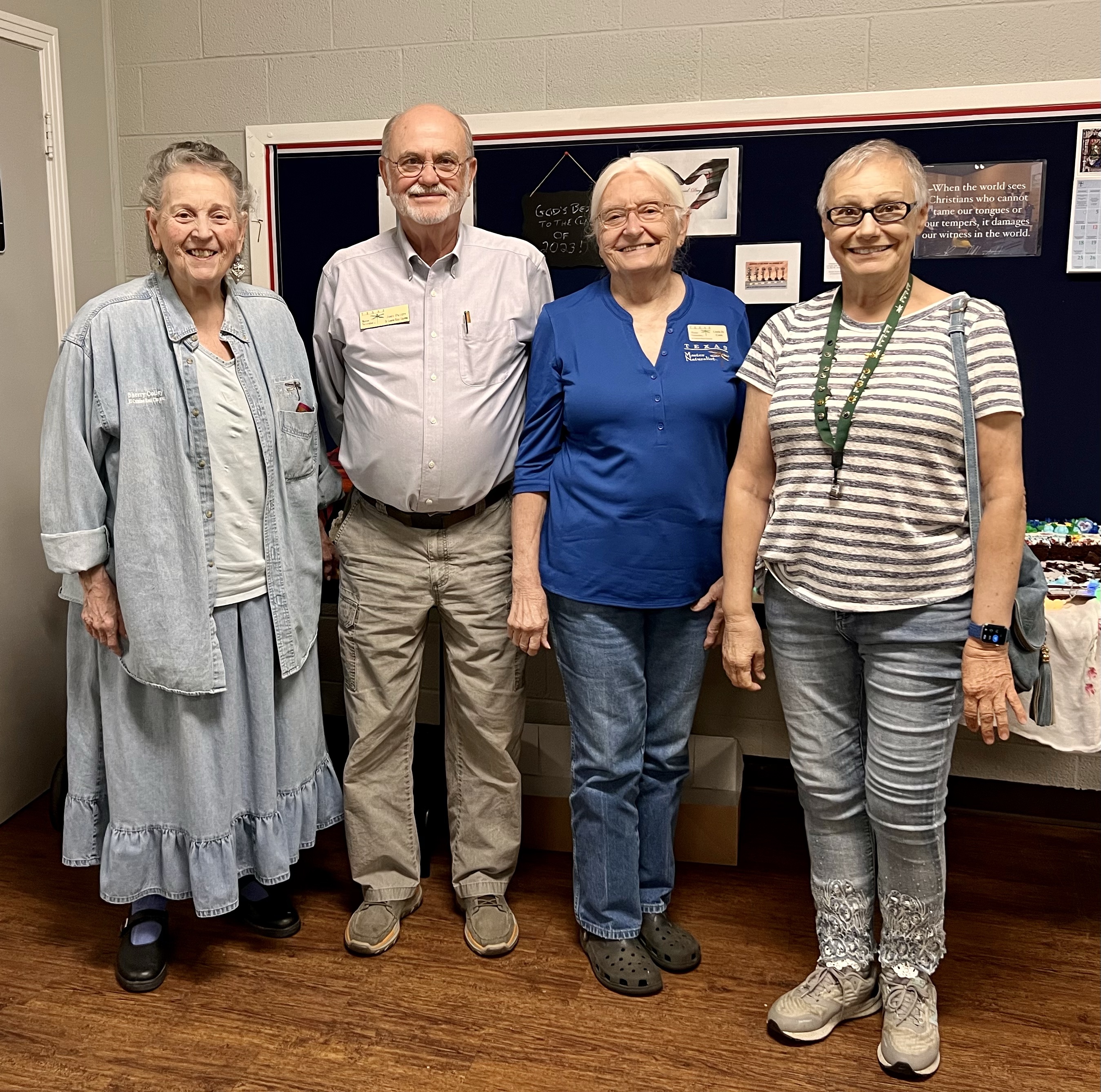
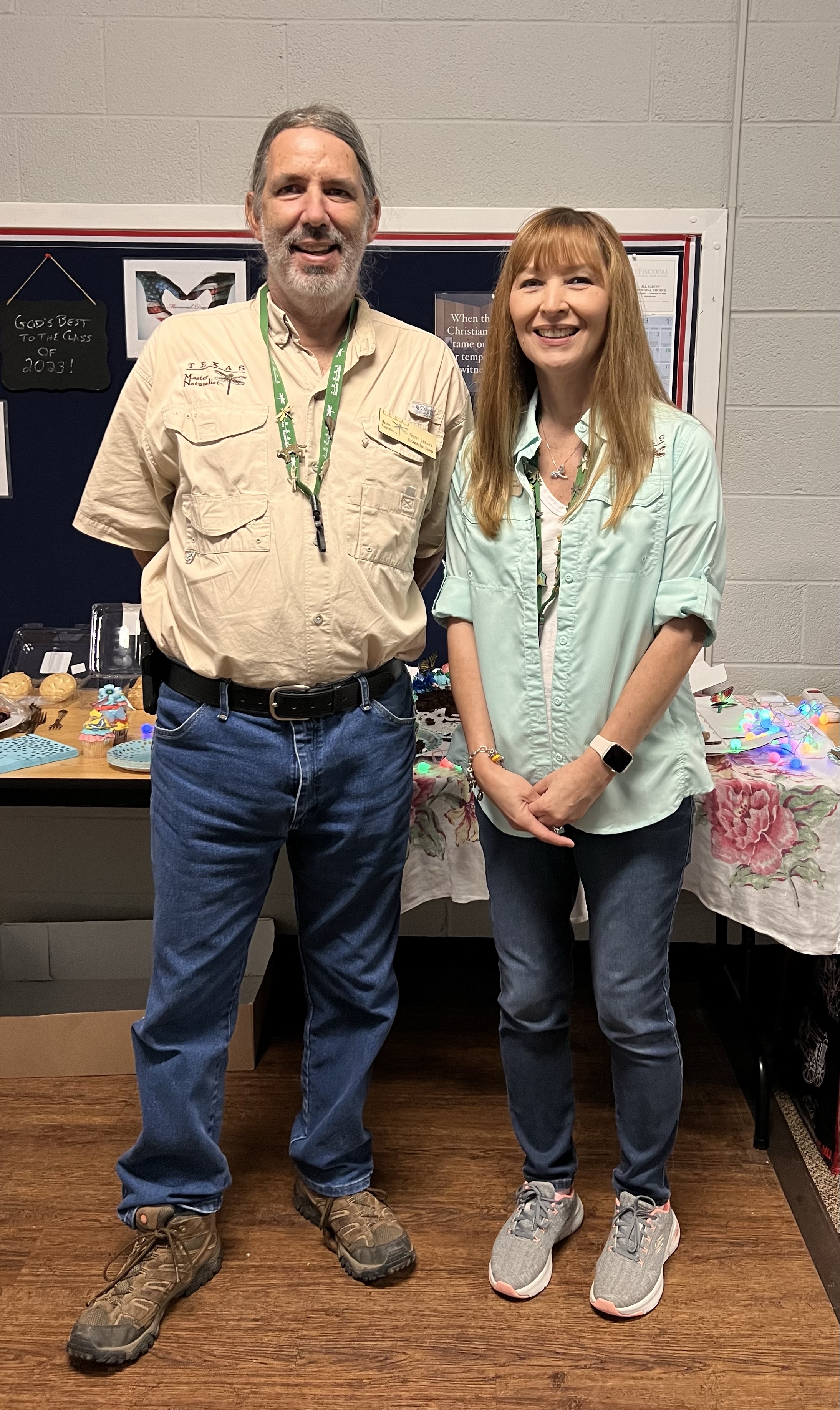
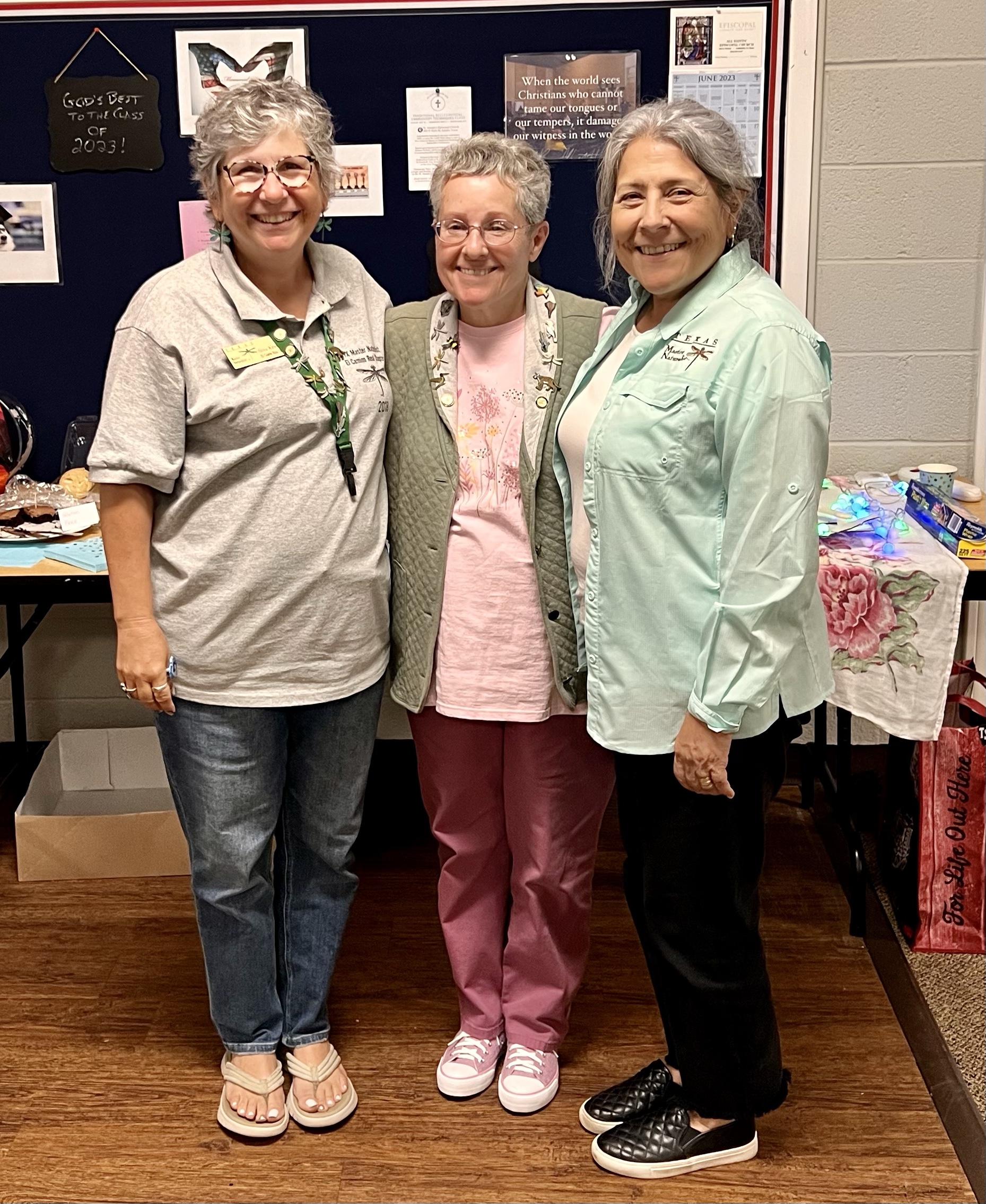
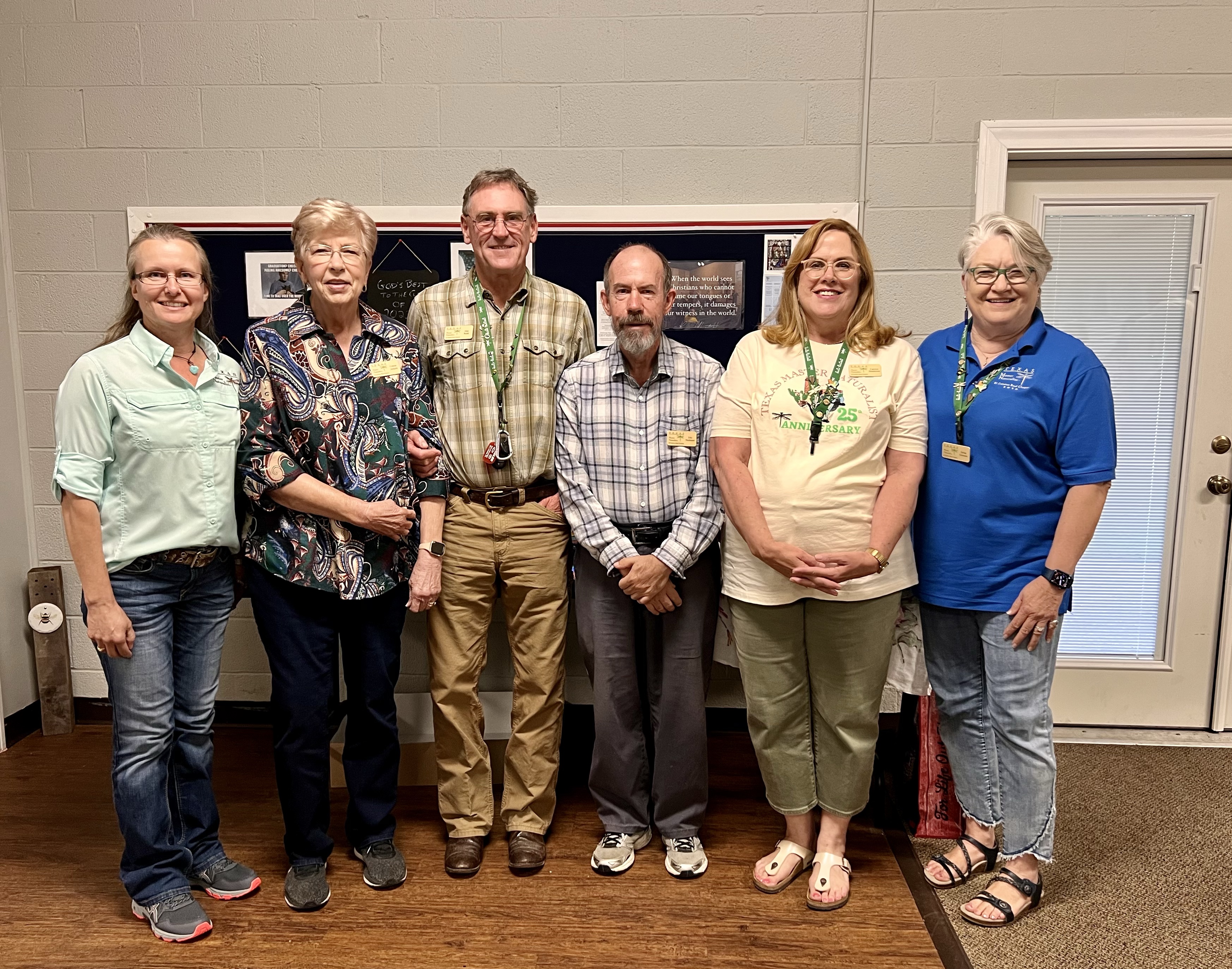
2008: Paul Unger, Don Travis, Mike Mitchell, Ann Collins, Phyllis Shuffield, and Sandra Dworaczyk2009: Pamela Neeley, Janice Johnson, Lolly Lewis, Cindy Travis, Dorothy Mayer, Kim Summers2010: Donna Lewis and Jackie Thornton2012: Sherry Colley, John Pruett, Linda Jo Conn, Jan Unger2016: Scott Berger and Lisa Milewski2018: Sue Ann Kendall, Catherine Johnson, Liz Lewis2020: Marian Buegeler, Connie Anderle, Alan Rudd, Eric Neubauer, Carolyn Henderson, Debra Sorensen2022: Gene Rek, Cindy Rek, Michelle Lopez, and Linda Burgess2023: Ellen Luckey, Neil Wettstein, Patricia Coombs
Interested in learning all about the nature in Texas? Let us know and we’ll contact you about our next training class. Visitors are always welcome at our monthly meetings, and you can become a Friend of El Camino Real Texas Master Naturalist if you attend more than two meetings and intend to take the next class. Join us!
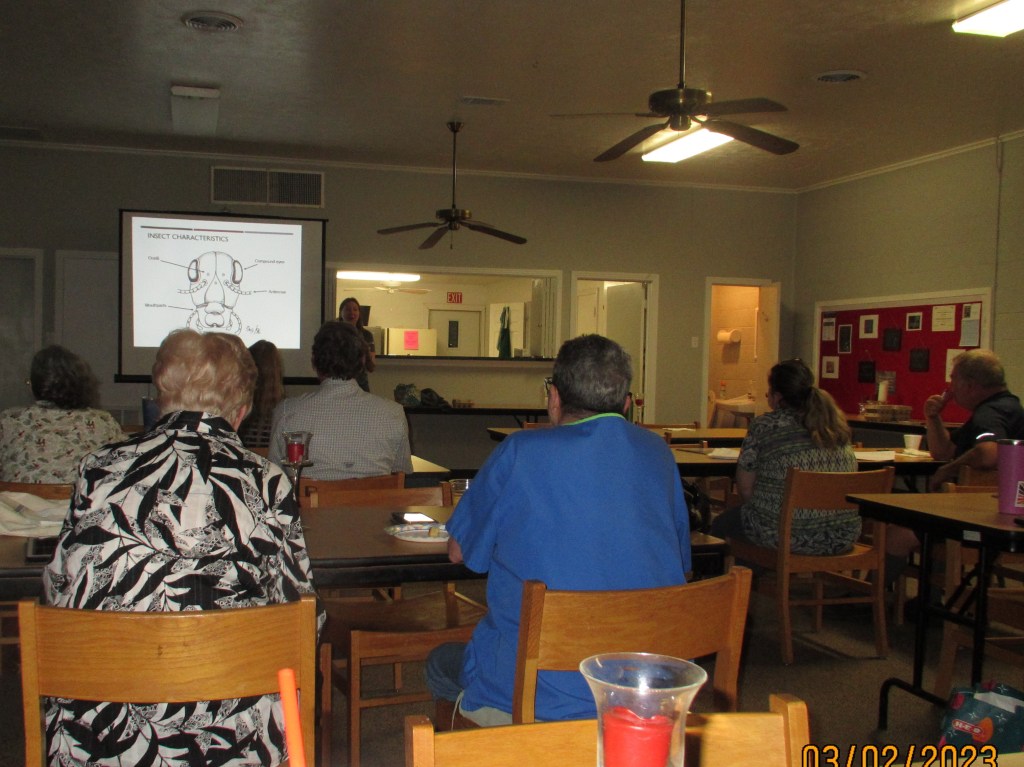
The El Camino Real Texas Master Naturalist training class was treated to a great program about bugs by Wizzie Brown, entomologist for TAMU AgriLife Extension in Travis County. Even the long-time members learned many new facts about Texas bugs. Ms. Brown’s favorite bug is a roach. That happens to be my least favorite. I’ve attached the ways to connect with her.
The Travis County AgriLife Extension office does blogs, programs, and YouTube posts about all things Texas nature. Many of these will give you AT hours while enthralling your interest in nature. If you email Ms. Brown, you can get on the email list that gets everyone notified of what is available. Kathy Lester, student trainer, emailed all the PowerPoint screens to everyone. The talk was even more informative.
Meeting in progress
At our regular meeting, March 9, Debbi Harris will teach us how to compost with worms.
Last night, our Chapter Meeting speaker was our own Alan Rudd. He happens to know a lot about fish, thanks to his training and profession of managing fisheries and lakes. He used his knowledge to show us all how little things we think don’t matter can have huge significance for those of us studying the natural world.
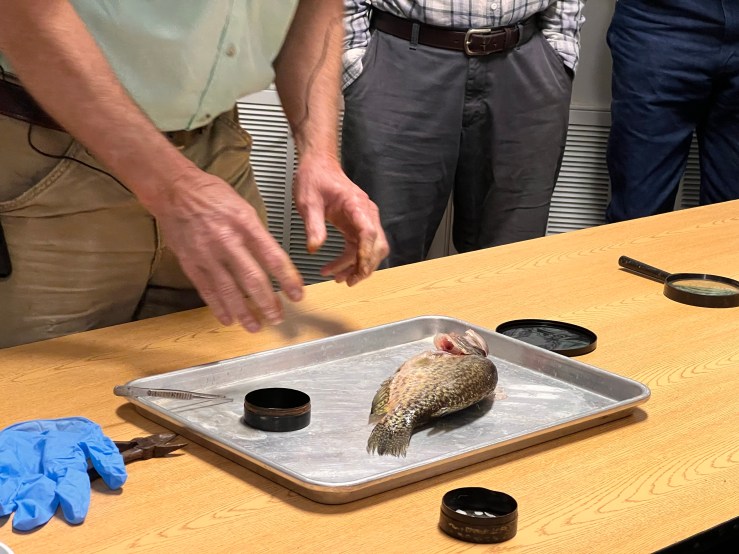
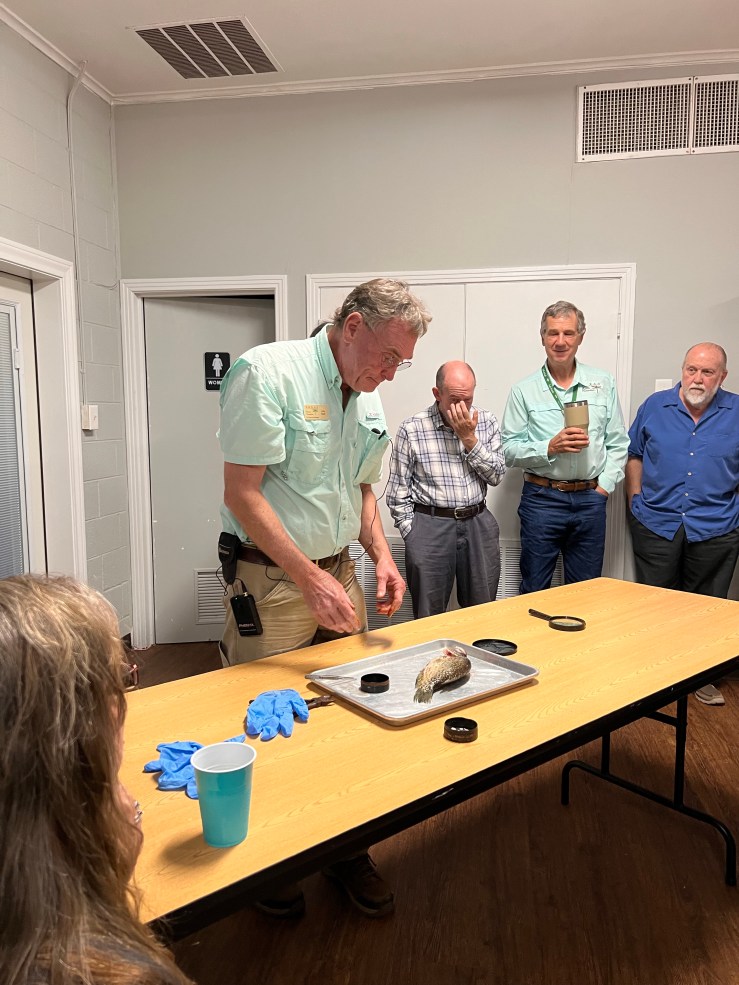
I have to say he had some excellent props for his talk. The first one he broke out was a dead fish. Yep. Alan proceeded to start the dissection process on a nice-sized crappie (a delicious member of the sunfish family). All he did was break its neck and extract something very small with his tweezers.
Ready to work on the fish. The tweezers are important!
What was it? It was a stone-like thing that grows in the ears of all fish, called an otolith or ear-stone. Every fish has them. It helps them hear. What use could that tiny thing be to research? Alan had wondered that himself, when he first studied fish anatomy.
Eric can’t bear to watch (not really)
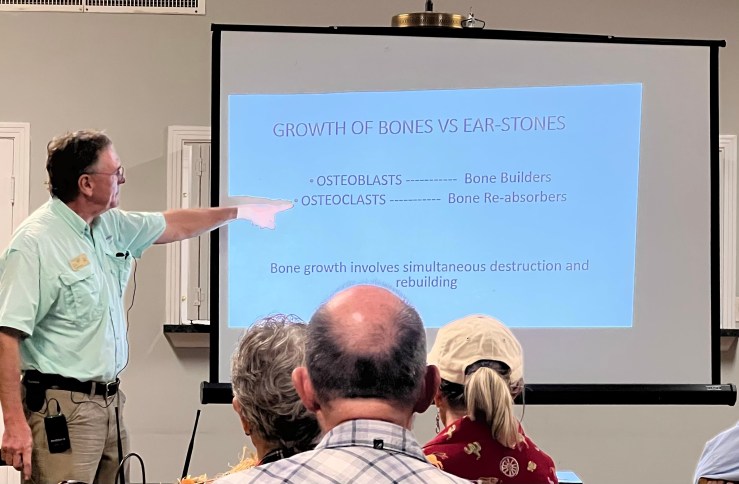
It turns out that otoliths are pretty cool. They are not bones, but more like stones. You see, bones grow in a process of taking away parts and growing new ones, thanks to components of bone called osteoblasts and osteoclasts. That’s how we get the porosity of our bones.
The only way I could remember this was to take a picture.
The ear-stones in fish grow by depositing new layers, like an oyster grows. So, they end up being solid. The stones in different types of fish look different, too, so you can tell where one came from even if the fish isn’t there. It turns out you can learn a lot from them, after all.
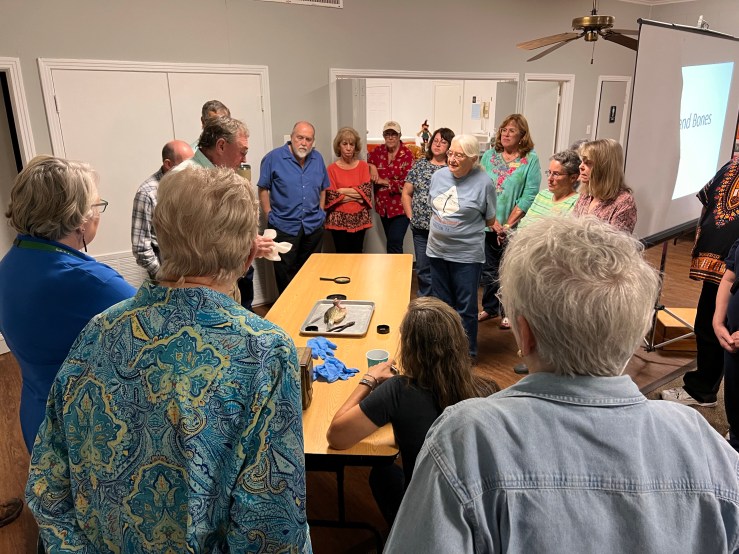
Not shown: the people who were grossed out by this whole process.
Alan shared with us a collection of ear stones from fish he’d harvested lately. They were very light, but quite hard. Then he shared how he came to find out how they help research.
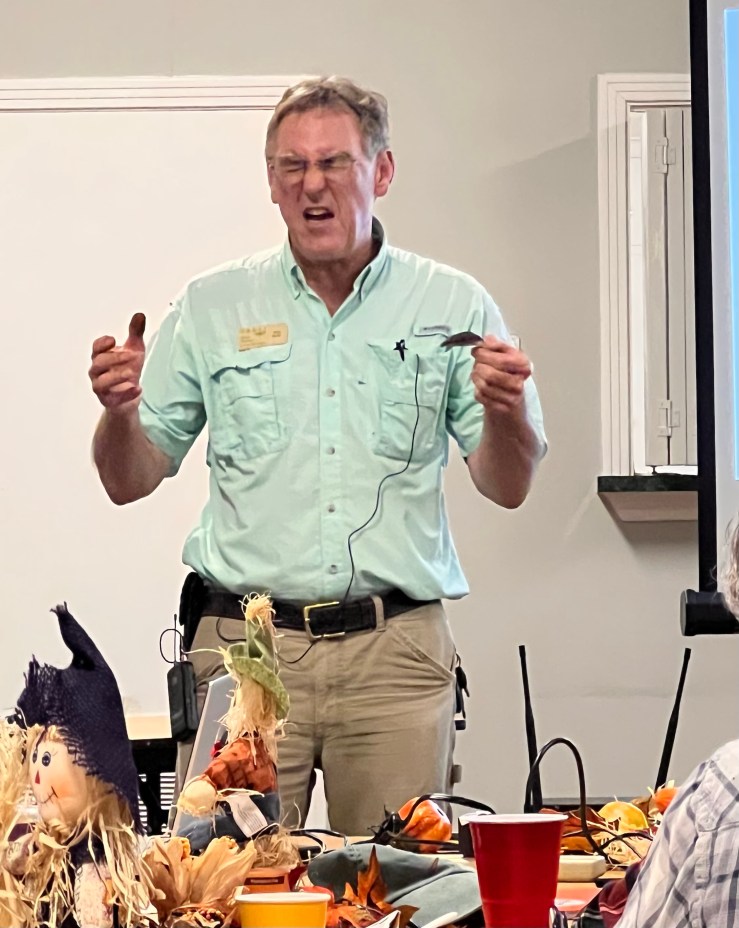
Alan is asking who gives a rat’s patoot about all those teeny tiny bones in baby fish?
He spent a summer doing research on salmon in the Pacific Ocean, abord a gigantic Japanese fishing boat, which had a whole fleet of other boats along with it. In addition to Alan, there was another American who was researching Dall’s dolphins, who sometimes got caught in the giant nets (over a thousand miles were put out every night–that adds up to a lot of salmon). Thanks to the other researcher freezing dolphins that had drowned and sending them off to research facilities, it was discovered exactly what the dolphins ate in the wild. How? By identifying ear-stones in their stomachs! Previously, it had been thought that the dolphins only ate squid, because all they found in formaldehyde-stored specimens were their beaks and that big bone they have. Freezing gave more info and saved the ear-stones. Progress. Yes.
Alan also shared how research had found that fish deposit a white layer every May (no one knows why) in their ear-stones. This lets you figure out many things about a particular fish. You can count the rings to see how old it was, but you can also inspect how closely together the rings are to determine how fast or slowly the fish grew. For commercial fisheries, you want fast-growing and healthy fish, and you can check on that by ear-stones. Who knew?
Bonus fact: Alan once found a 12-year-old fish in a very acidic lake. Its slow growth had let it live longer. Huh.
Bonus fact 2: Crappie breed every year at the full moon in March. They swim around looking at the moon until the right time (I made that part up).
I assure you this knowledge was much more fun to acquire via Alan’s talk. He is a good speaker, and his theme that knowledge builds slowly on the work of past researchers made a good point. Even the little things we discover doing citizen science can help someone make a big discovery someday.
The September Chapter Meeting presentation for El Camino Real Master Naturalist was by Debbi Sorenson, who has been observing vultures on her property for years and decided to do some research on these fascinating scavengers.
Debbi listens to questions and comments during her presentation
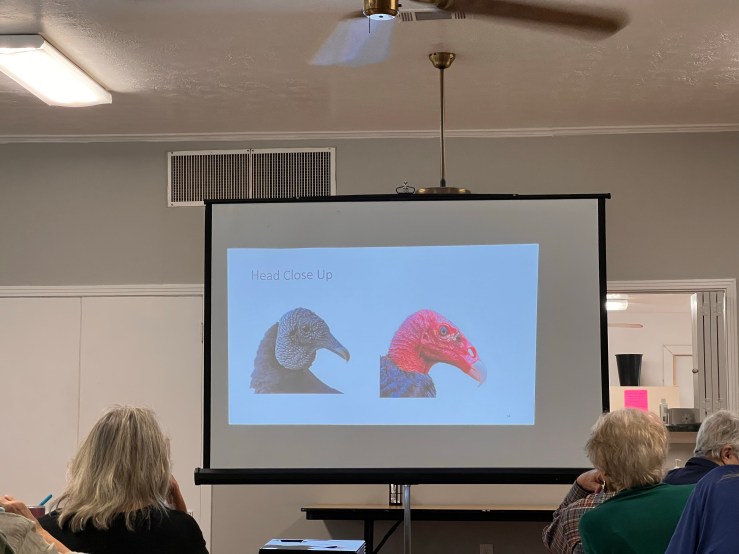
We learned how to distinguish our two resident vultures, the turkey vulture and the black vulture from each other. The easiest way is to look at their heads. Turkey vultures have red heads and black vultures have black heads. In flight, turkey vultures have white on their lower wings, while black vultures just have white “fingers” or wing-tips. The turkey vultures are also a little larger.
There you go, heads
Other interesting tidbits I gleaned were that turkey vultures are almost exclusively carrion feeders an find their food through extra-sensitive senses of smell. Black vultures both hunt and eat carrion and use sight to locate their food. They often see the red vultures eating and take over from them. I’ve seen this at my house.
These black vultures at my ranch found a dead snapping turtle that turkey vultures were eating, and took over.
Debbie also shared the ranges of both birds and told us about their breeding behavior, which is to lay two eggs in abandoned buildings or dead trees and raise them there. George Bowman, a visitor to our meeting, shared how he had a baby vulture raised on his front porch this year (which many of us had enjoyed on Facebook). He ended up with a poopy porch, but a successful fledging of the baby.
Baby BuzzardIt grew!
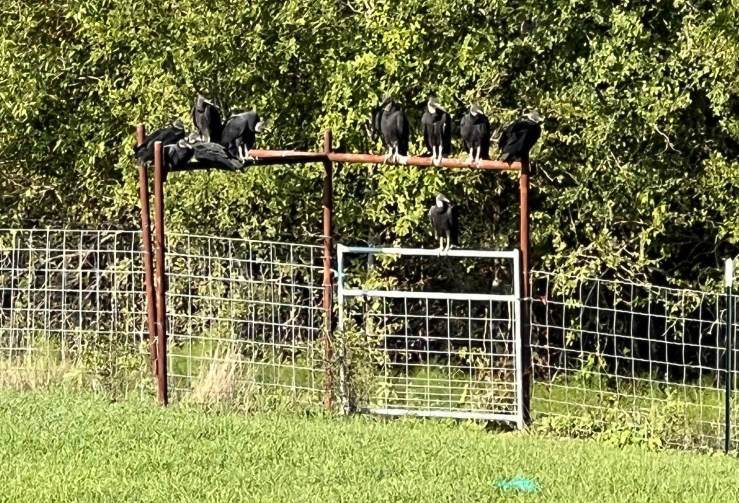
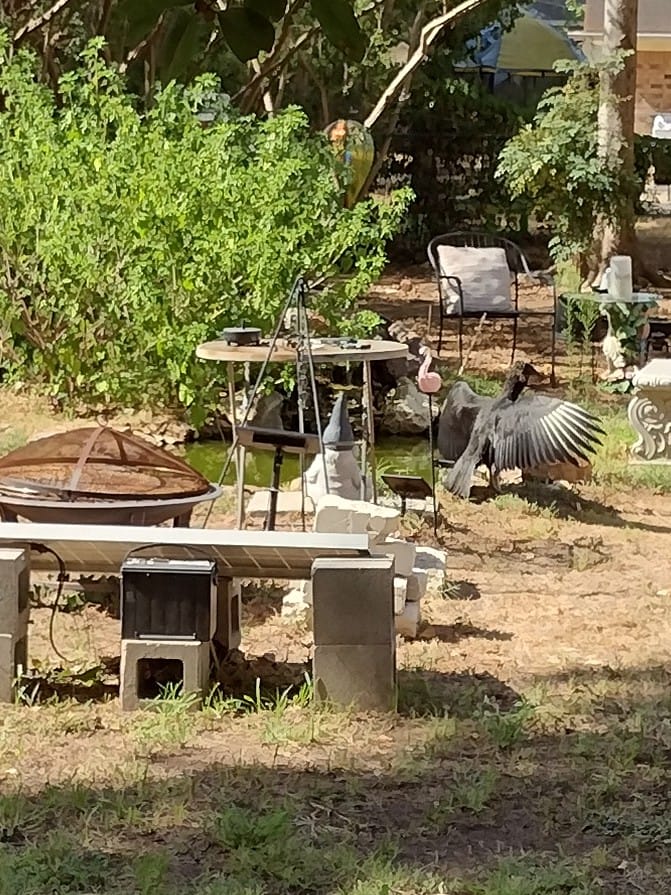
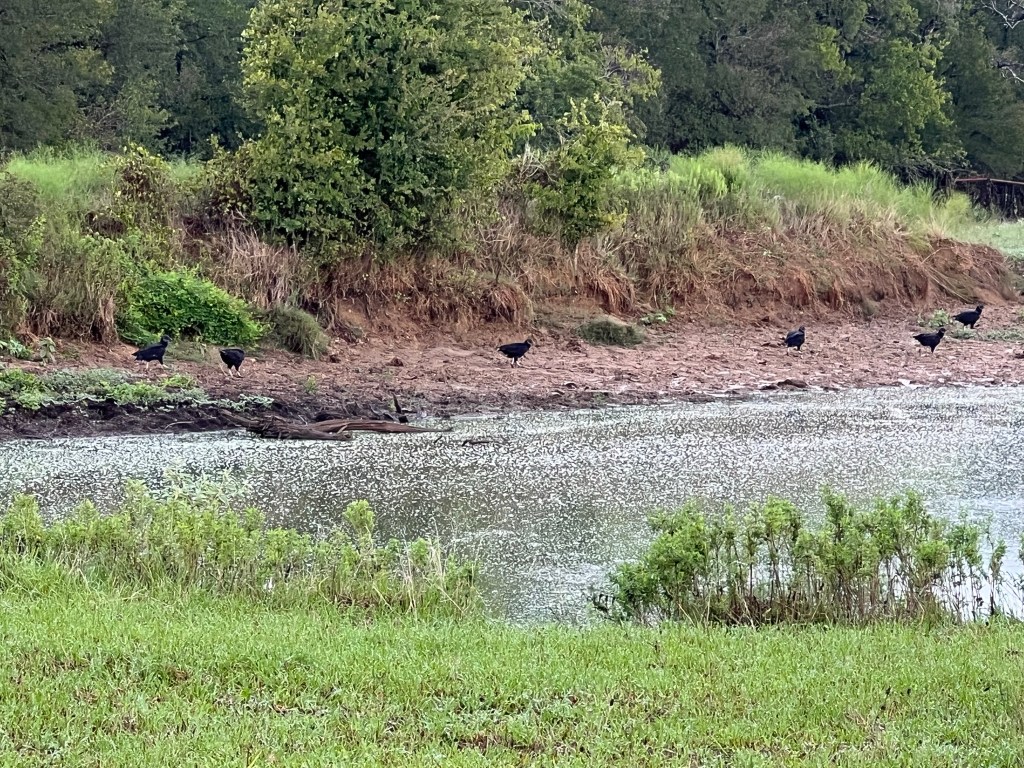
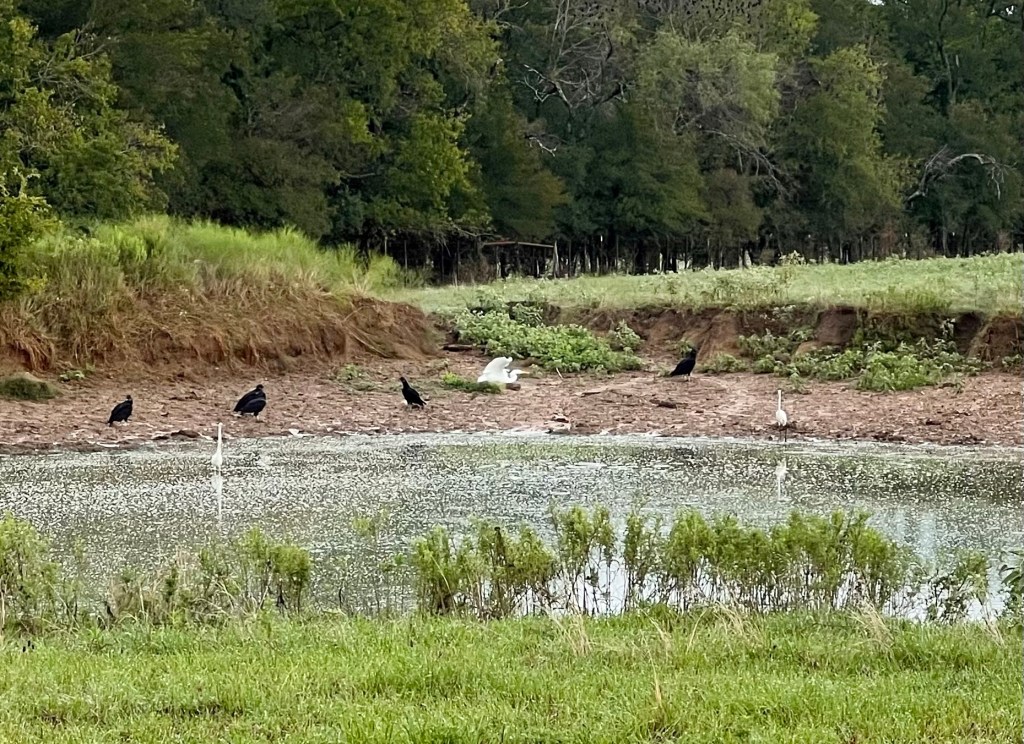
Debbi shared that their barn is a vulture nesting headquarters for a pair, and that they enjoyed watching one with just stumps for feet (Old Peg) as it grew. Debbi shares her garbage with them and gets lots of observations in return. I also enjoy watching them. They are graceful in the air but are pretty fun on the ground. I love to watch them as they hop, hop, hop around my tank behind the house.
Hopping around the tankEnjoying an armadilloHanging around with their egret friends.
I guess Debbi isn’t alone in enjoying vultures and their behavior. She had lots of questions to answer, and she also explained that our other resident carrion eater, the crested caracara, is not a vulture at all, but is a falcon, also known as the Mexican eagle.
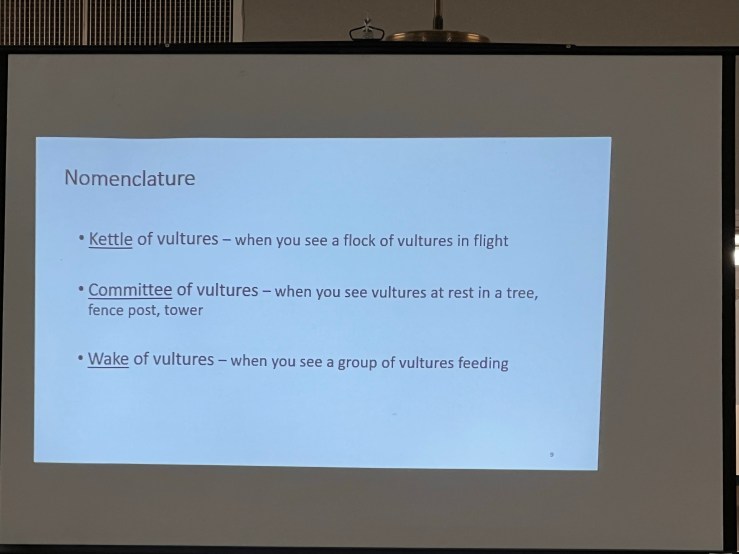
Here’s what you call a group of vultures, depending on what they are doing.
Our meeting concluded with the recognition of two of our members. Congratulations to Alan Rudd and Scott Berger for getting their annual recertification for forty volunteer hours and eight advanced training hours. And Scott received a milestone recognition for 250 hours contributing to the Master Naturalist organization. We appreciate our members!
Our membership chair, Lisa Milewski and our chapter President, Carolyn Henderson, enjoyed sharing the recognition.















 Nature Along the El Camino Real