Blog of the El Camino Real Chapter, Texas Master Naturalists, Milam County, Texas
Author: Sue Ann (Suna) Kendall
The person behind The Hermits' Rest blog and many others. I'm a certified Texas Master Naturalist and love the nature of Milam County. I manage technical writers in Austin, help with Hearts Homes and Hands, a personal assistance service, in Cameron, and serve on three nonprofit boards. You may know me from La Leche League, knitting, iNaturalist, or Facebook. I'm interested in ALL of you!
• Range is south-central Great Plains into Mexico. • 26th most commonly observed grasshopper in Texas at iNaturalist. • Eye oval in shape, less curved in front; dark with fine tan mottling. • Thin black stripe extends from front of eye, just over and past antenna. • Female has vestigial wings and is flightless. • Male has functional wings which usually extend beyond the abdomen. • Most have black “eyebrow”, curved on top and flattened on bottom. • Light dorsal stripes on pronotum are parallel toward front rather than pinched, then widening and fading toward back; slight pinching on males. • Front lateral edge of pronotum usually light. • Abdomen with black sides appears striped as segments have pale trailing edge. Black may be eroded, especially on females. Top of abdomen is pale. • Hind femur strongly banded on male • Outside of femur on female mostly black; back and inside may show banding. • Hind tibia violet on at least one female; apparently tibiae not colored on instars. • Female colors tan, green, and black. • Male colors dark brown, black, and yellowish tan.
The habits of this species aren’t well known. Photos of male abdomen and most instars are lacking here.
More Photos
Female with a lot of greenFemale with a little greenTwo more examplesFemale showing violet tibiaeLeft: yellowish female. Right: female with longer wingsTypical malesTypical maleLight maleYoungsters
You are welcome to download this PDF of the photo essay. Click the Download link below.
Earlier this week, I happened to be checking my Martin House poles when I thought I saw something in the netting around the poles. I looked closer and there was a female Mantid (Praying Mantis) who had gotten tangled in the netting.
It took me an hour to get her out unharmed. As soon as she was free she flew onto my arm and proceeded to climb up till she was on my shoulder. She looked at me with her triangular shaped head and turned her head back and forth. Kinda neat and creepy at the same time. I guess we were bonding…
Ms. Mantid
Mantids are a sit-and-wait predator. The females are larger than the males. It is rumored that sometimes if a second male comes near her during mating, well, she just eats the first guy by biting his head off. Maybe that’s where that saying comes from?
They mostly eat other insects or small lizards. They do call to attract a mate, but otherwise are silent.
She was interesting to say the least, and I guess she was thanking me for saving her, because when she finally flew down to the grass, she started following me.
I finally out-distanced her and everyone went home.
This is a bonus photo of a green lynx spider Donna saw. It’s messing with a butterfly.
Would you like to eat off a dirty plate? Birds probably will, but it is not safe for them.
So, I bet your feeders are not clean. It’s a nasty job we all hate to do. Let’s face it, it’s work!
Gotta clean out these seeds that are stuck to the feeder after a rain.
But a dirty bird feeder can transmit Salmonella enterica bacteria. Nasty…
Soap and water is not enough to do the job. Ole faithful…BLEACH is what is needed.
Your necessary cleaning supplies.
1. First, clear all the old seeds out of the feeder. Use a brush or putty remover because it will be like concrete to remove.
2. Wash the feeder with soap and water, scrubbing it good. Then dunk it in a bleach/water solution. A nine to one solution is recommended.
3. Next it must be completely dry before you add any seed again. Don’t get in a hurry.
Having a few extra feeders helps you rotate them.
Dunking in process. Note the rubber gloves!
4. Next clean under the feeders. Get rid of the old moldy seeds on the ground. Dispose of them so the birds cannot eat them again. They’re birds, they don’t know any different.
It’s a very good idea to wear rubber gloves while doing this. Birds can transmit some diseases
Note from Suna: Pamela Neeley from the El Camino Real chapter has been working with water features on her property for the past few months (years), creating not only areas of beauty (sight and sound), but places for aquatic plants to flourish, and wildlife to sustain themselves on. I toured her property a couple of weeks ago and encouraged her to share some of her ideas and techniques with fellow Master Naturalists. Maybe you can borrow of her creative thoughts some in your own gardens and wild areas!
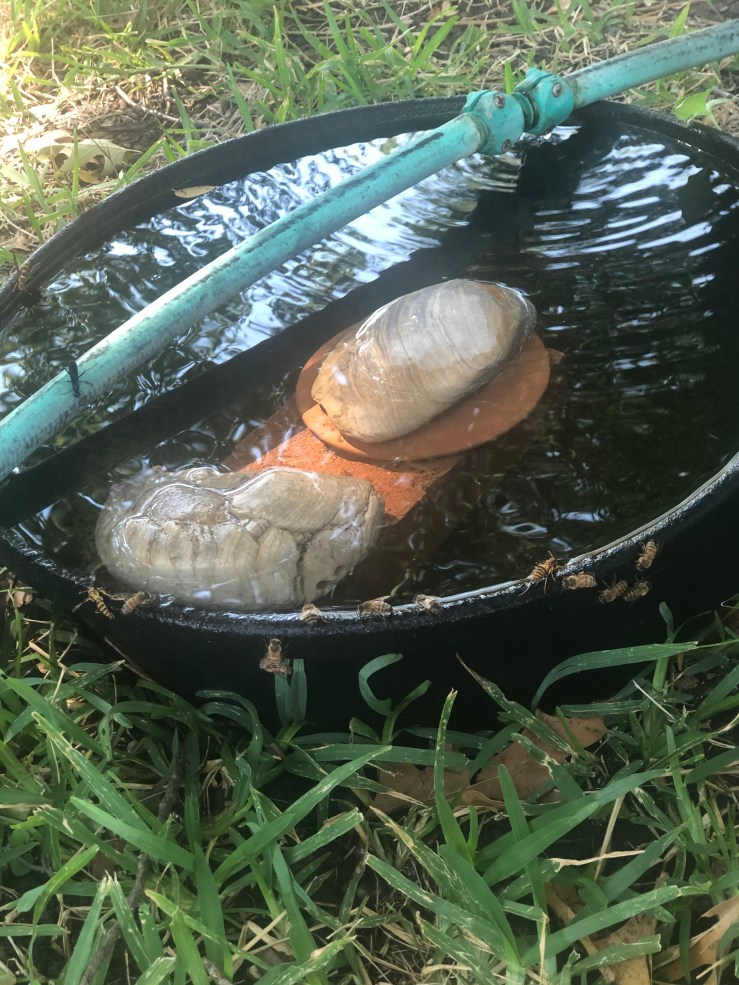
The rock is for butterflies and others to perch on
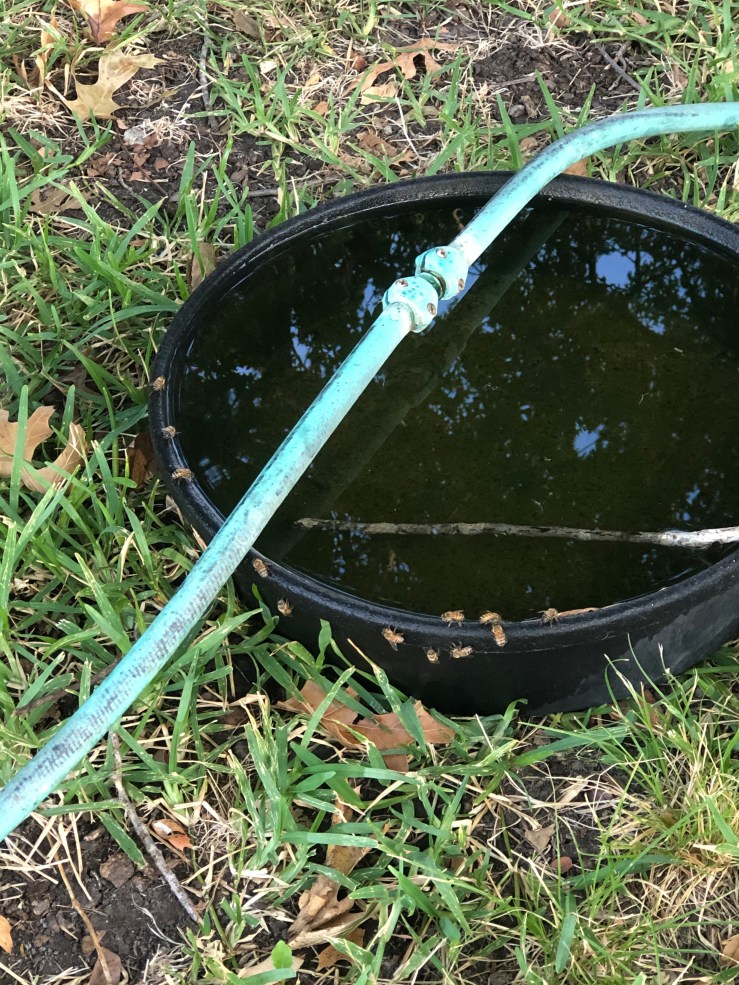
A leaky hose fills the container
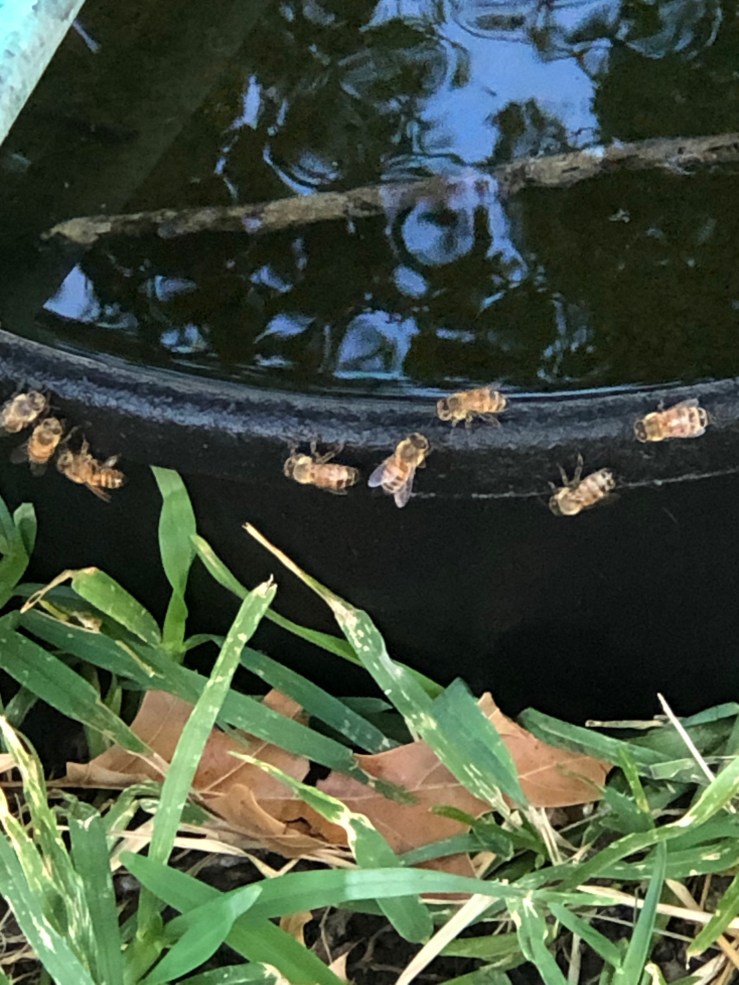
thirsty bees
This water feature is made from a hose repair that leaks. The container spills out on one edge, and the bees and wasps congregate. So far, the stones haven’t attracted many customers; bees like the edge.
See the fish?
Stunning skink
Lots of vegetation to hide in
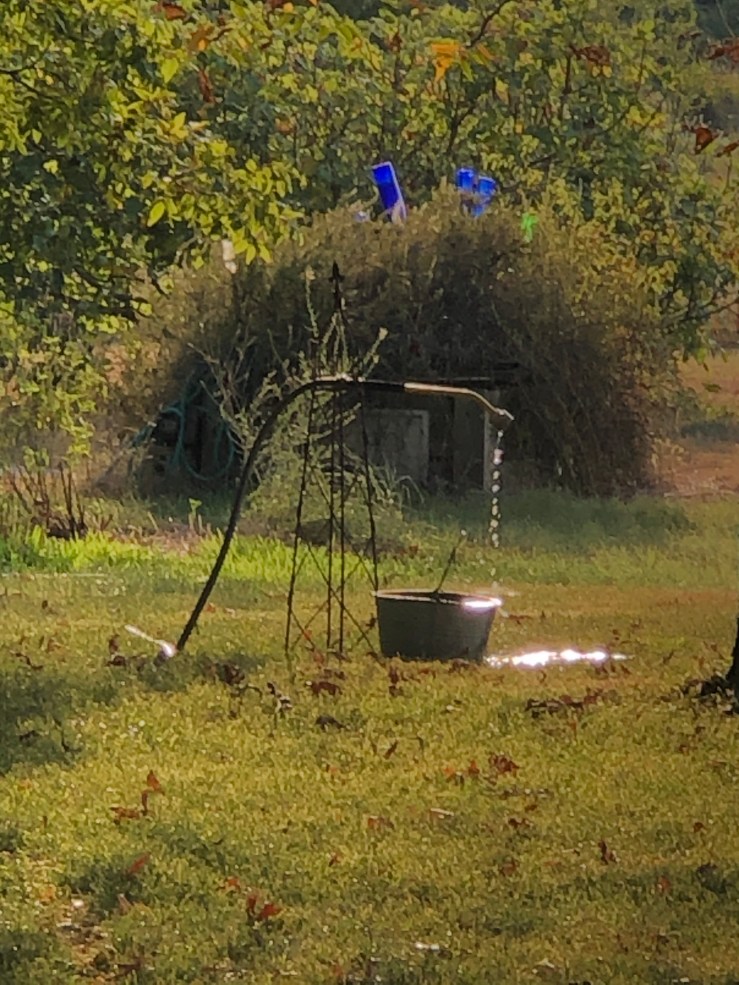
Here’s a simple water feature using a dripping hose connection. It feeds this container that’s used by my dogs and cats. There’s also a goldfish, goldfish housing (clay pot shards), and something green: a length of crow’s foot. A new visitor was This toothy skink, with beautiful turquoise tail stripes.Here’s another example of a dripping faucet connection caught into a container. Cats and dogs like this one, too.
This large, formal water feature has an electric pump, a ceramic fountain, goldfish, and terra-cotta shards. I didn’t think the wildlife cared for it until I saw the toad contemplating the water music.
This one is movable. I was very proud of my engineering and water movement. The birds were curious, but didn’t descend on it, so I’m not very bird clever. The fountain developed from a need to either water trees or the cement slab of the house. So, I added hope for bird visits. I do like the flexibility of being able to move this around.
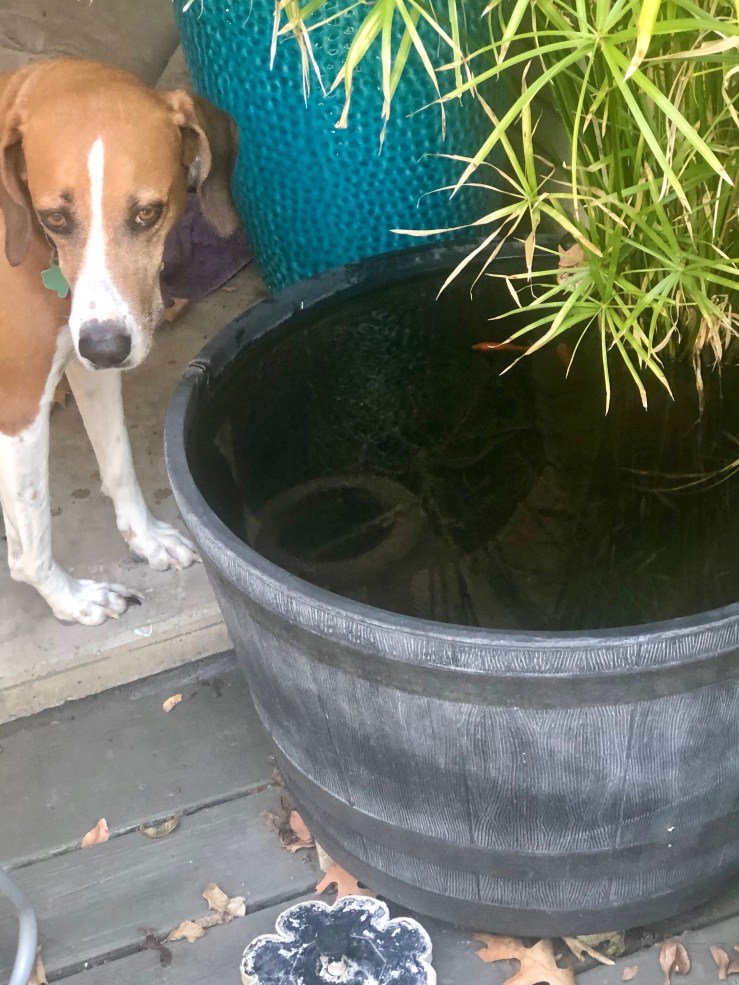
This is Ruby
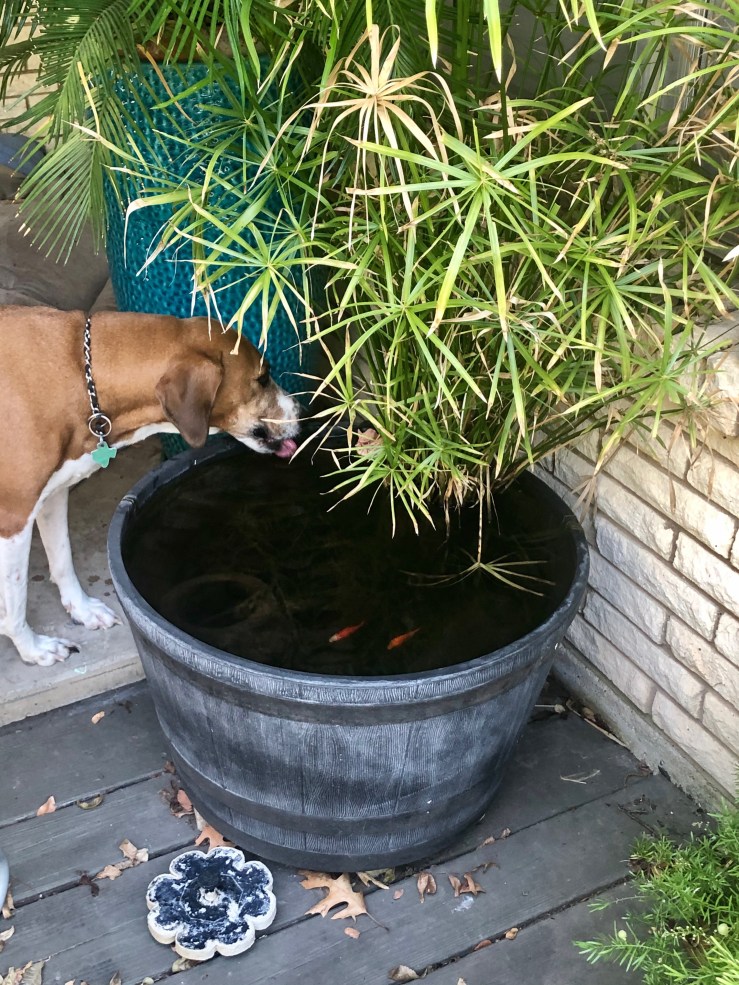
Ruby likes the water.
This one’s a simple water feature with dwarf papyrus. The roots have created an underwater jungle. The two goldfish have a strawberry pot and a terra-cotta pot with side pockets to swim in and around.
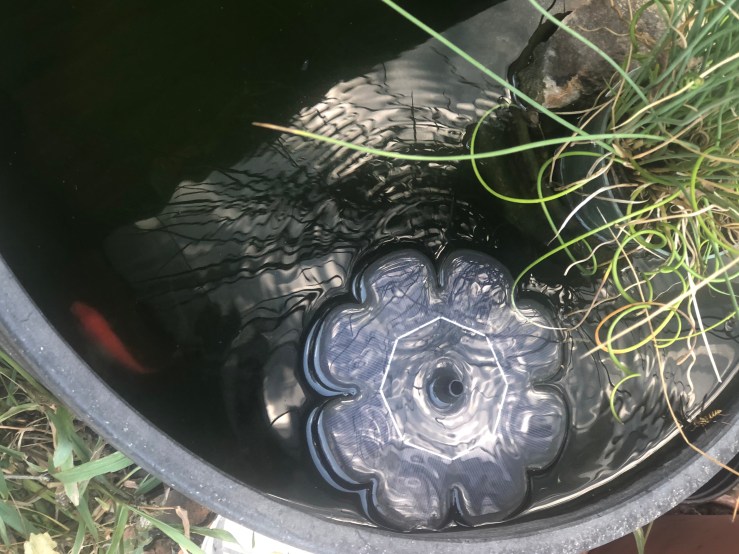
I’ve seen wasps and bees here, along with an occasional dog or cat. The water is very clean. It’s a straightforward container with a solar fountain that works, terra-cotta shards housing, a goldfish (previously two goldfish), a juncus, twisted arrow, and a fairy god duck. There are enough nutrients in this water to experiment with growing lettuce or other edible in a Styrofoam float.
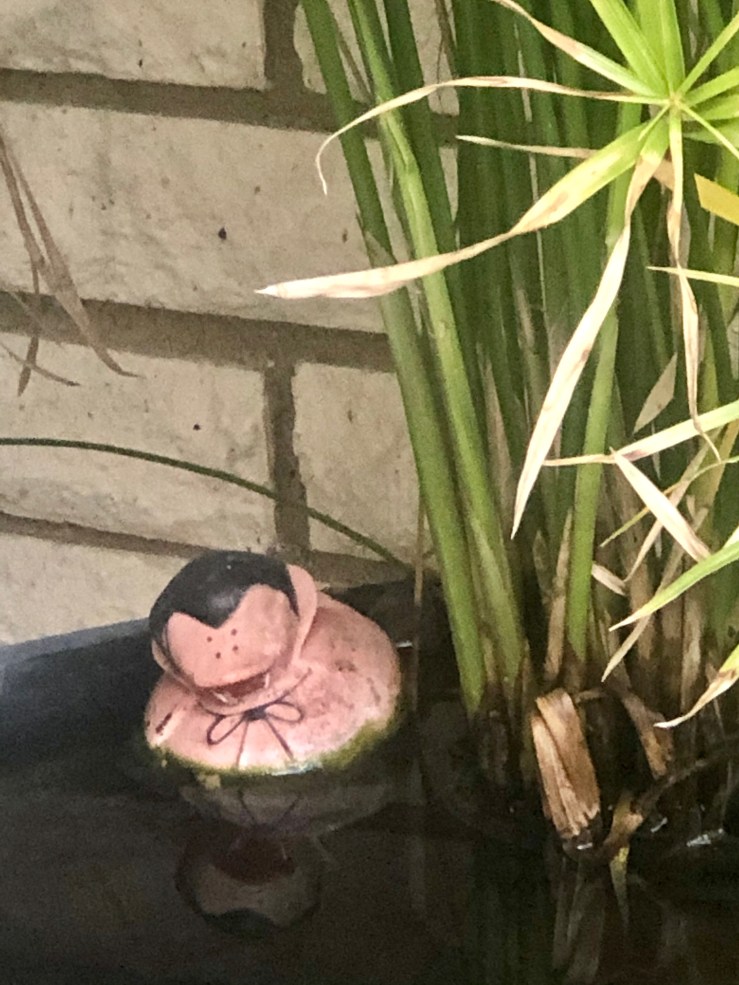
A few of my water features have rubber duckies. Here are Count Duckula and Ghost duck. Some color fading has occurred.







 Nature Along the El Camino Real