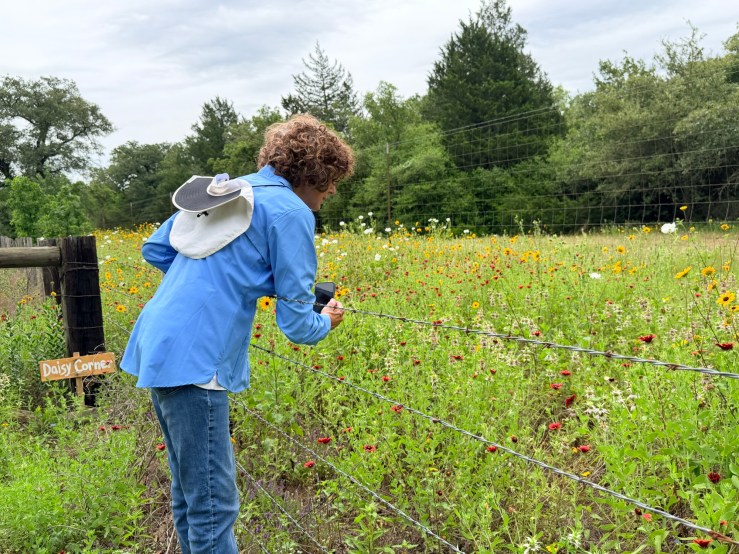
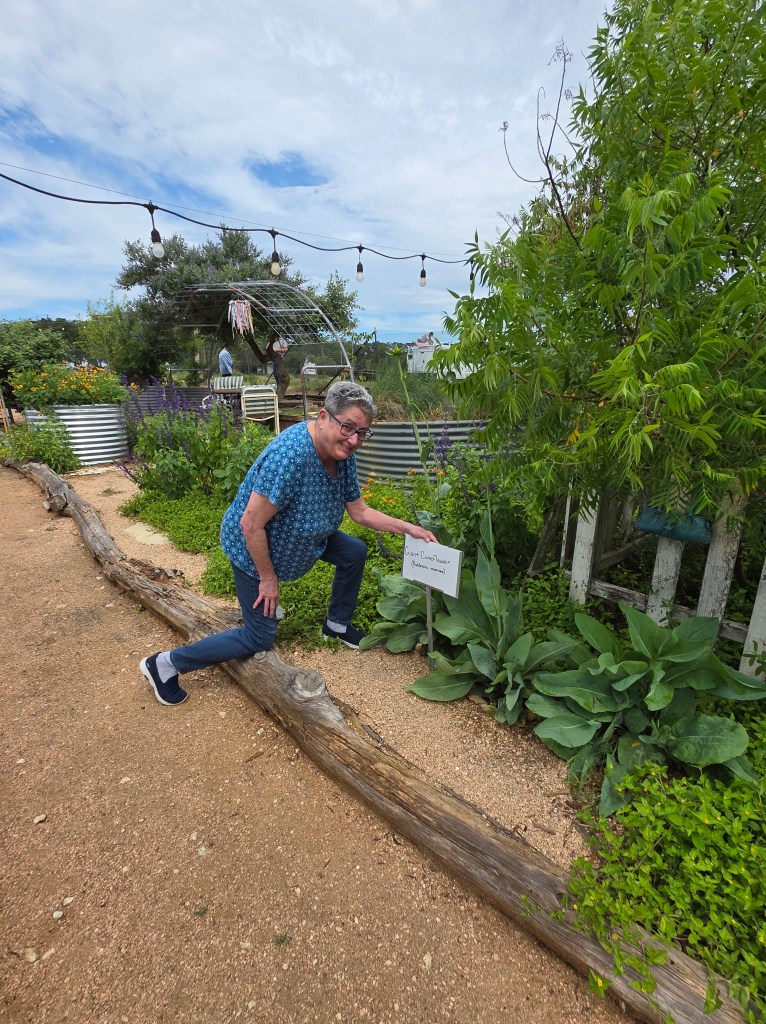
A few weeks ago I showed up at the Milam Wildscape and worked up a sweat pulling weeds and cleaning up the garden beds along with other TMNs. While there, I talked with Ann Collins about the Wild Wings Bird Sanctuary nearby. I had only been there once before and loved the peaceful feel of the area with the fresh running water bird bath and sturdy benches to sit at and admire the many visiting birds. I asked Ann if she needed help with it. Turned out it was both our lucky days. She asked if I could take it on to visit and work on the site regularly and I said yes! Quite a few folks have worked hard to create and then keep the space up since its origin in 2024. I read the past blog posts and heard several events have been hosted there. Gene Rek especially has created so much there and keeps the feeders full and water running. I hoped to take on more responsibility to help manage the space.
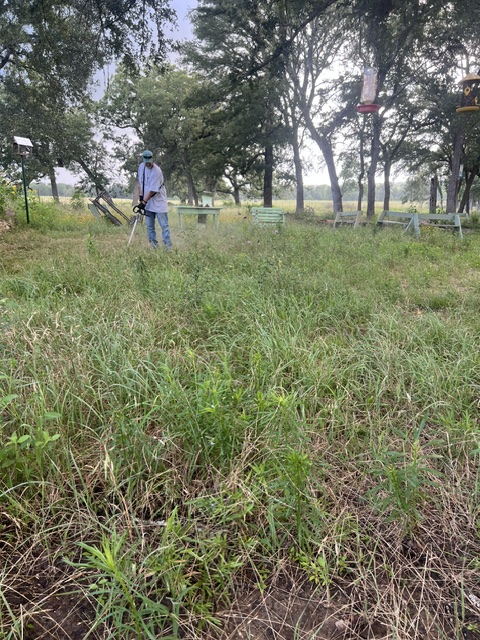
Last Thursday morning my husband, Vern and I loaded the van with tools and headed over. He worked the weed whacker, trying to tame a path from the road into the area so that you can easily park and walk to the seating.
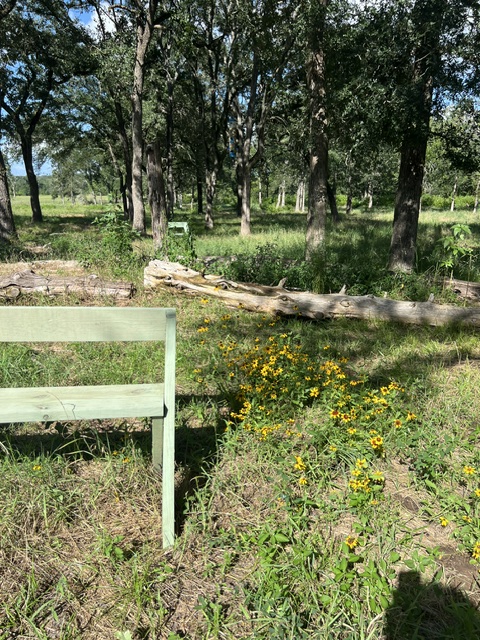
I took my tool to the garden beds to remove some grasses and weeds. The Black Eyed Susans were plentiful and we left them intact.
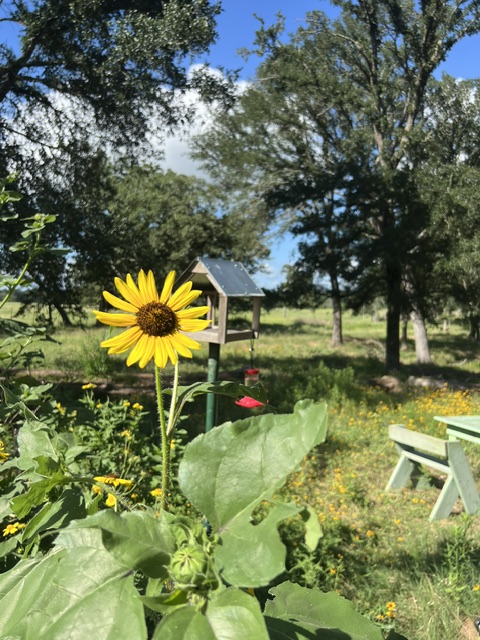
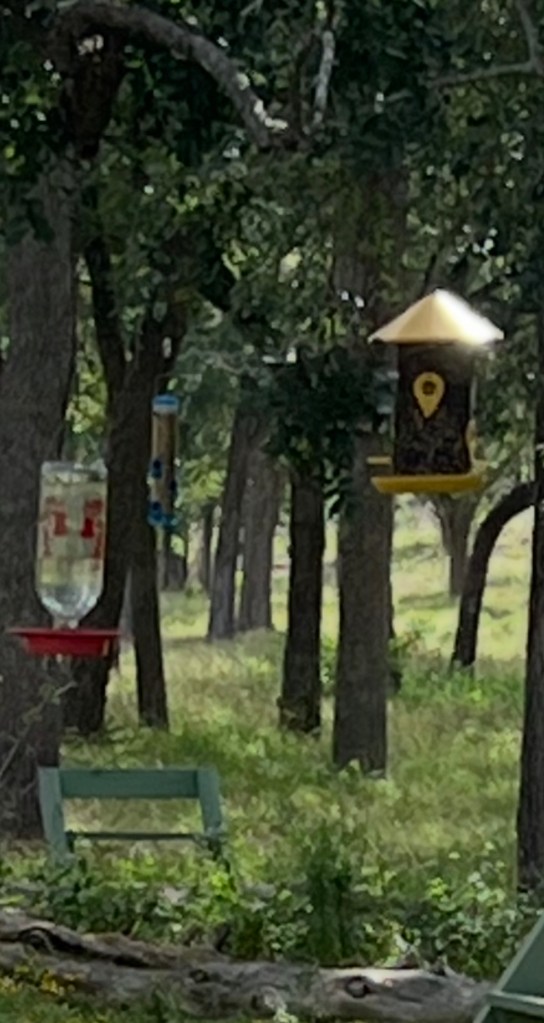
I also saw Lantana and beautiful bunches of sunflowers getting ready to blossom. I filled the seed bird feeders and hung the hummingbird feeders with fresh sugar water.
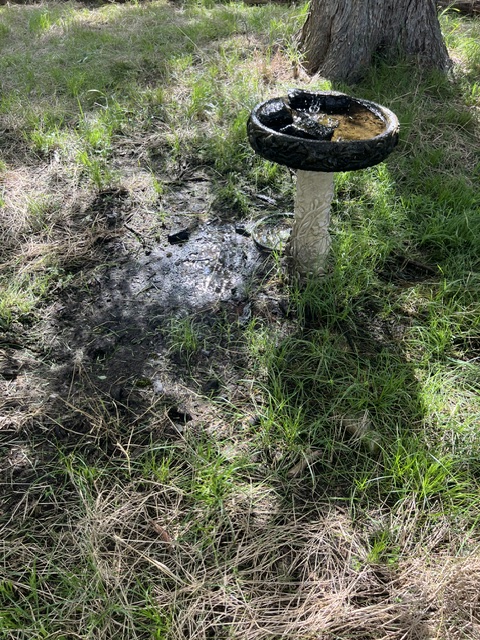
Besides general maintenance, I hope to add a few improvements. That’s where all you come in. Anyone have any bird feeders to donate? Want to create some bird houses to hang? How about a few Five gallon buckets of small and medium rock to put on the ground around the water bath to help contain the mud area.
And of course I will appreciate help with decisions and work on adding a bunch of seeds to the beds now so that we get a great turn out of flowering plants next spring. I am working with Linda Burgess to collect seed packets to use.
If you have donations or want to help, reach out to me at tmbrickey@aol.com.
Today was a happy day for this blog. We have a new member of the blogging crew. Let’s welcome Terri Brickey to the team! She’s an experienced blogger who just needed a refresher course in how WordPress has changed since she last worked on her own blog. Now when I’m unavailable, we have a helper! And she’s going to contribute more blogs of her own nature observations. We had a fun afternoon looking at the nature where I live and planning future activities.
Terri is also a fan of iNaturalist observations
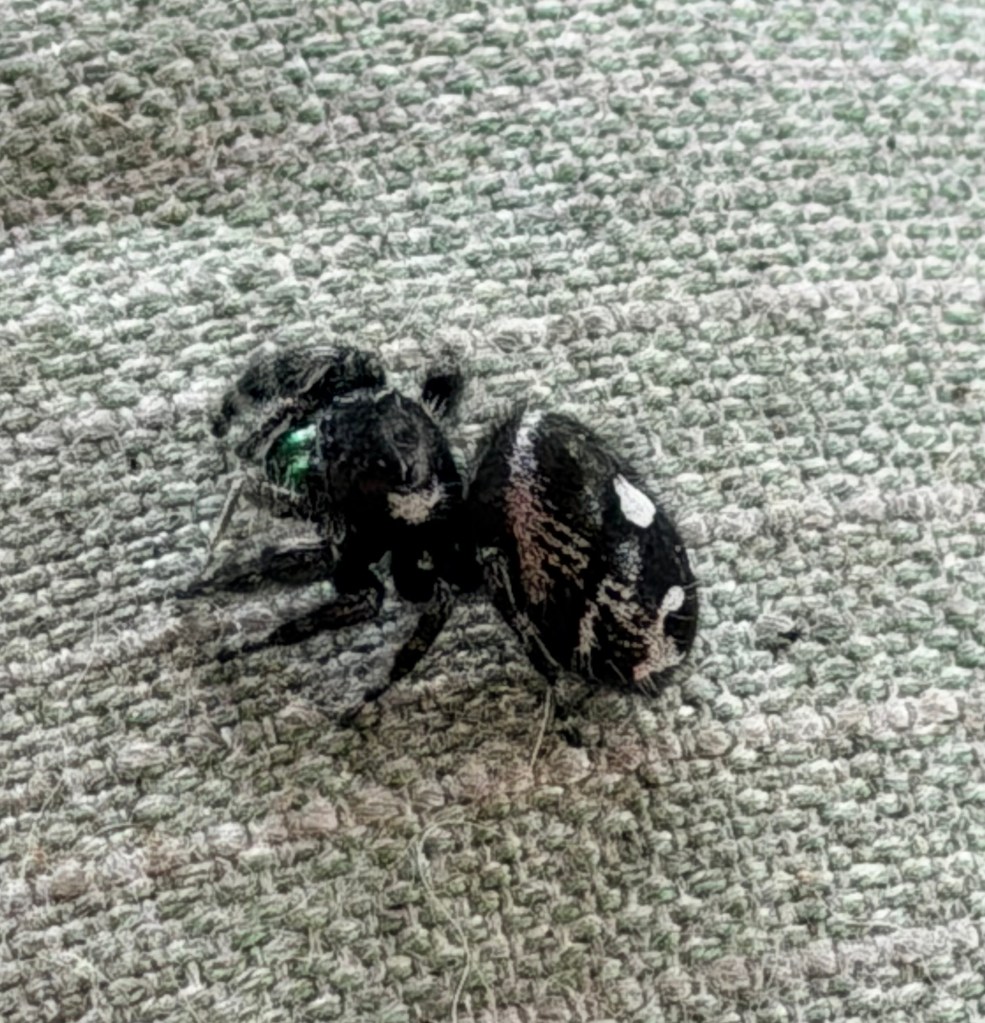
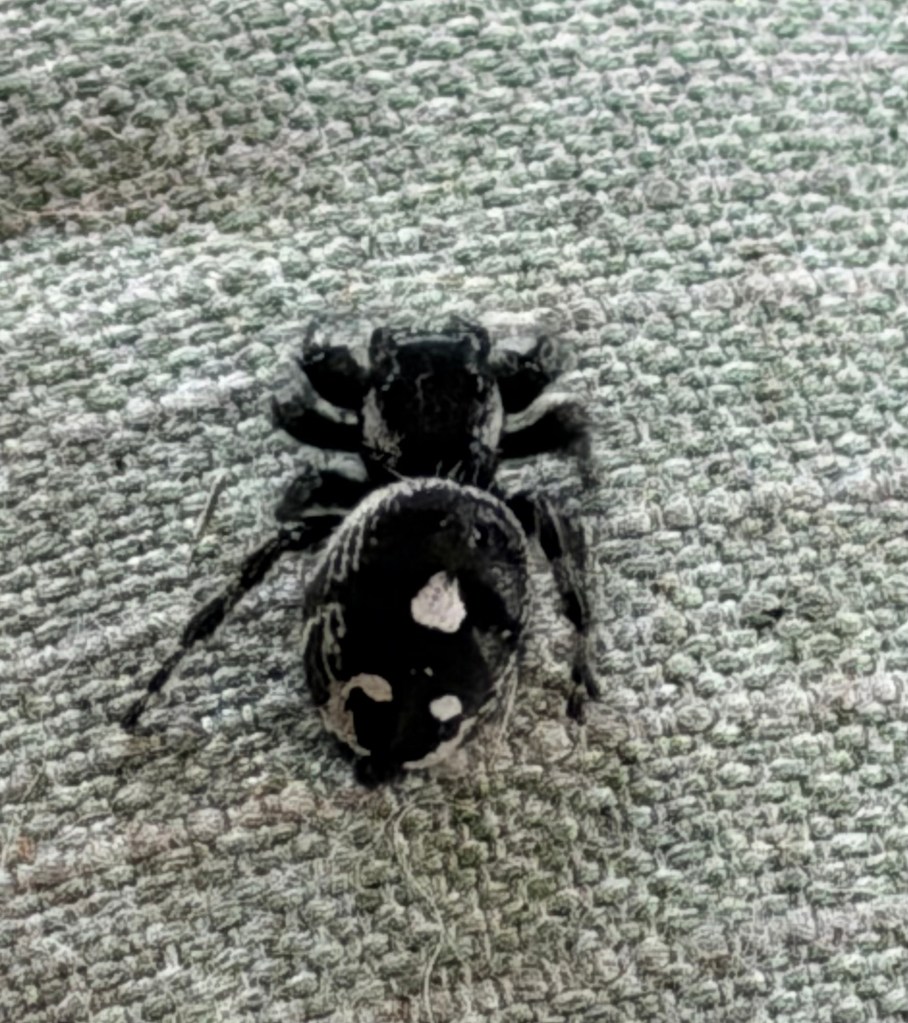
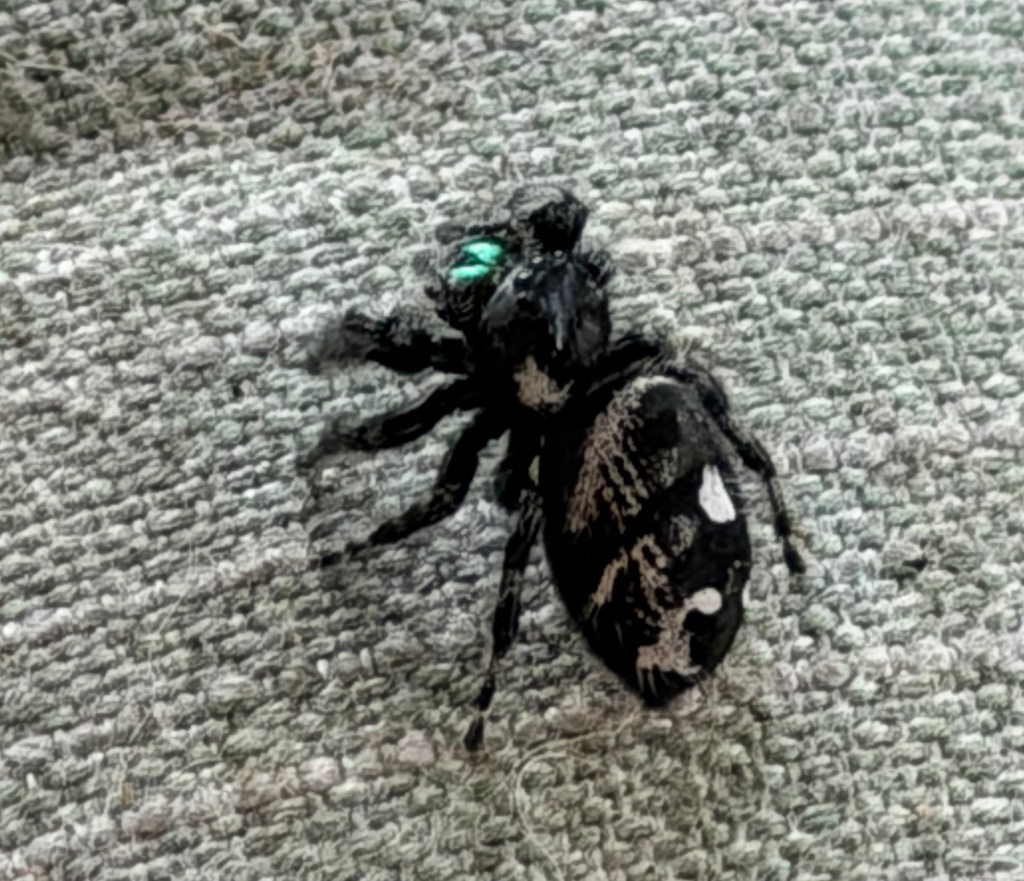
In nature news, I saw a spider today. It was one of the largest bold jumping spiders (Phidippus audax) I ever saw! Look at those charming green eyes!
a cutie pie
These spiders are often kept as pets, but I enjoy them in the wild. They have nested in our mailbox many times. They’re solitary and carnivorous. Their ability to move quickly and see extremely well makes them quite successful native species. They have iridescent chelicerae, which is one reason I enjoy them so much.
Earlier this week, I worked on adding up how many bird species I observed at our Milam County property, the Hermits’ Rest last month. I keep notebooks that record the species I see and/or hear with help from Merlin Bird ID every day I’m at home. I was happy to have seen 126 different species as the migration season drew to a close. I was wondering if there was a seasonal pattern, because I intuited that the spring and autumn migration seasons would bring in more species.
Speaking of birds, I’m not sure if this sparrow nest addendum was on purpose.
I don’t remember exactly what I did, but somehow Excel asked me if I wanted an analysis of the data. Well, yes, I did, because data analysis using spreadsheets is not one of my skill sets. I had all kinds of questions that I’d like answered, like what were the most common species, which species have been here every month, etc.
Like, am I a bird?
Suddenly, BOOM. a new tab opened on the spreadsheet. It had all the answers. Something had analyzed my spreadsheet. Oh no, I found a use for AI! Damn! I couldn’t not look at the results. I really wanted to know.
Right on top, there was a summary of my ranch bird data:
The sheet is a month-by-species presence matrix: an X means a bird was recorded in that month. Coverage spans Dec-23 through May-26, with 2,804 total monthly presence marks. May-25 is the richest month (129 species); Jul-24 is the quietest (60 species). 18 species appear in every month, suggesting reliable year-round residents. 30 species appear in only one month, highlighting possible migrants, one-off observations, or rare sightings.
That’s all the stuff I wanted to know! To top it all off, there were tables and charts! Look at this.
I was wrong about the seasons. Winter, with all those sparrows, has the second most sightings, after what I expected…that spring gets the most.
This one is probably my favorite. I wonder, though, how we got so many species last June, when the previous June, July, and August were so low (and this June is starting off pretty slow). What I really think is that I need another couple of years of data to see these patterns better. Here’s another graph:
These are the 18 birds we see every month, with two that occur almost every month. I am not at all surprised at the species I see here. I wasn’t sure that Eastern Bluebirds were here every month. I don’t see them every day, but I guess they are here. Okay, one final fascinating thing.
These are supposedly the birds we’ve only seen once. That’s pretty interesting, but look! There are weird spellings on the birds, which I assure you are spelled correctly on the original spreadsheet. I probably shouldn’t have asked for a red border. I wonder what a Swalver is? And I think those last two are both Virginia Rails. But it appears only once on my list. I went too far and AI mauled my data.
What are my conclusions? In summary, AI is helpful upon occasion, but AI also is inclined to do weird stuff to the data. You have to keep your eyes open. Here’s the actual data of birds that were only seen or heard by Merlin Bird ID once. (This does not include a couple of obvious errors where the location got messed up or some other Merlin glitch happened; you’ve got to keep an eye on Merlin, too.)
American Golden-plover
American Tree Sparrow
Barn Owl
Bay-breasted Warbler
Black Capped Chickadee
Black Tern
Black-and-white Warbler
Black-necked Stilt
Boat-tailed Grackle
Canada Warbler
Caspian Tern
Chestnut-collared Longspur
Chuck-Will’s Widow
Common Raven
Crested Lark
Greater White-fronted Goose
Hooded Warbler
Indian Peafowl
Lark Bunting
Olive-sided Flycatcher
Pyrrhuloxia
Rough-winged Swallow
Semi-palmated Plover
Semi-palmated Sandpiper
Spotless Starling
Thick-billed Longspur
Tricolored Heron
Virginia Rail
Western Wood Pewee
Yellow-green Vireo
Dang, I’m ambivalent. But now I have some helpful insights about my bird data. I am pleased about that and look forward to continuing with monthly analysis and getting more information.
I was not quite so pleased when I sleepily ventured onto the screened porch to guzzle some coffee before my 8 am standup (once again it went 30 minutes over). I went to set my coffee down and spotted a snakeskin on the arm of my chair. You know I’ve lived here a while, because all I did was ask Lee if he put it there. Nope. I set the skin on my big turtle shell where it looks quite decorative.
It wasn’t a big one.
I guess the rat snake left the way it came in when it realized there were no birds or rodents to snack on. Ah, it’s always something!
If you happen to be in Dickens, TX, and head west on US 82 toward Crosbyton, you will soon find yourself crossing the White River, where there is a highway rest area. This is no ordinary rest stop, because it’s connected with historic Silver Falls Park. A series of steps lead down to the White River from the parking area. About two-thirds of the way down there is a font off to the right with a dribbling pipe sticking out from the back wall. The font has settled a bit, and a trickle of water flows across the bottom and down into a crack at the back.
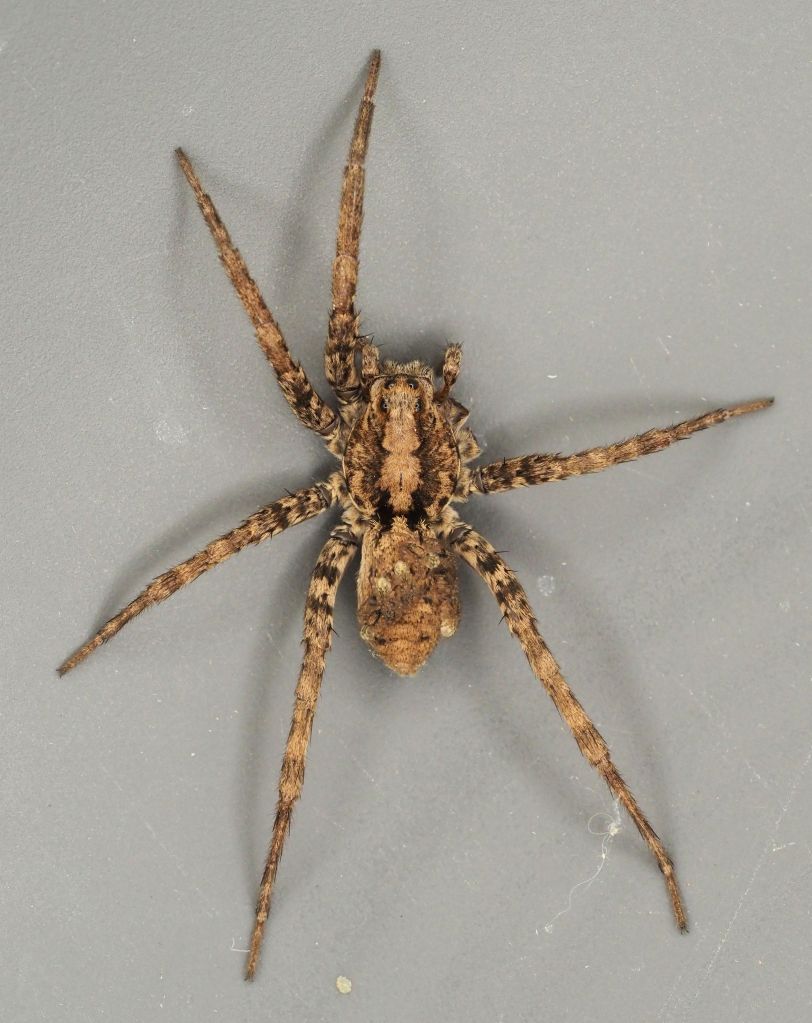
I revisit the park periodically because someone else saw some large, unidentified wolf spiders there years ago. On May 28, I made another stop. I couldn’t use my headlamp until 9 PM because of the late sunset and then spent a futile hour looking for something interesting on both sides of the river. About a half dozen fireflies in one dark corner was the best I could find. Coming back up the steps while planning to leave, I looked to the left and saw a large wolf spider on the near rim of the font. I went closer and could see it was just what I wanted, and that it was a female with a lumpy abdomen. I tried to catch her, and she went down the inside wall to the back of the bottom. I stepped into the font and tried again. She went into the crack, and all I got for my trouble was some drips of water on my back and shoulders. It was obviously hopeless, so I went up the rest of the steps and to my car. Then I had to go back just in case. There she was on the far side of the font. I knew she’d be heading for the crack at the bottom again and was able to head her off into another crack between the side and the back. It took a while but eventually I was able to gently pry her out with a small stalk of something. Then I got her into a container and took her to be photographed.
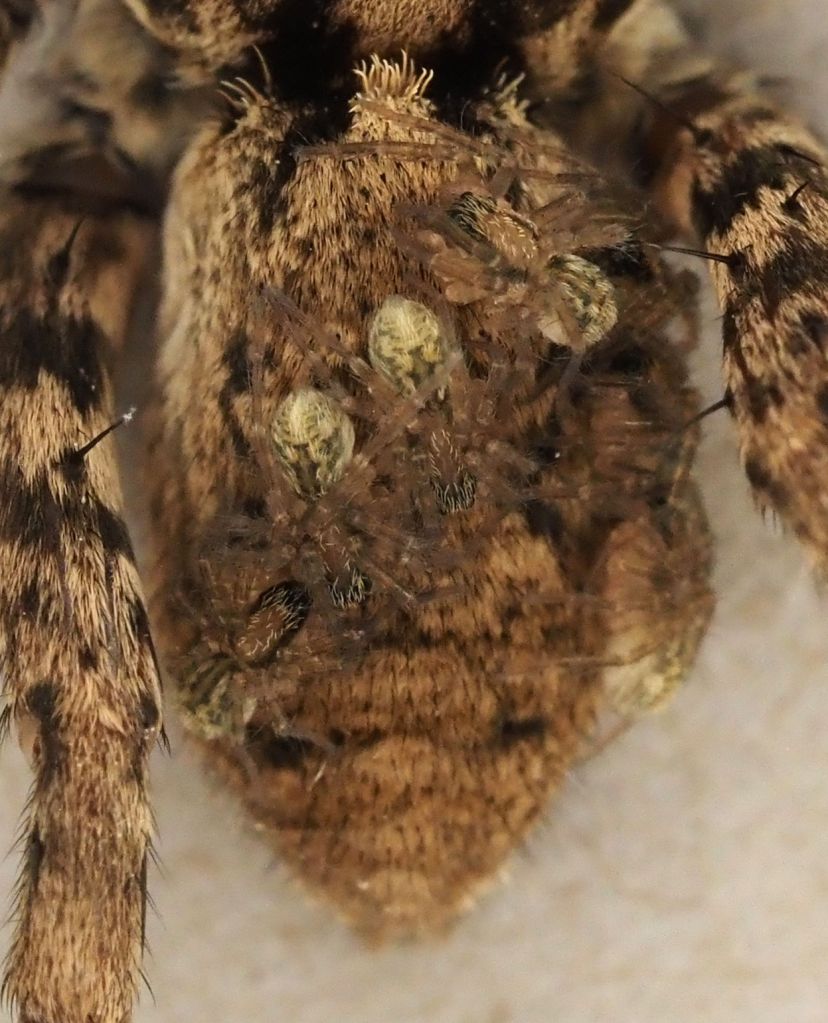
She had lost two of her right legs and only had a few spiderlings left, possibly the results of a single earlier incident. Whatever it was, it all had happened before I started chasing her. She turned out to be a Gladicosa gulosa, the first I ever encountered in person.
Mother spider
Wolf spider behavior is pretty easy to understand. When thinking with their stomachs, they jump on anything that moves. Faster than can be seen, they decide if it’s food than can be subdued or something else that isn’t. If the latter, they immediately disengage and prepare to run long before even considering taking a bite. Subduction begins by pinning its prey against its sternum with as may legs as necessary. A spider may end up on its back so it can use all 8. Somehow they can flip themselves back upright while holding prey. Only then does it grasp the prey with chelicerae and inject venom. When not thinking with their stomachs, various evasive maneuvers are used. This time, the female was doing all she could to run off with her remaining spiderlings. After photos I released her on the far rim of the font. She immediately ran into the font and partway down the side as if she knew exactly where she was.
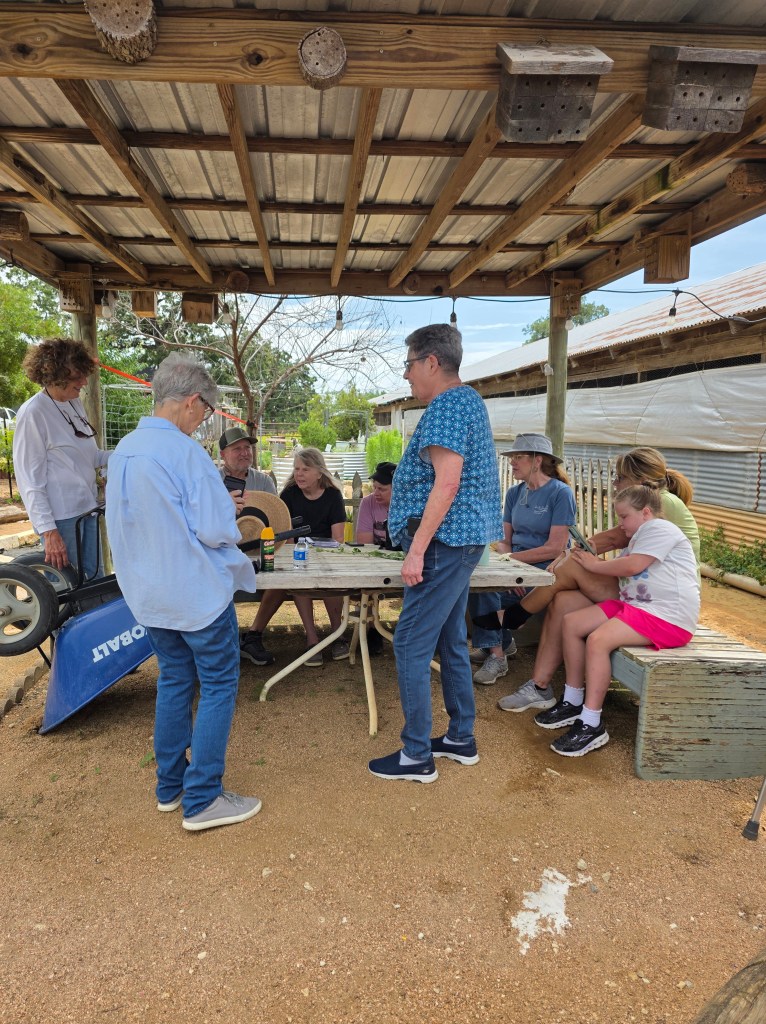
Members pruned, weeded, and watered in the Wildscape. They also took pictures of pollinators and worked on signs.
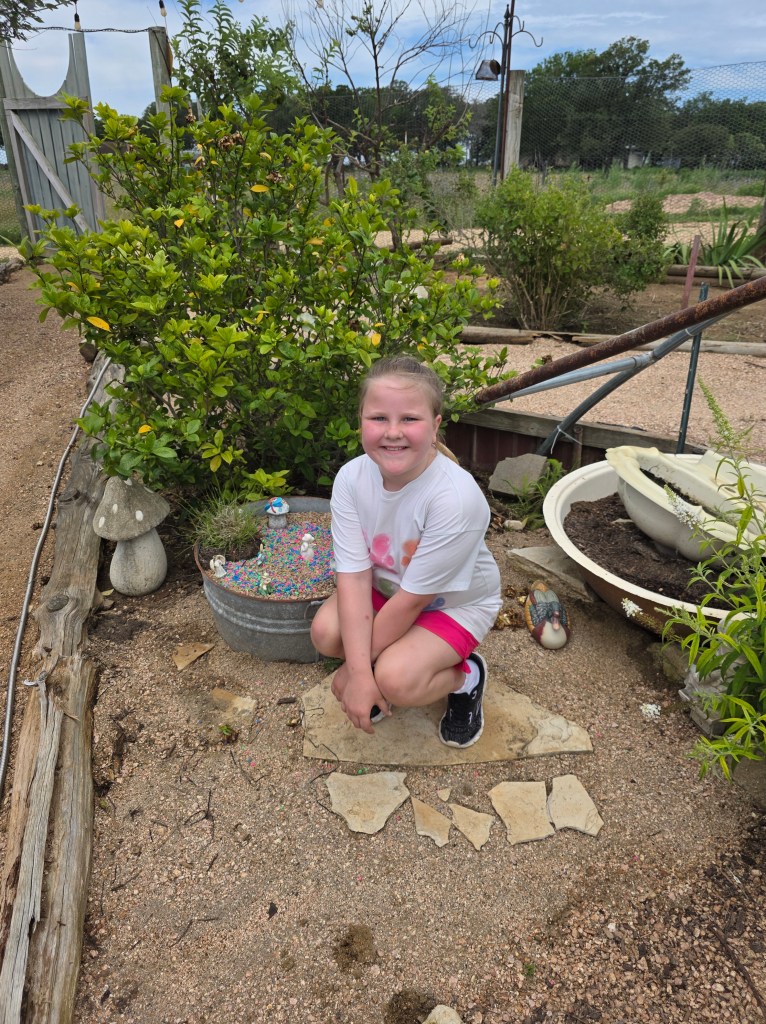
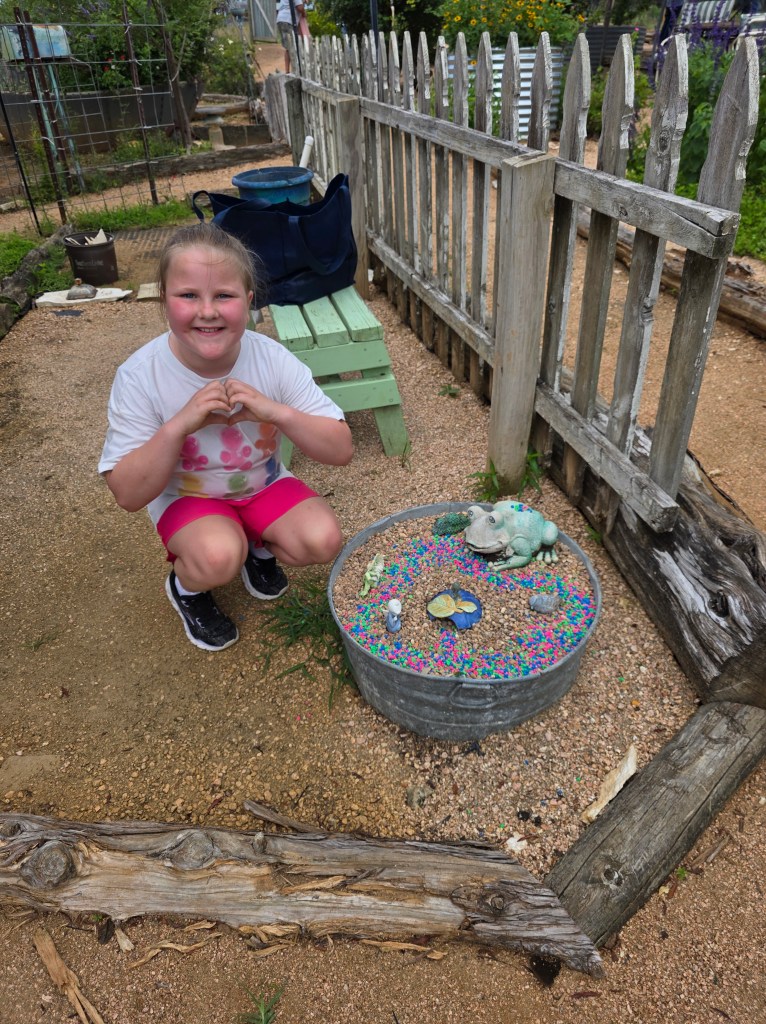
The highlight was seeing three Fairy Gardens designed and installed by Friend of the Wildscape, Jordan: Town Square, Frogs & Fairies, and Mushroom Valley.