Bald Cypress and Montezuma Cypress

by Alan E. Rudd

The oldest individual bald cypress tree (Taxodium distichum) in North America is likely to be one in North Carolina that has been aged by drilling a core to the center of its trunk to expose the number of annual rings. This specimen growing along the Black River is over 2600 years old and apparently still
looking mighty healthy.

The conifer family Cupressaceae, showed up in the fossil record over 200 million years ago. Bald cypress are modern North American members of this family that has over 130 species occurring across the northern hemisphere They traveled along as blocks of continental plates broke up and moved apart. Cypress trees in the Mediterranean look a good bit different than the bald cypress growing in our southern swamps and along riverside habitats in North America, but they are all related to those that lived on the super-continent Pangea.

Bald cypress

In North America tree scientists agree that we have two distinct species, bald cypress and Montezuma cypress (Taxodium mucronatum). As with all taxonomists there is skepticism and disagreement. This involves yet another variety dubbed “pond cypress.” We will leave the bickering about pond cypress to the paid professionals.
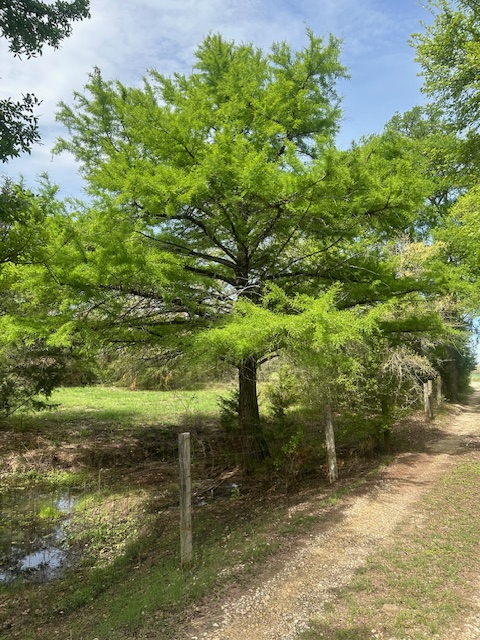
Montezuma Cypress

I have both Montezuma and bald cypress around my pond and have watched them develop differently for years. I observed my bald cypress in Burleson County to be flowering in late January. These trees have male catkins that are about 2 inches long which emerge from the end of last years twigs. Just below those pollen-emitting catkins are small female flower parts that resemble tiny pine cones. The amazing thing to me is that these delicate flowers bloom when it is almost a dead certainty that several hard freezes will arrive before spring. Across North America and as far north as Delaware bald cypress are shown to flower in January. Here in Texas the flowers are exposed for as much as 7 weeks before any new leaves begin to erupt in March.
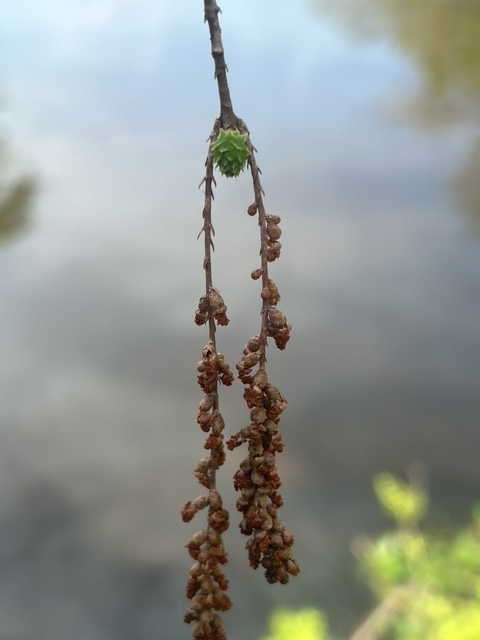
Flower

Contrast that with a Montezuma cypress located on the same pond 70 feet away. It sprouted leaves in early February and is in full-green glory on the same day that my bald cypress trees are still leafless. Montezuma cypress is the National Tree of the Republic of Mexico. In central Mexico and further south these trees never lose their leaves. The one in my yard holds it leaves much later in fall than the bald cypress, but eventually does drop them after hard freezes around Christmas each year. Burleson County, Texas isn’t Mexico City, but these trees have the ability to be either evergreen or deciduous.
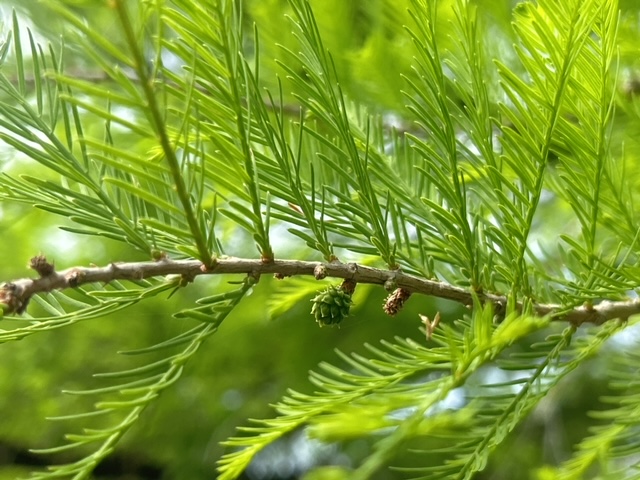
Montezuma cypress flower

It has always fascinated me that bald cypress are present in abundance along swampy acidic streams
in East Texas and yet also along calcareous, alkaline streams in the Texas Hill Country. It is an adaptable plant that can thrive in both pH 4.5 or pH 9.5. I wonder if at one time in the past they extended completely across the south, through Texas and down into Mexico as a solid band? Maybe while we let the tree taxonomists argue we can imagine a scene in deep time when things looked very different on the continent now known as North America. This ancient lineage of trees has survived a roller coaster of changes and thrived during “ice-box earth” and in times when tropical warmth dominated the across the Arctic Circle.

Bald Cypress

These cypress trees are tough organisms.

Hogna Fantasy

by Ann Collins

Long ago and not so far away lived a group who called themselves the “Hogna.” Sounds like a Native American tribe, doesn’t it? But, no, we who are better informed know them as a strain of arachnids, joint-legged arthropods. That’s “wolf spiders” for those of you who need a head’s up.

Anyway, it seems the leaders of the group were interested in genealogy and had heard rumors of some cousins that had disappeared from the family tree. These were the antelucana part of the tribe, and they wanted to reconnect with the cousins. They didn’t even know what to call them; they just knew they were Hognas.

Hogna antelucana (photo by E. A. Neubauer)

Fortunately, one day a young man by the name of Eric was discovered in their home territory. Now, Eric was a bit of a mystery to the Hogna, and the Hogna were an equal mystery to Eric. The Hogna were terrified of Eric in the beginning, because he was always running them down and swooping them up in a Tupperware container. Hogna aren’t jumping spiders, and the sides of the plastic containers were too slick to climb out of, so they were trapped. Nobody likes that feeling, do they? It wasn’t too long before they realized that sooner or later Eric would dump them out of the Tupperware, and they could once again go about the business of their daily lives.

Somehow or other those who were abducted by the Tupperware King were able to communicate their interest in their genealogy search. Eric couldn’t promise much since he wasn’t proficient in that kind of search. After all, he was a cross between an engineer and an ice skater! But he said he would look into it for them. Out came the Tupperware and even more of the Hognas got to experience the thrill of the hunt.

One fantastic day, Eric noticed some differences to the antelucana in a wolf spider he had caught. Maybe he was better at this genealogy thing than he had initially thought. He kept finding more of these Hognas with strange markings.

When he needed to see both sides of a spider (wolf spiders being on the larger side) it became a bit of a challenge to Eric as well as to the Hogna. Eric got the engineering part of his brain working on the problem and designed and built a contraption that would allow photographs to be taken without the discomfort of having the Hogna lie motionless on their backs while he took pictures and studied the differences between the cousins. (Some of us think he should apply for a patend for this device! What do you think?)

Well, time moved on, as it has a way of doing, and Eric became convinced that he had truly found the lost Hogna cousins. (He put a talk, with pictures, together and presented it to friends and folks who became staunch supporters of his research. He even presented his research at the Texas Master Naturalist State Conference.) He was becoming something of a celebrity in the world of spiders.

Russell Pfau, who is a professor at a college up in Stephenville, began paying attention to Eric’s research. Russell was able to confirm that our very own Eric had indeed discovered a new species never before documented (again, we are so proud!). Eric even found out what the branch of Hogna wanted to be called. Hogna incognita is the name/title they will be known as from now on. Somewhere in this discovery Eric Neubauer will be forever linked.

We are all so very proud of Eric for his dedication, persistence, and patience in his quest to prove his research was valid.

Way to go, my friend!

Happy Wildscape Surprises

by Catherine Johnson

There were surprises at the Wildscape discovered on a quick trip to assemble a donated shade arbor.  The Mexican Plum trees that looked dead for a long time are back, as are thought-dead Blackfoot Daisy and Desert Mallow. 

Pink primroses are back, too. They bloom the second year from seed.  The grasses Debra cut are already two- to three-feet high. Rough-leaf Dogwood and Arroya Sweetwood are fine, but the tallest Anacacho Orchid suffered major damage. 

Gaillardia and Thistles are taking over as all manner of “Belly Botany” wildflowers. Come see the Wildscape before some of it has to go so that we can safely walk the paths!

Symbiosis in Motion

by Alan E. Rudd

We have had the typical bumper crop of red berries in the yaupon (Ilex vomitoria) thickets of Burleson County again this year. Last year during the February 2023 cold spell these berries that contain hard seeds were consumed by legions of robins (Turdus migratorius).  A mockingbird (Mimus polyglottos) that owns our front-yard and half the farm, fought thousands of these rest-breasted raiders trying to protect his winter food supply. He lost the battle, but survived to eat grasshoppers as the spring season warmed toward the heat of summer.

Today is the “Ides of March” 2024 and so far very few robins have ganged-up in the oak thickets of Edwards Ranch. I saw them in the woods along Sandy Creek in February, but they never touched the yaupon berries near the house.  A sizable flock of cedar waxwings (Bombycilla cedrorum), however, have been staying about and gorging themselves on yaupon fruit for the last three days. These calm, gregarious birds allowed me stand at a distance of six feet and watch them pluck red berries from a 12-foot tall female yaupon. It required me to be completely still and lean into a tree trunk, while doing my best to impersonate shaggy bark. I watched predator eat prey. After eating berries for less than a minute the birds flew up into the height of a nearby bald cypress (Taxodium distichum), only to repeatedly return to the yaupon to continue the feast. The winged berry-predators were dropping seeds processed through their digestive tract to the fertile ground below. 

Those waxwings were smiling. The yaupons, too, were smiling.   As in every true symbiotic relationship, who is the master and who is the servant?