Wolf Spiders of Winter

by Eric Neubauer

Finding wolf spiders during winter is a challenge since favorable temperatures are uncommon and often short lived. It’s a good time of year for me to concentrate on local species that need better photo
coverage. One such species is Gladicosa pulchra, the contrary wolf spider that dwells in the treetops. They seem to be absent from the Blackland Prairie, and I’m only aware of them being at one location in each of Burleson and Milam Counties.
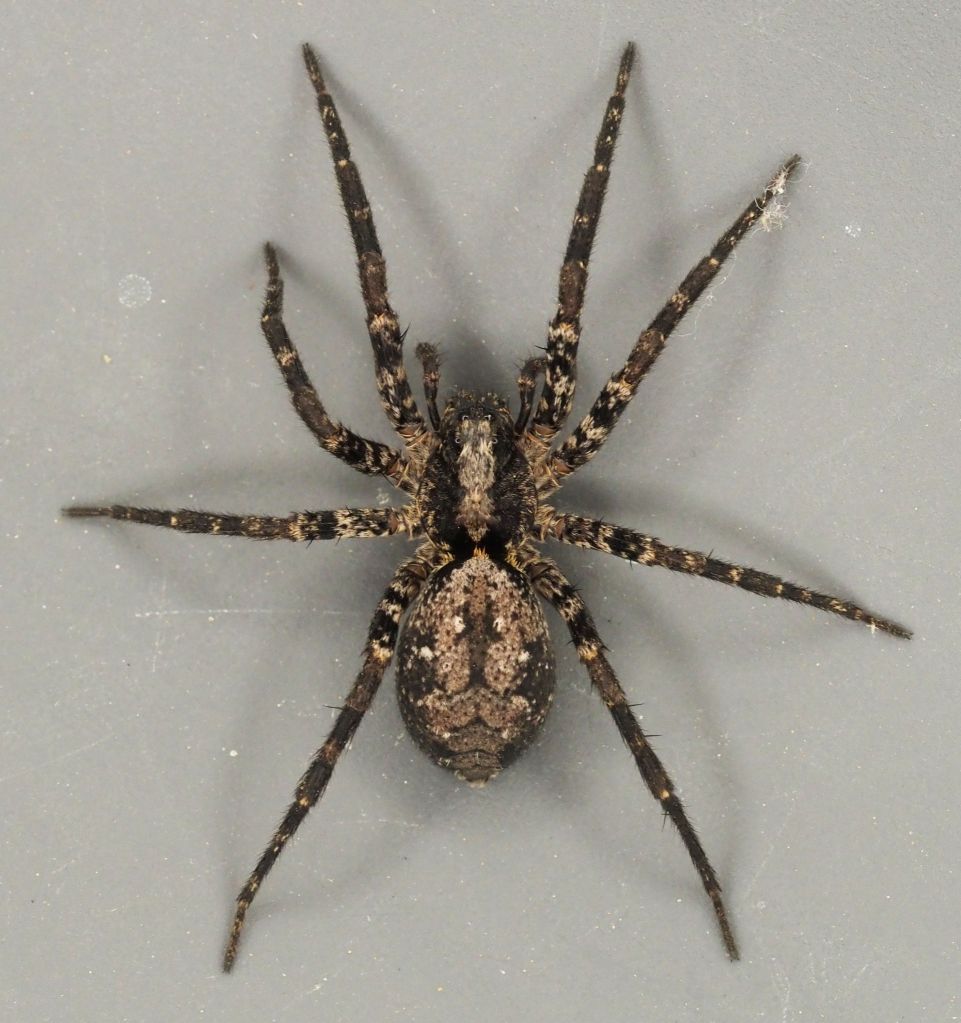
Female – dark

On December 25, I visited the Cedar Hill Nature Preserve, and on January 7 I visited Edwards Ranch. Spotlighting was the easiest way to find them. I quickly discovered they are more plentiful than I expected, and that December-January is the height of their mating season. I also found that while they live in the canopies of post oaks most of the time, they all follow the leaves down to the ground where they became a lot easier to catch for my photos of several adult females, some already gravid, and two adult males.
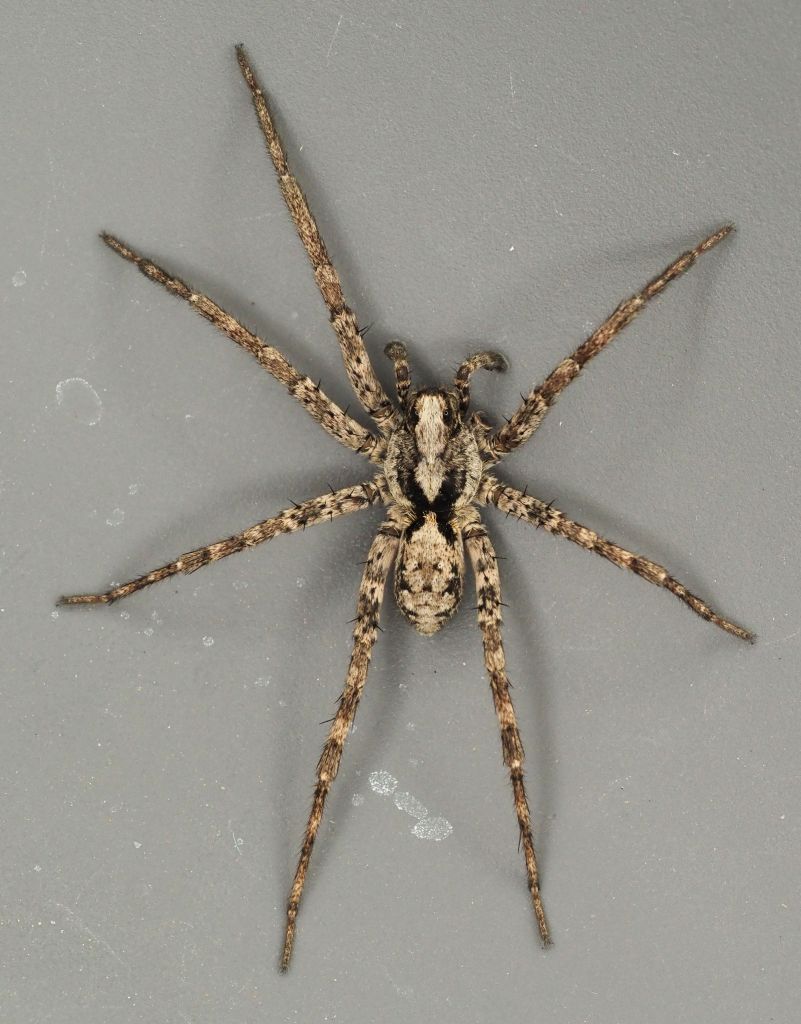
Male – light

Gladicosa pulchra was first described in 1877, spent time in several different genera, and was ultimately put into a new Gladicosa genus by Brady in 1987. Regarding the color, he wrote,

“The range of color in G. pulchra is greater than that of G. gulosa. I have noted light forms and dark forms of pulchra. These do not represent a genetic polymorphism but are the extremes in a color continuum. There is no discernible correlation between geographic locality and color pattern among the specimens examined. The darker forms are much more numerous than the light colored ones.”

With my recent observations, I believe I have a natural explanation for the two forms, and it’s most certainly genetic polymorphism though of the sexual dimorphism variety. A little field work certainly paid off. True to the last sentence, I saw more dark females than pale males which is typical of most species since males don’t live as long as females as adults. Females may even delay egg production while waiting for better conditions.


Addendum: Coincidentally, as I was getting this blog ready to upload, I looked over and there was a Hogna antelucana watching me. I took this friend outside to a warm spot — Sue Ann Kendall
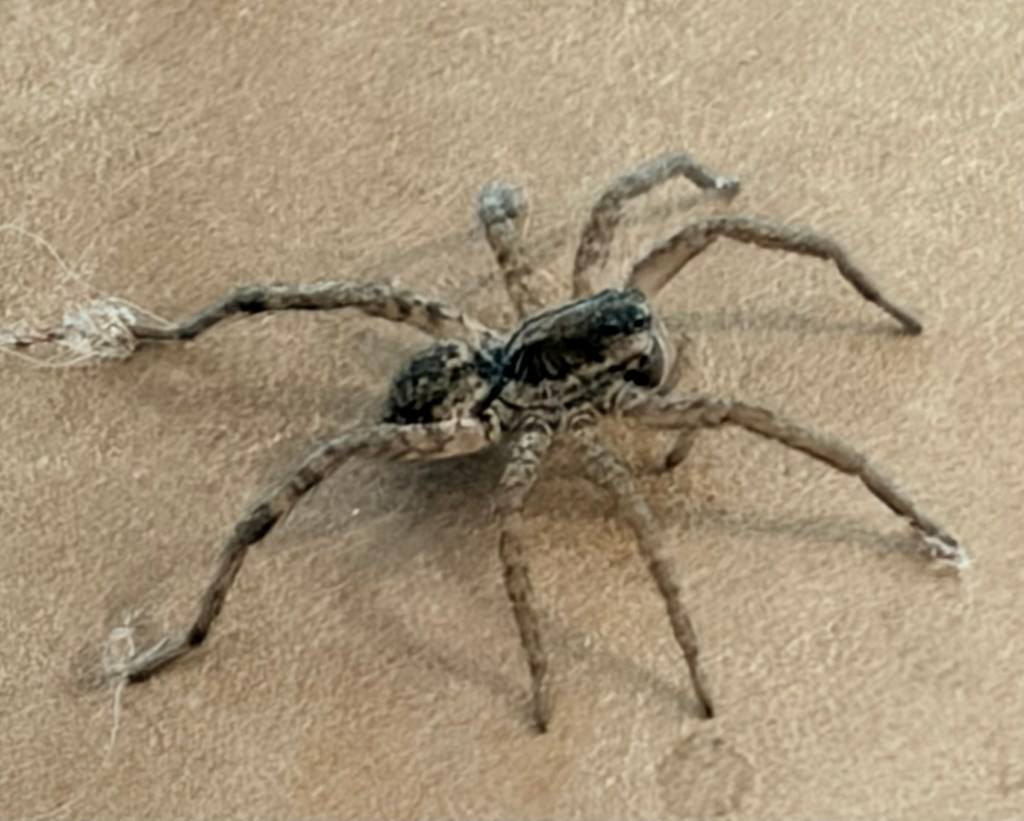
My phone doesn’t take as clear photos as Eric’s camera and lighting.

Little Brown Spiders

by Eric Neubauer

The wolf spider world never shuts down in Texas if you know where to look. About a dozen species from a number of genera mature over winter when they can hide among fallen leaves. They can be quite active at night during rare warm spells. They all look generally similar and are often hard to tell apart unless you know exactly what details to look for.

Here we have the obscure S. perplexa, which I’ve written about before. Turn it over and the white on black abdomen pattern makes identification easy. This is a juvenile male just one molt away from adulthood.

The other is Varacosa avara. I had found some a couple of weeks earlier and speculated they were this species mostly because of the strongly pinched carapace medial band at the posterior lateral eyes. This time it was another adult male, and I was able to confirm it from the spine lengths on the underside of tibia I thanks to a better image. The pinched medial band is a lot easier to see than the translucent spines, but the medial band pinching isn’t mentioned in the literature. Body lengths of both spiders are a little over 8 mm (a third of an inch).

Also seen was a much larger Tigrosa georgicola. The presumed female has been in about the same place for over a month. Previously she had retreated into her burrow as I approached but this time she held her ground. I didn’t attempt to capture her for photos since I already have a lot of photos of that species.

New and Unusual Wolf Spider Observations

by Eric Neubauer

Here are two spiders I’ve recently observed in my quest to identify all Texas wolf spiders

Do wolf spiders intentionally lie on their backs?

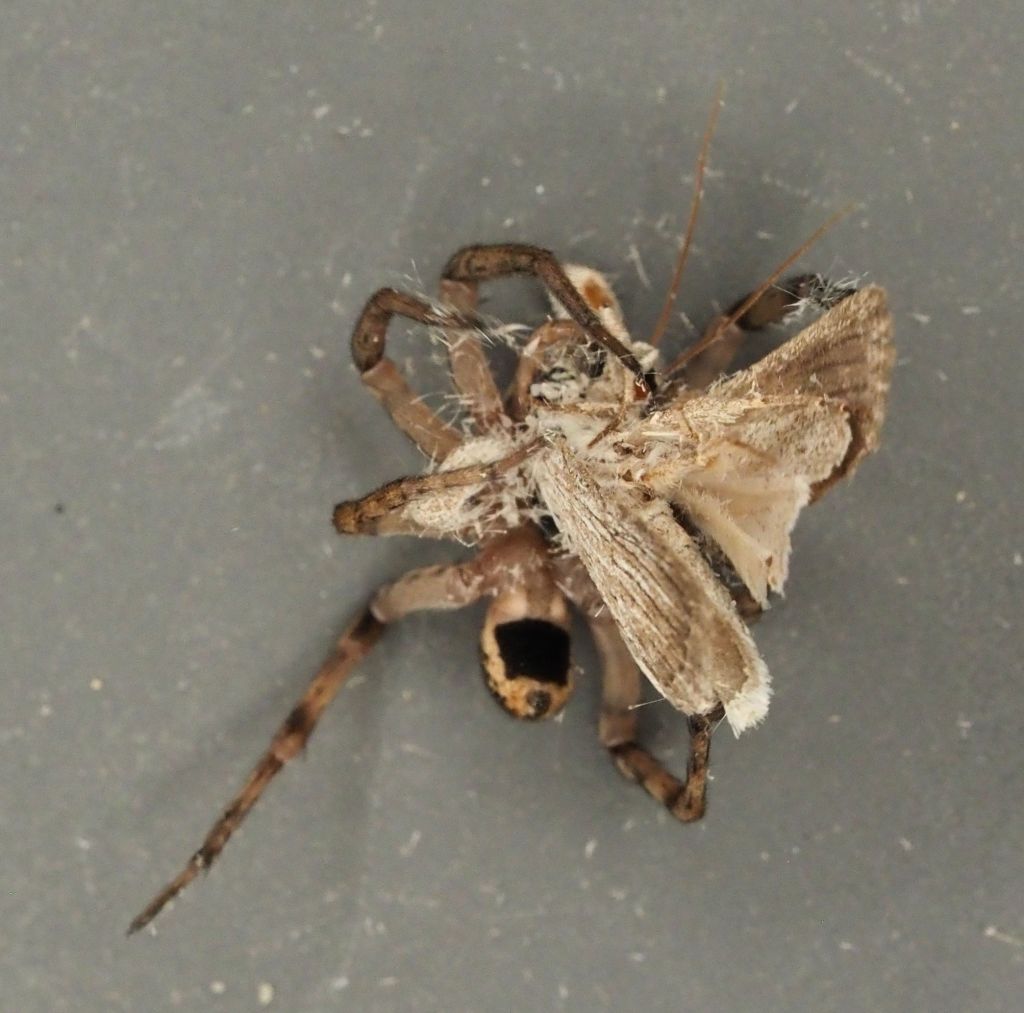
Yes! Here a juvenile Hogna baltimorina does just that while subduing a moth it captured a
second earlier and just seconds after I finished photographing it. It has all legs free to hang on to the moth. After the struggle ended, the spider quickly flipped over, prey and all.

The spider was released later and took its dinner with it.

A few years back I saw a wolf spider pounce on a grasshopper about the same size. The grasshopper jumped a couple of feet into the air, taking the spider with it. The grasshopper immediately made a much smaller second jump with the spider still hanging on. Then it was all over.

Moral of the story: If you meet a really big wolf spider, don’t try wrestling with it. You won’t win.

New Hogna Species Spotted

For years I’ve been trying to sort out the various Pardosa species in Texas. There are over a dozen of them and many are very difficult to tell apart by either appearance or genitalia. One common species in Texas appears to be a more southern species (Mexico and Central America), and the species it’s supposed to be is actually many miles east Texas. Others have sketchy ranges or none at all. It would be easy for an unnamed species to be hiding in Texas but I’ve been avoiding this possibility, which could seriously complicate an already messy situation.

Well apparently here’s one that is fortunately different enough from others to not be confused with them. It also has the most shocking appearance of any. There are at least 5 details besides pattern boldness that set it apart from others. Ostensibly it’s in the lapidicina species group which is known for its evenly banded legs, at least as juveniles and females. They also love rocks of all sizes and often sun on them. Steep clay slopes will do in a pinch.

 I’ll be working with a professor at UT on this. I was visiting his ranch surveying wolf spiders and these just popped up out of nowhere. I’ve been working on that genus for years with only middling success but instantly knew this was something that was different than anything I’d seen in Texas in person or on iNat. Funding for domestic taxnomic research is scarce, so being able to interest professors in that area is important. 

The spider show that didn’t happen and came back as blog fodder

by Eric Neubauer

I noticed I hadn’t taken a wolf spider photo at all in June. It wasn’t as if I didn’t have spiders on the brain. We were working on a species group that’s prevalent in South Texas. Still, I thought I’d like to do something with live spiders, and I thought it would be nice to find several big ones and bring them in to the El Camino Real Texas Master Naturalist booth on the 4th of July for show and tell.

Before the sun was up, I was out looking and found two out of the three I hoped for. By early afternoon those of us at the west end of the county could see the impending storm looming over us but we had no way of knowing it was about to stall. So I decided not to drive into Cameron.

As the day ended, I photographed the two spiders and then released them. The first was a mellow and self assured adult male Rabidosa rabida with black forelegs. His leg span was nearly 3″, and he required special treatment, because he easily climbed out of containers that work for most wolf spiders.

The second was a cautious adult female Hogna antelucana who gave me no trouble at all except for fidgeting during her face shots.

The Railroad Down Under

by Eric Neubauer

I saw many things during my expedition around the lower half of the Texas Panhandle. Too many in fact to even summarize. So here is one thing I particularly noticed. I spent some time at Big Spring State Park after sunset.

The land was dry, and the spiders were scarce. Finally, I found a nice adult female Big-eyed Wolf Spider at the edge of the road near the entrance. This is only one of a growing number of fairly large
unnamed wolf spiders in the pipeline.

Big-eyed Wolf Spider, female

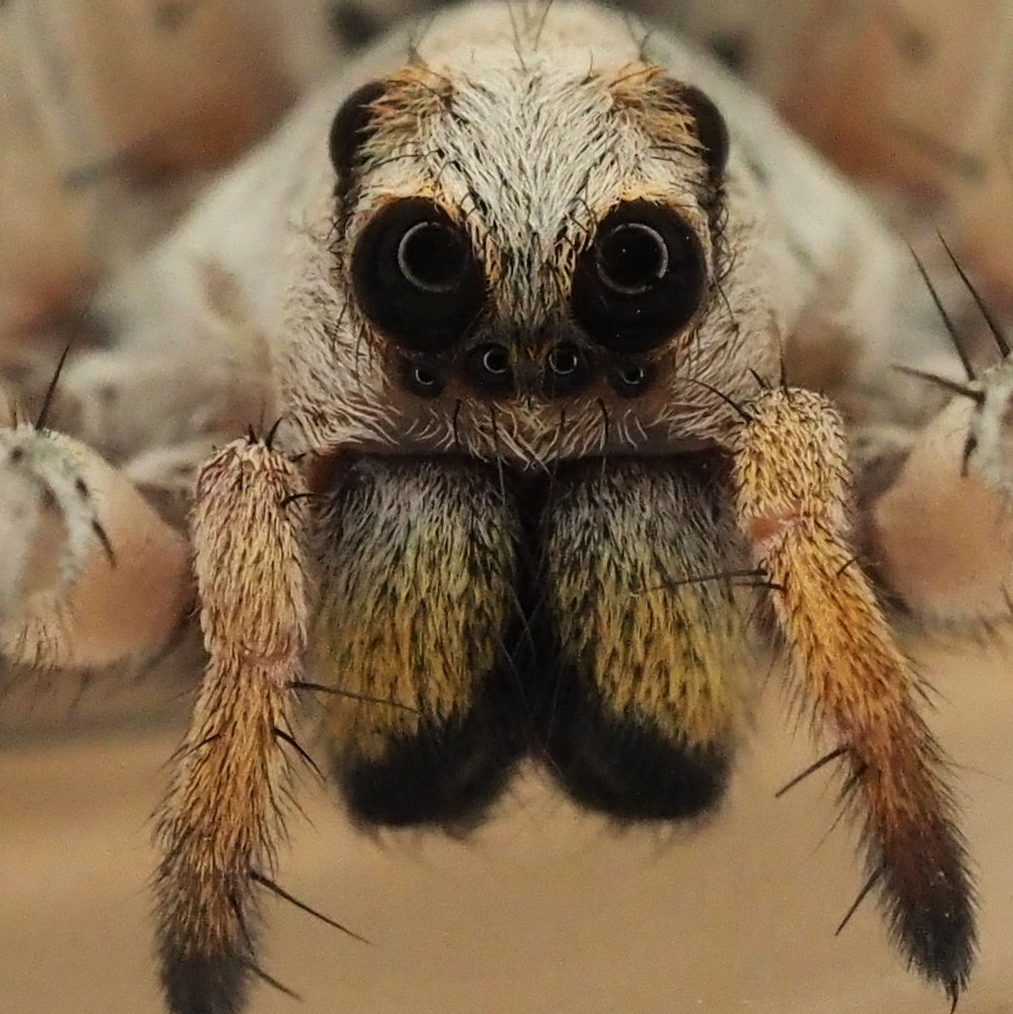
While preparing photos for iNaturalist, I was struck (not for the first time) by the rainbow colors on the chelicerae of this species. The chelicerae are analogous to human lips or jaws except for housing venomous spines at the ends and separating in a vertical plane. Wolf spiders often have bold or complex patterns, but here is something extremely delicate.

Face close up.

Starting earlier this year I added face shots to my routine. After all, this is what spiders see when they meet each other. In this case it captures a colorful detail that would have been missed and shows how big the eyes of the Big-eyed Wolf Spider really are. The white circles in six of the eyes are artifacts, reflections of the dedicated light ring that is part of my setup.