Geeking Out over Sound Patterns

By Sue Ann Kendall

[I wrote this for my personal blog but accidentally created it on this site, so enjoy my fascination.]

Bear in mind that I have been looking at waveforms most of my adult life, so this stuff interests me. I still edit myself talking a lot (yep, it’s my job), so I know when I’m gasping or clicking from saliva before I even listen. It’s interesting, not that fun.

But it’s only in the past couple of years, since I e had Merlin Bird ID that I’ve been able to identify bird calls by how they look on a spectrogram.

Loggerhead Shrike – you can just tell it’s loud and harsh, not melodic.

This kind of knowledge is helpful in winter when there are so many sparrows around. Their spectrograms look different. Here’s one I also like.

Red-bellied Woodpecker

Songbird recordings look very different. Some are more horizontal lines going up or down with the pitch. Others have a mix of tones, but you can see the melody. These two I got from Merlin, of birds I’ve heard.
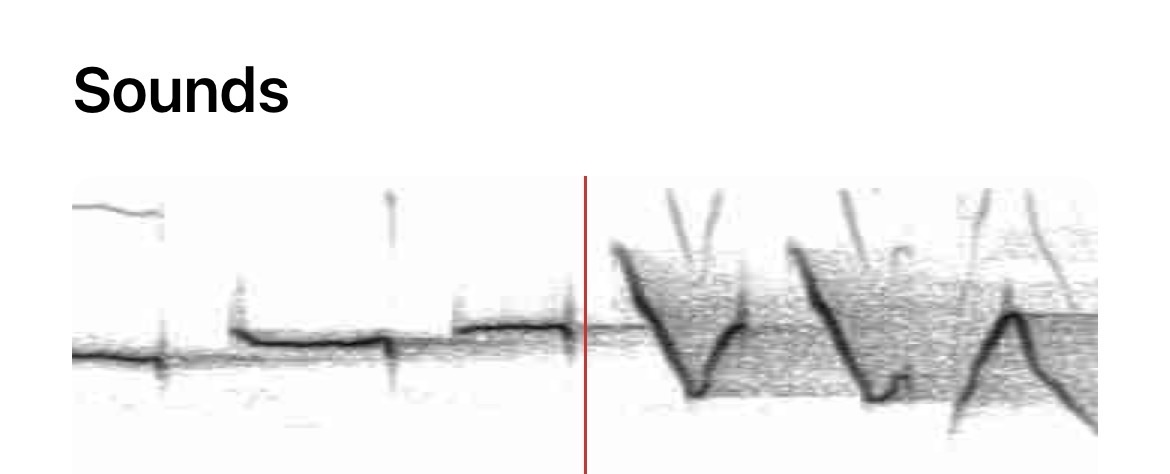
As I’ve been enjoying the sounds birds, there have been other sounds Merlin catches, like loud trucks, airplanes, and wind. And, of course there are insects. I was being deafened by the sounds of late-summer cicadas when I looked down at the waveforms. Wow!

They look three dimensional.

You can practically feel the pulsing by looking at those fascinating shapes. On the other hand, crickets just stick to one note.

This is wind and a cricket.

So if anyone ever asks me how I know a sound is a cricket versus a cicada, I can turn on Merlin. It may not ID it, but I can now from the shape.

Here’s a sound I’m glad Merlin heard: a Yellow-headed Blackbird. They only show up here a few days a year during migration. Photo by Dorian Anderson.

I used to have some frog images but I can’t find them. I’ll be paying attention and when I hear something interesting, I’ll stop the recording, since Merlin doesn’t save recordings over about 20 minutes long, due to storage constraints. My phone would be FULL.

Sandhill Cranes: Wonderful Sign of Spring

by Sue Ann Kendall

Last weekend I was at a horsemanship clinic when I heard a familiar sound. I pointed up and said, “Listen!” The ten-year-old girl who was in my group asked me what in the world that was. I said it was the sandhill cranes migrating north. It made my day to see how excited she was about it. She promised to keep her ears open this year and from now on.

Photo by @lburlew71 via Twenty20

The sandhill crane, Antigone canadensis, comes by twice a year, heading up north and heading back south. They aren’t endangered or anything, but they are endearing to me. I can remember when my children were small, I’d hear them from inside my car, pull over, and make my sons watch them flying over, clacking and honking as hard as they could. That was in Williamson County.

Nice quality, huh?

Of course, they fly over Milam County as well. Friends report that they touch down in some of our larger lakes, like over by the old Alcoa property, to rest as they go by. They’ve never stopped by our little ponds, but sometimes they are close enough to see the colors on their heads with binoculars.

Yep, it’s birds all right.

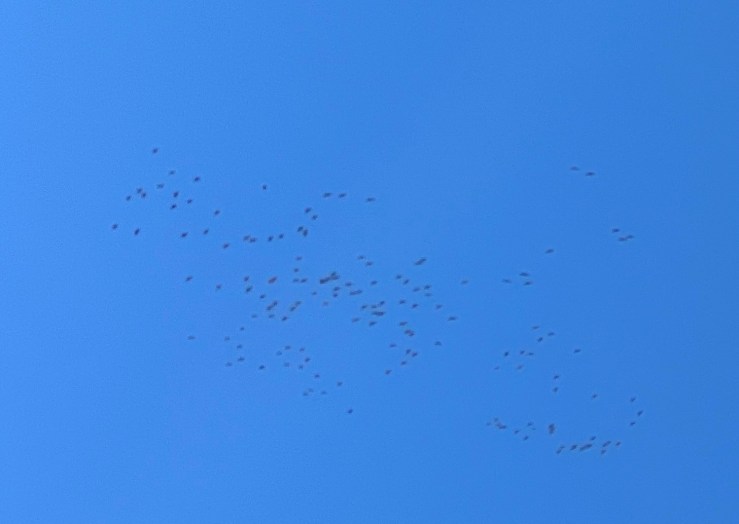
I ran outside today when I heard them from inside my house, and got a recording and took a few photos. They aren’t great, but that’s okay. I like to document when different birds migrate through each year to see how it differs. Last year they were a little later than this year. Hey, I’m a naturalist.

Well, it was pretty in person.

I’m glad I got the recording, so my iNat identification will be easier. Since I was on my property, I can’t get any credit for the observations, but so what? I got the thrill of listening to my favorite signs of spring as they head up to get some nice fresh food. Learning to observe the rhythms of nature is one of the best things about our training.

This took me forever to convert from one format to another, so truly, enjoy the sounds!