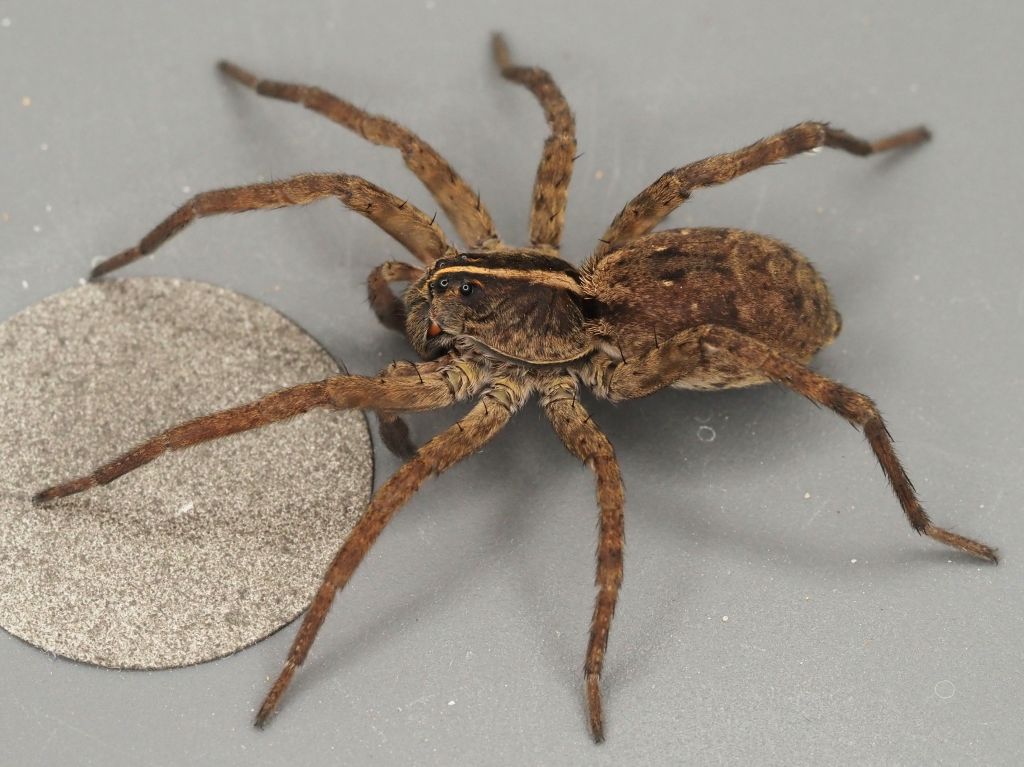
I usually take photos for identification, but occasionally there’s one that could hang on a wall.
Look at those eyes!
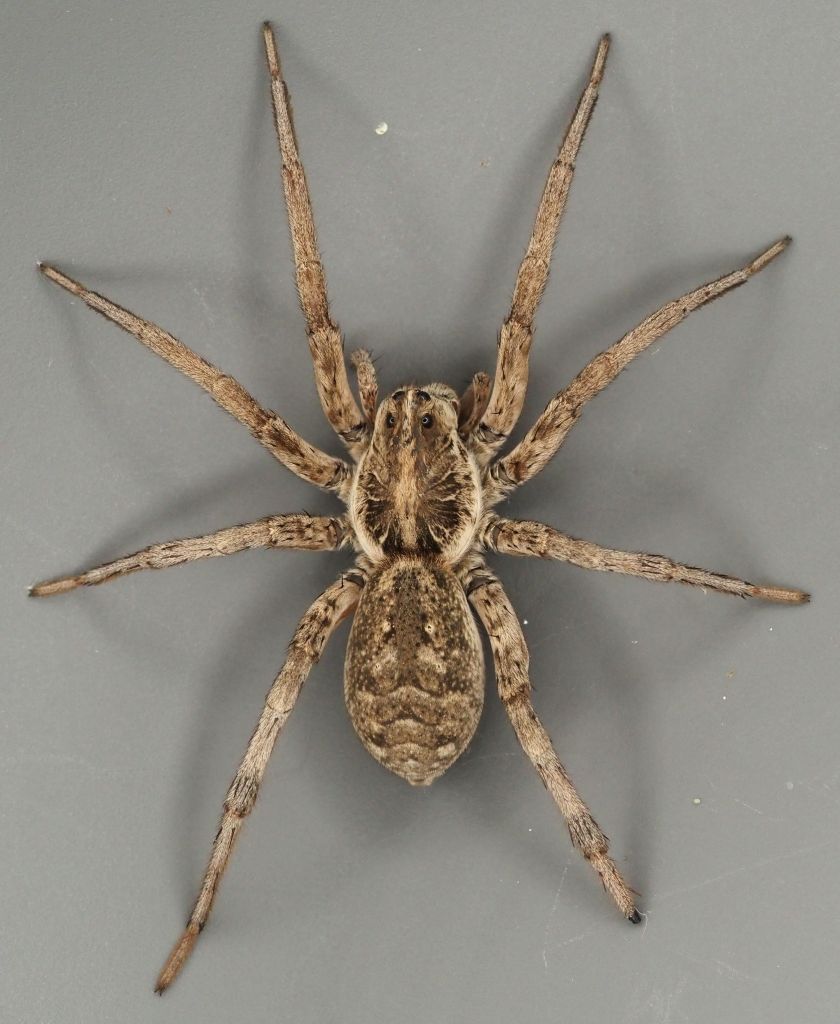
Most wolf spider species pass the winter as juveniles. Tigrosa georgicola is an exception and one of the larger species. I’ve generally had trouble identifying Tigrosa to species, mostly because I hardly ever encounter adults.
This winter I have two locations where I can more or less reliably find Tigrosa georgicola adults and am taking full advantage of it. The females must be keeping to their lairs since I usually find males, but at least I’m getting practice identifying one of the sexes.
Sorry to miss the last meeting, but it was prime (for January) wolf spider weather in the early evening and I had unfinished business down near Alligator Creek.
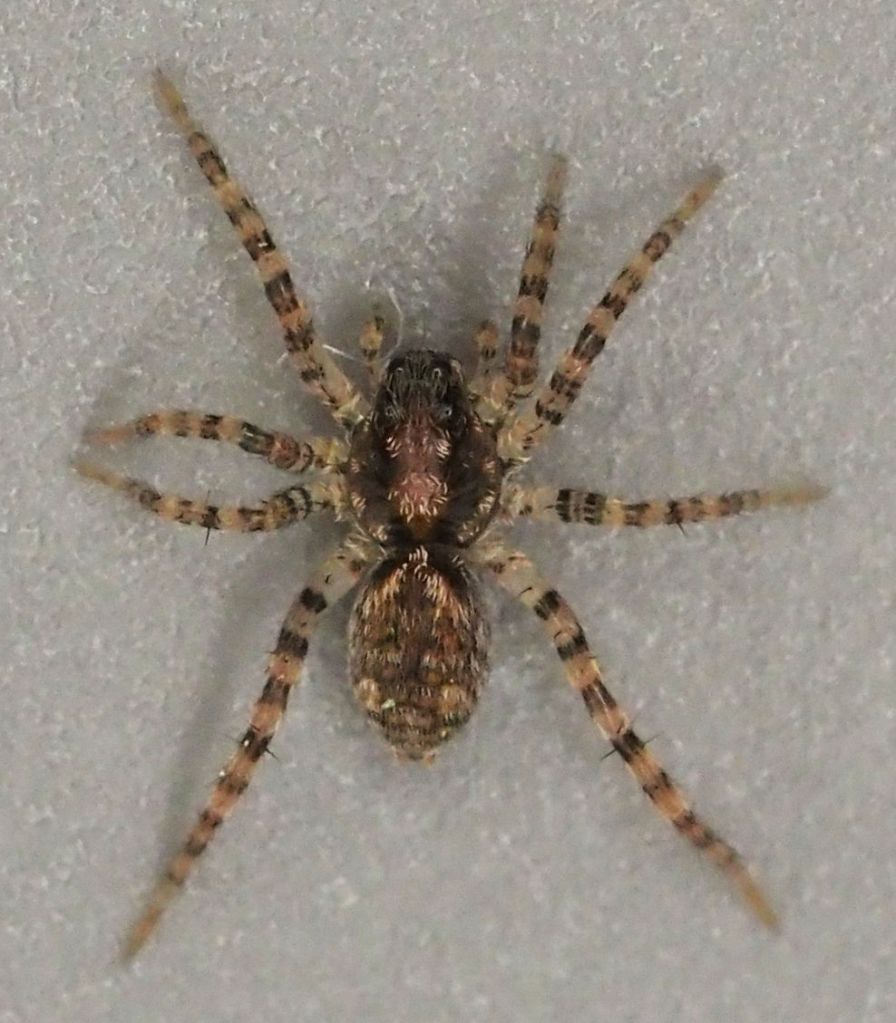
Two images are attached. Both are adult males and would be considered large wolf spiders with a body length approaching a half inch. One is Tigrosa georgicola, a common species around here. I’ve seen them near the creek several times.
The other [P111694] has been baffling me after I found the first one on New Year’s Eve. Field identification guidance is fairly well developed for the larger wolf spiders, but there were reasons for eliminating all of them. I’ve found three now, so the first wasn’t an oddity.
Originally, I thought it might be Alopecosa, which only has a few images on the internet. At present I’m thinking it might be a morph of the other species I found there, Tigrosa georgicola. If I was still taking typical wolf spider photos, that is dorsal views only that weren’t highly detailed, it would have ended up as “something in the Schizocosa ocreata species group” and that would be the end of it.
As it is now, I can’t get beyond subfamily Lycosinae but am favoring a rare morph of an existing Tigrosa species or much less likely an undescribed Tigrosa species. Considering all three were found in the same area, they could all be siblings. Their mother would be proud.
I suppose there could be another option: a hybrid of Tigrosa georgicola and Schizocosa perplexa but I’d think the two are too unrelated to produce offspring.
Wolf spiders can be a winter activity; just use a headlamp at night when it’s relatively warm and humid.
Last Wednesday, I went out there to see what I could find, and came up with five species. Most were juveniles of course, and now is a good time to photograph them as they grow.
The ones I saw covered most of the possible size range. The smallest had a body length of 0.11″/2.8 mm. At this size it could still be with its mother. The legs are short (fully stretched out in the photo) and they don’t run very fast. Their best defense is to pull their legs in close, stay still, and pretend they’re a wee lump of nothing worth notice.
Juvenile
The largest had a body length of 1.1″/27 mm. I’m still not certain which of two species it is and should have used a larger container for photos so she could stretch out her legs and show me another clue of her identity.
Adult
Doing the math suggests that the weight of 1,000 of the little ones would equal the weight of the large one.
Johnson grass, in greener times. Photo by SA Kendall.
You’d think the hard dry soil would add to the difficulty of pulling up plants, but some of the plants are coming up easily. I’ve often marveled at how fast new shoots can come up.
Just about every Master Naturalist knows that Johnson grass uses stored energy in its rhizomes to do this. There is a cost because the rhizome shrivels up as the new shoot advances. Johnson grass appears to be exceptionally adept in moving its resources around. Even as the water becomes scarce, the shoots keep coming. There is a point when the grass has to stop growing, as it did last summer.
Anyhow, I am amazed that the grass has been undeterred so far except for giving up on inflorescences and at least nothing is presently being added to the seed bank. But I shouldn’t be. As the plants use their stored resources for continued growth, they are metabolizing. The products of metabolism are carbon dioxide (plenty of that around) and water, a scarce commodity. All the plant needs to do is relocate that water to the advancing shoot. Growth can still occur.
Johnson grass doing what it can’t do in the current drought. Photo by SA Kendall.
Meanwhile, the rhizomes are invisibly shrinking under the surface and the plants can end up being anchored by only a few measly roots. That explains why some plants are easier to pull up now. It also means that rather than digging for rhizomes, it’s only a matter of waiting until they magically turn into shoots and then pull those.
Last night’s Chapter Meeting was very informative and a lot of fun. We even had a couple of visitors, and that prompts me to remind you that anyone who happens to be in Cameron, Texas on the second Thursday of any month is welcome to join us at All Saints Episcopal Church. Potluck at 5:30, followed by our program. The monthly meeting follows the presentation. At this month’s meeting, we were privileged to learn from a presentation on land trusts and conservation easements and how they work, from Melanie Pavlas and Lauri Mason, Executive Director and Outreach Manager for Pines and Prairies Land Trusts. This was especially relevant, since Milam County is now a part of the area served by Pines and Prairies.
Melanie shared her passion for land trusts with us.
As we were listening to how land trusts can preserve land from being over-developed, yet let the owners live on the land and farm/ranch just as they always had, many ears perked up. I think they’ll be getting a few phone calls from Master Naturalist landowners! Melanie and Lauri both said they love to talk to folks about what they do, and promise they aren’t trying to sell anything. But, honestly, if one’s heirs aren’t interested in preserving land for use by native plants and animals, this sounds like a great idea.
Please visit their website to learn more about how you can enjoy your land and ensure its preservation in the future.
As usual, we had some milestones to mark, and this month we honored Neil Wettstein for achieving his initial certification, as well as Ellen Luckey from our most recent class for also getting in her first year’s certification in addition to the initial one. Whew.
Members Pamela Neeley, Cindy Rek, and Gene Rek were recertified for 2023. Congratulations to all.
Ellen Luckey, Pamela Neeley, Carolyn Henderson (Chapter President), Neil Wettstein, Cindy Rek, and Gene Rek
There was also some fun, as our cheerleader and iNat superhero, Linda Jo Conn, presented Eric Neubauer with a “Big Spider Badge” in honor of his contributions and of the fact that he’s presenting a talk at the upcoming 2023 Texas Master Naturalist meeting.
Eric self designated it, the badge says. That was fun.
After the meeting, we were joined by Dale Kruse, plant expert extraordinaire (especially mosses and bryophytes, he will tell you), held an orientation meeting for the group of folks who are going to take a class on grass identification with him. Having done this twice myself, I know they will learn so much they’ll feel like their heads will explode, but it will be fantastic. We’re lucky to have people so willing to share their time and expertise with us.





 Nature Along the El Camino Real