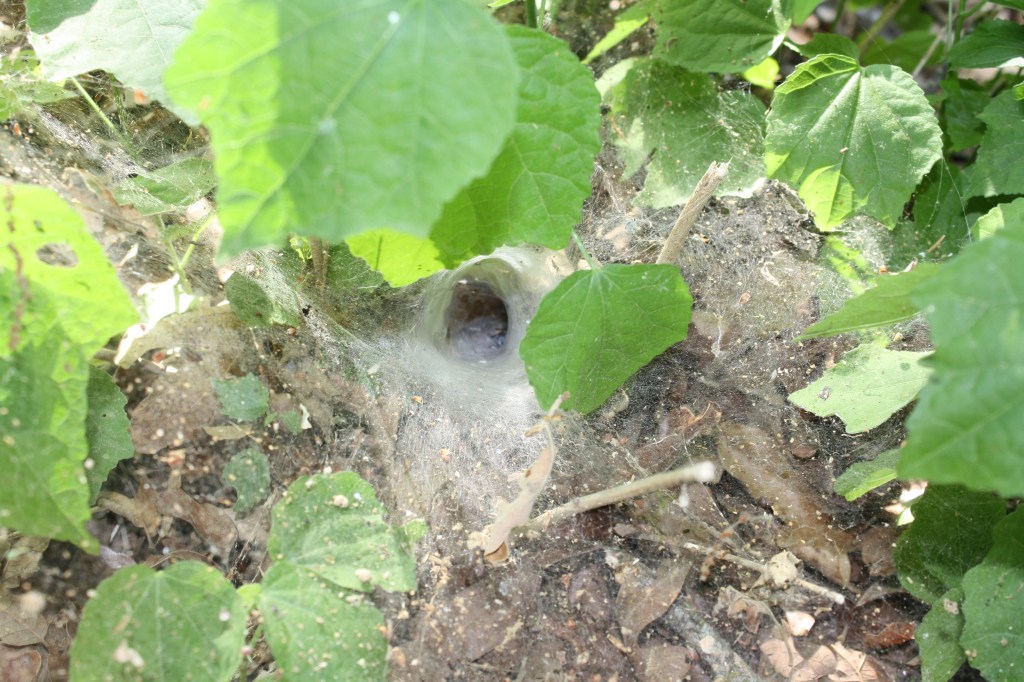
Just before it rained the other day, I saw this very interesting spider web under a tree, wound up in a Turk’s Cap plant.
I was not about to get too close as it looked like something that if I were a small insect, I would enter and never come out again. I think they make horror movies about these kinds of things.
But I was also struck by how intricate and, yes, beautiful it was. How can a tiny insect have the mind to construct something like this? Another one of nature’s secrets.
I sent the photo to Master Naturalist Eric Neubauer, who we are fortunate to have as a member of our Chapter to identify what spider made this. He said it was either in the family of Agelenopsis or Agelenidae Funnel Spider.
They look similar to a Wolf Spider. But I am not going to get that close to ask it.
The lesson is as usual, look around at nature and you will see wonderful things.
Boy was I amazed and lucky this afternoon! I was talking to my sister on the phone and I looked out our southern facing windows. I saw something dark on one of the metal fence posts. So, I opened the curtains and there were two roadrunners, each sitting on a fence post!!
I hardly ever see them anymore, but to see two…WOW!
I went as fast as I could to get my camera. One bird was still there when I got back to the window. Just as I started to focus my camera it jumped off the post, but I did get a photo. So, I didn’t just imagine it.
You just don’t get to see things like this too often. It makes you feel so good.
The Peterson Field Guide (written in 2009) says these large birds are common. I don’t believe that is true nowadays. That is sad.
But this day, I was sure a happy camper.
By the way, roadrunners have unusual feet in that they have two toes forward and two toes backward. I bet it’s hard to find shoes that fit. They eat caterpillars, insects, reptiles, other small birds and fruit. Pretty versatile in the food area.
And of course, they can run really fast.
Lucky me.
Hey, our blogger, Suna told me that she and her husband have seen more of them than usual this year, which is a good sign, for sure. They also enjoyed watching a very large jackrabbit bounding across a field near their property. We are always glad to see the wildlife that’s been dwindling around here when they make an appearance.
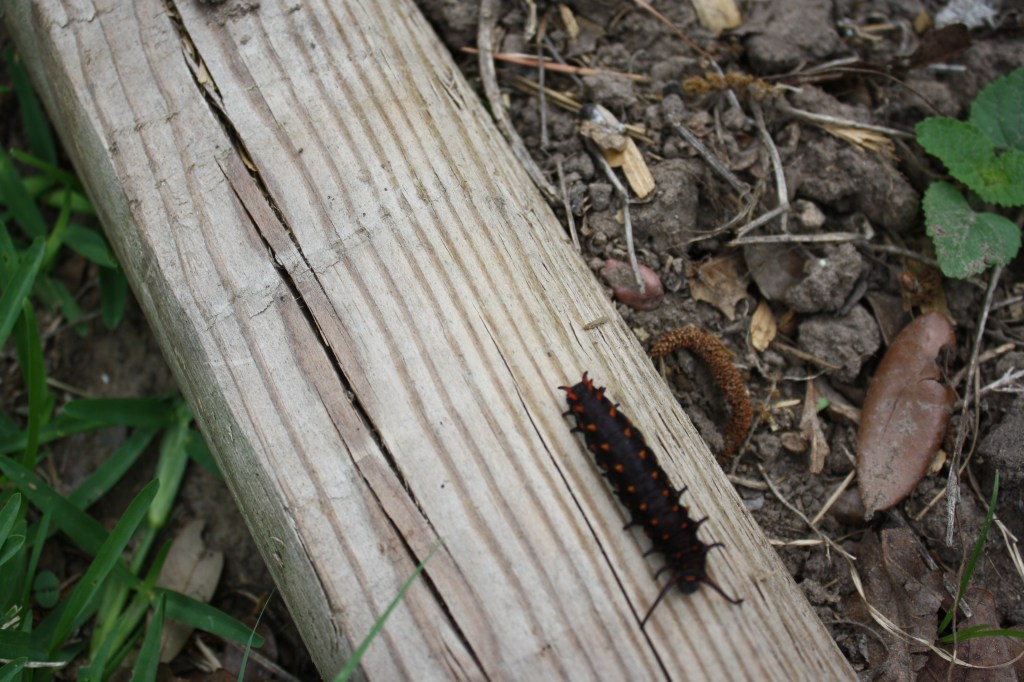
So, for a while I have been talking about the really neat caterpillars of the Pipevine butterfly. Their host plant is the Pipevine plant. I have a naturalized Pipevine in my garden called Aristolochia fimbriata that originally came from Brazil. There are native ones in our area, which are very hard to see and find.
Black!
My plant is a groundcover plant not a vine. The caterpillars will eat the plant leaves and stems down to the ground overnight once they hatch.
Then in about three weeks, the little plant regrows, and this happens four times during the summer months. It is amazingly fast how this happens.
Black!
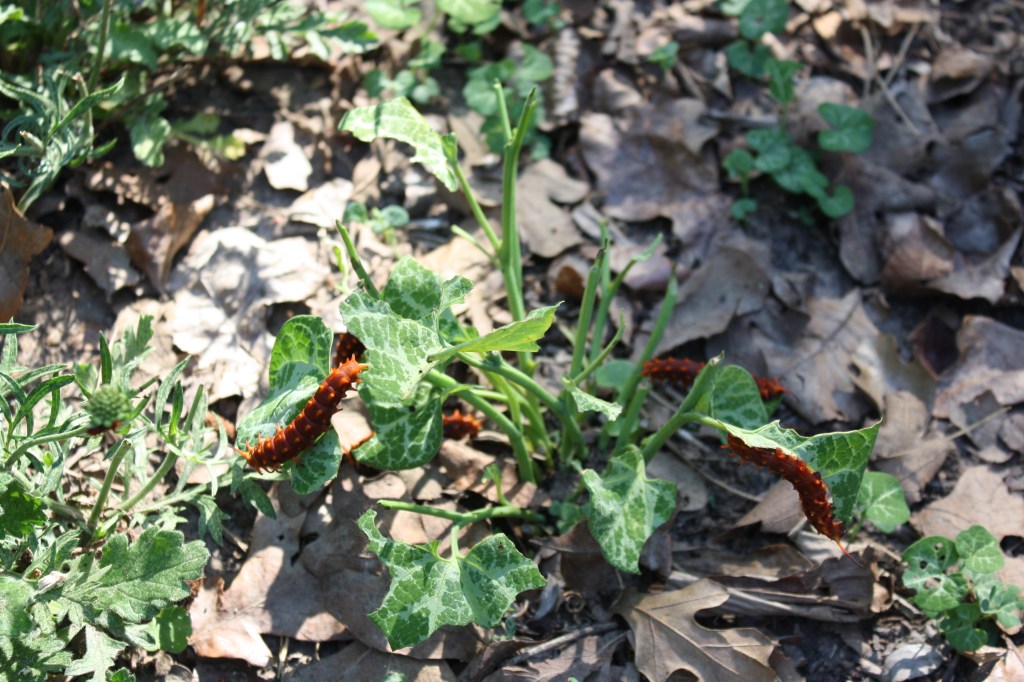
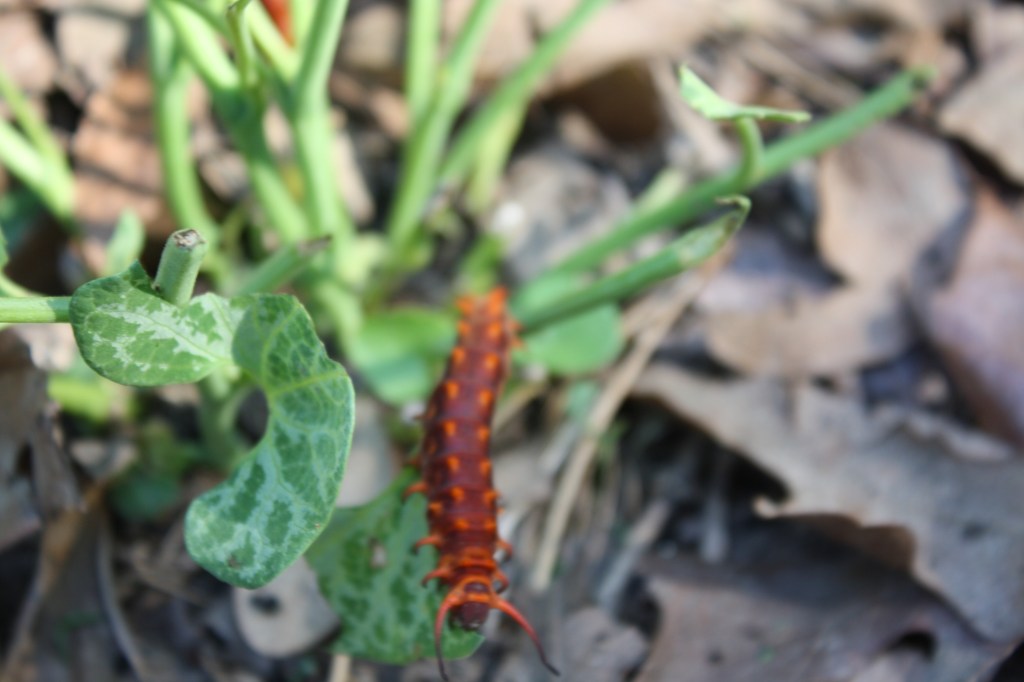
The Pipe-vine Butterfly produces two different colors of caterpillars! Crazy! I do not know of another butterfly that does this.
I have looked up tons of information from many groups on this color issue. I have found that the older field guides and published books believe as the caterpillars aged, they changed colors. I do not think that is correct, after watching them for many years.
The newest theory from several universities including the latest study from The University of Virginia is that hot weather causes the red color to emerge rather than the black color. This is the current theory.
Red!
So let me throw a wrench on this theory. Right now, today May 20th, 2022, it is really hot in my garden. It is hot everywhere in Central Texas. And I have a grouping of both the red caterpillars and the black ones.
So how does that fit into the current findings? A real puzzle. We will just have to keep watching and see if nature will tell us her secret.
Red!
Nature is more amazing than anything mankind can produce, and they don’t even need a computer. Wow.
Who are you gardening for?
Sorry for the delay in blog publishing. Your poor blogger has been working too hard at her paid job and has been dealing with world events, like the rest of us. There will be catch-up blogs coming in the next few days.
I think everyone can agree it’s hot! It’s looking like this is the new norm and will get hotter in the years to come.
We humans can go inside and enjoy a nice glass of iced tea or whatever.
But what about everything that lives outside? Yes, they were born outside, but not in this kind of weather. So, can we help them a little without taming them?
I think so.
I just put up some heat shields on my Purple Martin Gourds. I could feel the difference it made on my face as I installed them. Just a little help.
Cooler birds
I make sure that the many water stations I have for the birds are filled several times a day. The bees are also drinking from them. Water is so important for everything right now.
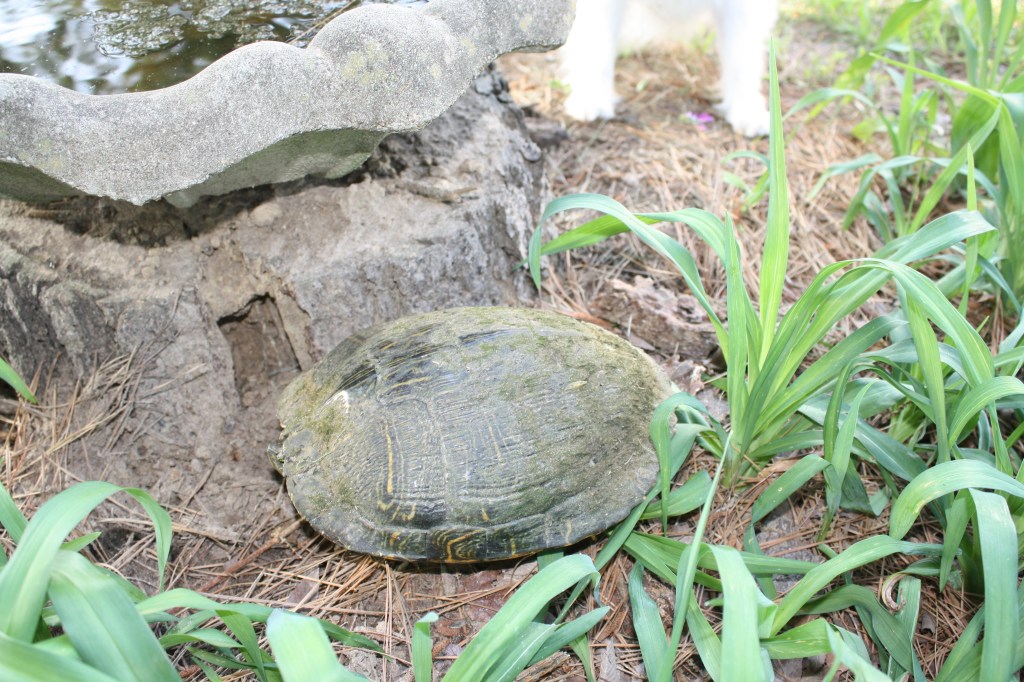
On the afternoon of Sunday, May 8, our little dog found a turtle in our yard near the house.
He barked and barked, getting my attention really fast. I was sure it must be a snake, but it was a female Red-Eared Slider (Trachemys scripta elegans) a long name for a turtle…who comes up with these names?
She was really far from the pond at the rear of our property. Maybe she was laying eggs, who knows?
I promptly canceled my task of mowing the area. Now I’ll have to hope she didn’t bury her eggs somewhere where the tractor will roll over them. I will never be able to look for them in the pasture. But yes (you know me) I did look.
Normally I see these turtles on the turtle dock we made on our small pond. However, these guys are crossing the roads right now, looking for a date.
If you decide to assist that journey, put them on the side of the road that they are pointed at. Make sure to wash your hands as soon as possible after handling any reptile. Happy trails…





 Nature Along the El Camino Real