Geeking Out over Sound Patterns

By Sue Ann Kendall

[I wrote this for my personal blog but accidentally created it on this site, so enjoy my fascination.]

Bear in mind that I have been looking at waveforms most of my adult life, so this stuff interests me. I still edit myself talking a lot (yep, it’s my job), so I know when I’m gasping or clicking from saliva before I even listen. It’s interesting, not that fun.

But it’s only in the past couple of years, since I e had Merlin Bird ID that I’ve been able to identify bird calls by how they look on a spectrogram.

Loggerhead Shrike – you can just tell it’s loud and harsh, not melodic.

This kind of knowledge is helpful in winter when there are so many sparrows around. Their spectrograms look different. Here’s one I also like.

Red-bellied Woodpecker

Songbird recordings look very different. Some are more horizontal lines going up or down with the pitch. Others have a mix of tones, but you can see the melody. These two I got from Merlin, of birds I’ve heard.
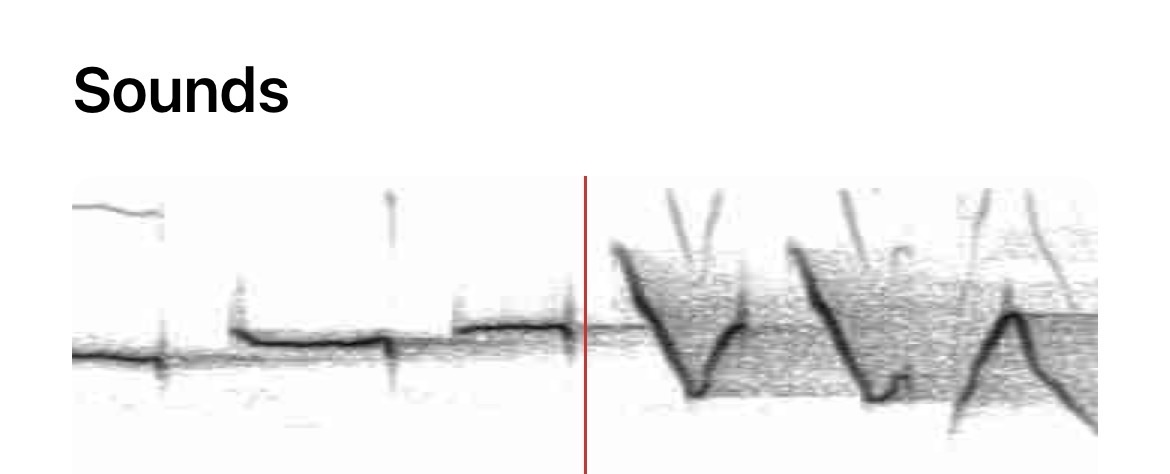
As I’ve been enjoying the sounds birds, there have been other sounds Merlin catches, like loud trucks, airplanes, and wind. And, of course there are insects. I was being deafened by the sounds of late-summer cicadas when I looked down at the waveforms. Wow!

They look three dimensional.

You can practically feel the pulsing by looking at those fascinating shapes. On the other hand, crickets just stick to one note.

This is wind and a cricket.

So if anyone ever asks me how I know a sound is a cricket versus a cicada, I can turn on Merlin. It may not ID it, but I can now from the shape.

Here’s a sound I’m glad Merlin heard: a Yellow-headed Blackbird. They only show up here a few days a year during migration. Photo by Dorian Anderson.

I used to have some frog images but I can’t find them. I’ll be paying attention and when I hear something interesting, I’ll stop the recording, since Merlin doesn’t save recordings over about 20 minutes long, due to storage constraints. My phone would be FULL.

Oh the Sounds of Summer – Cicadas

by Lisa Milewski

Growing up, my siblings and I would hear the infamous sounds of summer. Yes, the Cicadas. We would always hear them but never see them.  We would see their shells once they emerged, usually on trees but not a live one. 

Cicada shell

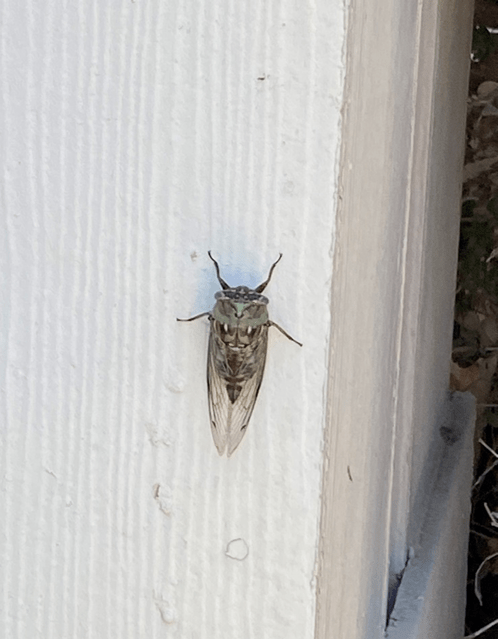
To my delight, my son was playing basketball in the front yard and rushed in to tell me I might want to see this big bug. My eye for birds, insects, lizards, etc. has rubbed off on my children annd husband; I love it! They know how excited I get. Low and behold, it was a cicada. I slowly move in for a close-up picture to not scare it away. Yay, I got it! 

I posted it in iNaturalist and identified it as a Resh Cicada.  Per iNaturalist, the Megatibicen resh, the resh cicada or western dusk singing cicada, is a species of cicada in the family Cicadidae, found in North America.

An internet article on Cicada Mania stated it’s known as the Resh Cicada because of the markings on its back resemble the Hebrew symbol Resh “x” (Hebrew letter that looks like an upside down “L”). The Resh Cicada has been documented to be found in Arkansas, Kansas, Louisiana, Mississippi, Nebraska, Oklahoma, South Carolina, Tennessee, and Texas. During the molting process, up until the cicada’s body sclerotizes (hardens), the cicada’s body is leaf-green (camouflaged like a hanging leaf).

The Song of the Cicadas

by Donna Lewis; photos by Michelle Lopez and Carolyn Henderson

I hope all of you have been hearing what I am hearing during the late afternoon mostly, a sound that brings back many wonderful childhood memories of summer, cool nights, and my parents and grandparents, who I miss every day.

Superb Dog-Day Cicada photo by chapter member Michelle Lopez.

There is something endearing to their song.  The cicadas sing from tree to tree.

It is only the males who sing.  They will burst out of a hole in the ground and then shed their skins where a new body will come from. The skins are left behind for kids to find, hanging them on their clothes and maybe their pets. At least that’s what I did.  My Dachshund thought it was great. When it finally fell off, my dog ate it.  Awful, but I’m sure it was not harmful.  

The cicadas here in Texas have a life cycle of about 3 to 5 years on average.

The periodical cicadas live from 13 to 17 years and are more common in the north.

If you are walking and one of these fellows hit you, they can put an eye out. They are like the bulldog of the insect world, and go forth headfirst when flying. They try to get to the trees for safety.   

Nature is so full of wondrous things. There are as many different varieties as there are stars in the skies.

So just go outside and enjoy nature.

Another of the same cicada, taken in June by Carolyn Henderson.