By Larry Kocian. Adopted from a Facebook post on Milam County Veggie and Plant Exchange, September 22, 2019.
Free from nature, these vines (also known as tie vine —Impomoea cordatotriloba) make an appearance in late spring, early summer. In mid- to late summer and into autumn, they are showy with their purple/lavender colors.
Tie vine is just as pretty as hybrid morning glories, just with smaller blossoms.
Some people say invasive. I say not, because they are easily controlled by going into the garden and removing/sculpting them. I let mine climb, and they do climb into the mimosa trees. I do control some when they wrap in the wrong place or too much on a particular plant/tree.
My point is that most natural occurring plants that are labeled invasive are not at all. I always encourage everyone who reads this to go outside and get to know your garden. It’s very therapeutic.
The Bird Station is an important component for my wildlife exemption. Plus its just a great place to enjoy the woods and the wildlife.
Since there are lots of ferns, I feel I must water often. It gets a couple of hours of water about every four days. It’s very hot and there’s no rain at all!
When the August temperature gets to 100 degrees, plants simply cook; they just about curl up and die or go dormant.
Every year I plant more and more ferns. This year I want to plant some flowering trees, red bud, camellias, and maybe a few azaleas. I can’t help myself!
I just wanted to share with you all the interesting thing I found while driving down County Road 140 this week. That’s the road that Fannin/Ballpark Road becomes when it crossed 485 in Cameron. I drive there every day, since our ranch is just the other side of Walker’s Creek, for those of you who know the area.
I saw it Thursday when I was driving home, but was too tired to stop. Then I kept forgetting to pull over. Finally, yesterday when I was in no hurry whatsoever, my friend and I pulled over to investigate.
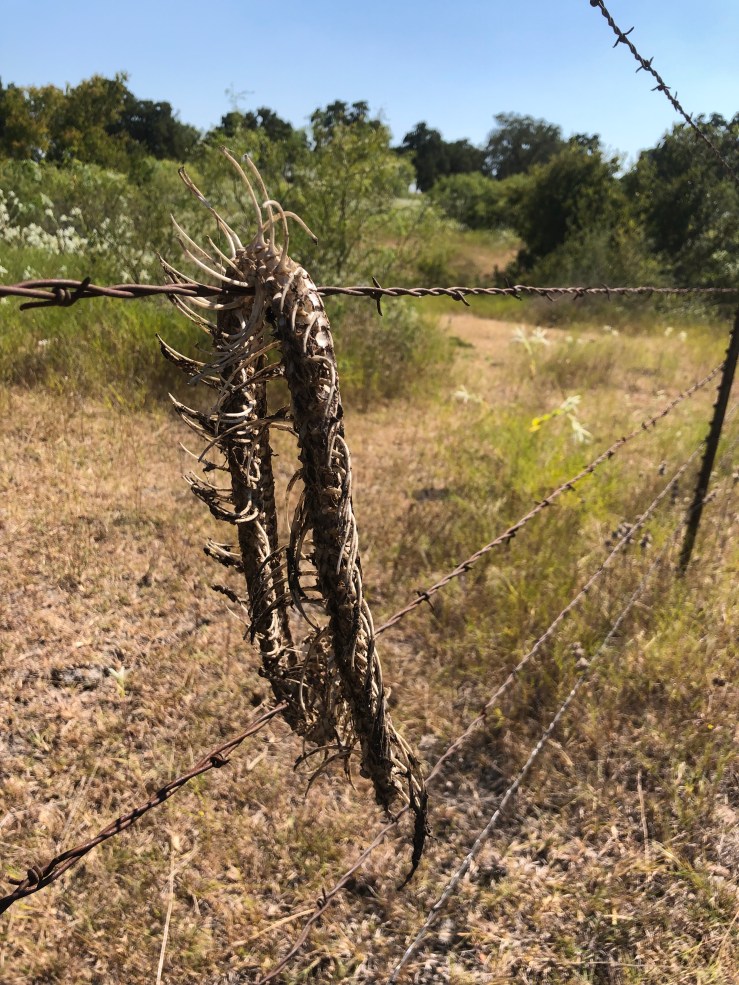
Still life with snake skeleton, cow patty, and snow-on-the-prairie.
It’s a rattlesnake, judging from the size, and missing its head. My teen companion who had on better shoes looked around for evidence of the head, but found none.
From the way it’s draped, we figure someone put it on the fence as a warning. I used to see (much bigger) rattlesnakes draped over fences when I was a little girl in central Florida. When they’d build new neighborhoods, construction workers would have to be really careful of them. My dad said they put them on the fences as a warning. Other people I’ve talked to say they’ve seen coyotes like that. Ugh.
Another view
The thing is, I used to see entire snakes, not skeletons. Where did the rest of it go? Did someone skin it first? How did the vultures, or whoever it was, get all the meat off and just leave the bones just as they were?
Extreme close-up. It’s pretty darned clean.
Do any of you Master Naturalist friends have any ideas? Please share!
PS: I’d love to blog about YOUR nature sights and finds. Send them to Suna by email, photo, text, or piece of paper. I’ll blog them! To prove it, the next one came from a photo of a piece of paper!
This is the time of year when everything is crispy and shriveled. But still, you can see life moving along, if you look carefully.
After talking to Linda Jo Conn last week about how many shriveled images were being uploaded to iNaturalist now, I got curious as to what floral beauty I could find at my place, the Hermits’ Rest Ranch.
So, my dogs and I set out to see what we could find. I looked in a meadow, a woodland border, and a riparian area. The pond still has plenty of marsh marigolds in it, but I can’t safely get to them for photos.
You can see how thin the leaves are on the broomweed. The stems are a nice and bright green, which looks good against all the brown foliage everywhere.
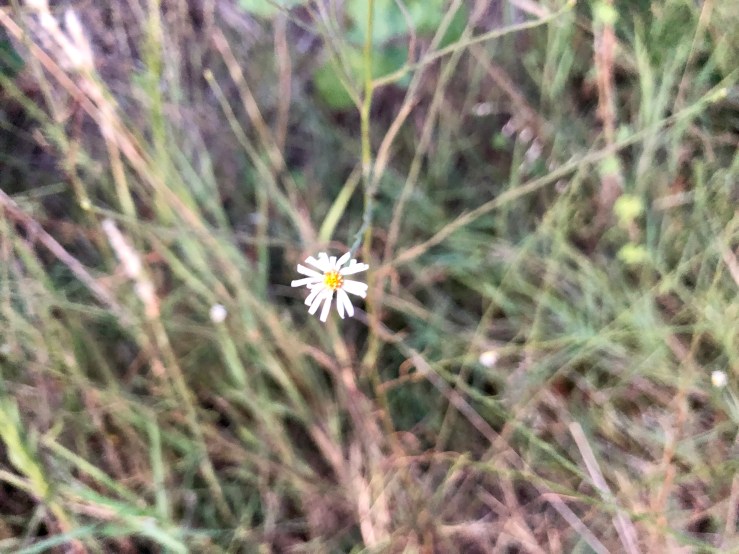
Most of the flowering plants right now seem to have two characteristics: very few or very thin leaves and small blossoms. The two most common examples are the prairie broomweed and yard aster, both of which look practically leafless and have tiny flowers.
These little asters are pale pinkish purple and widely scattered on the plant.
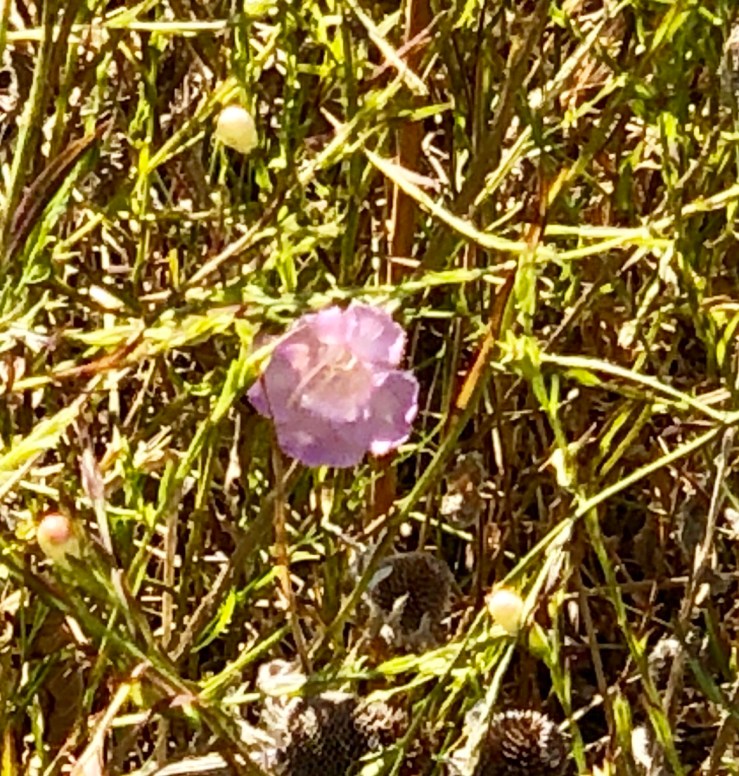
I had to take this over a fence, so it’s not frat. It’s hiding among the seedheads of the spring flowers.
In slightly shadier areas I saw a few rather tired looking prairie false foxgloves, a flower I’ve always enjoyed running into. They also have sparsely flowered plants with few leaves. I am guessing all three of these plants are high on drought tolerance lists.
I know the Mexican ruellia that’s still hanging on does well in droughts, because it did well at my Austin house, too, throwing those seeds out all over my xeriscaped garden. They are hard to get rid of, which for the most part is a feature I value a lot in a plant.
This is a “Mexican petunia” blossom that had just been expelled from the plant.
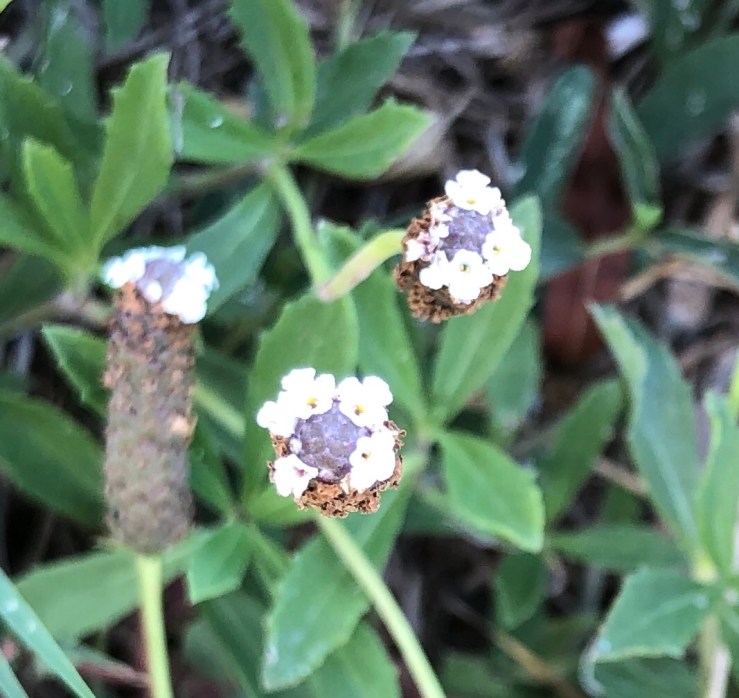
Other plants I saw were turkey tangle frogfruit, which has been going strong all year, and a lot of pretty grasses. Since I stink at grass ID, I just look at the fluffy ones, watch the ones that blow in the wind wander around the area, and admire the dignified nodding stalks.
My mother called these matchstick flowers. I thought they were really matches and was apprehensive around them for a few years as a child.
I know others in our Chapter have been out looking for flowers, such as Conni Jo, who found a lot of flowers to photograph for the wilfdlower brochure we’re putting together. Have any of you others seen any stalwart bloomers out there braving the heat and dryness? Let us know. Share some pictures!
Here’s another story from the nature notebooks of Ann Collins It’s from last year.
June 19
Two chimney swifts were circling around the old well at the top of the hill. I saw them often, two together. When disturbed by the mule, one would fly out of the well.
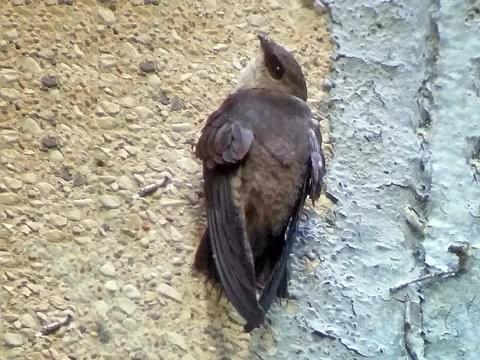
Chimney swifts are good at clinging to walls (photo from Cornell Labs)
June 22
I looked in the well and saw a nest with three white eggs in it. I felt sad, because I was afraid they would hatch then fall out and drown in the nasty water below.