by Eric Neubauer, elaborated upon by Sue Ann Kendall
A long while back I observed about a half dozen flies of an unknown species, which baffled everyone on iNaturalist. The genus has finally been identified.
Visit the observation on iNaturalist if you want to learn how experts go about narrowing down what genus and species an observation might be. The users aispinsects (Arturo Santos) and tpape (Dr. Thomas Pape of the Natural History Museum of Denmark) worked together through the ID process under that observation, though most was done by Santos. Thank goodness the photos were so good, as details like veining are very helpful in identifying flies. It’s gratifying to see two true experts helping out with the identification of this unusual fly with very small eyes and an atypical head shape.
One thing we do know about these flies is that the fly maggots are parasitic on lizards. You can see an infected anole lizard on the iNat page for Lepidodexia if your stomach is strong (that’s from Sue Ann).
As often happens with the oddities I get fixated on, I’m immediately top observer. There are only ten observations of the Lepidodexia on iNat at present (one new one happened recently). No doubt there are others as yet unidentified.
I need to look at flies some more.
Here’s a quote from Dr. Pape’s comments. He thinks he knows the species for the fly, but is not sure:
“The large flesh fly genus Lepidodexia is mainly Neotropical and has several very tachinid-like species. There are a few Nearctic species, and the present certainly fits the genus and may very well be Lepidodexia hirculus, see: http://diptera.dk/sarco/Detail_s.php?RecordNumber=11734 Very little is known on the biology of species of Lepidodexia, but they include as varied breeding records as live frogs, lizards, snails and earthworms.”
Santos is a wonderful contributor to iNat and has helped identify many flies around the world. He’s a citizen scientist at its best!
The following are my opinions, based on a good bit of reading but not rigorous research.
Paper, steel, modern-tin, aluminum, and glass cause minimal harm if they are “lost” into the environment. (Roadside non-plastic trash is more an esthetic issue than an environmental issue.) Many chemicals and metals are also harmful, but these should not be present in household recycling.
Plastic on the other hand causes lots of problems if it is “lost” into the environment.
Tiny, micro, and nano particles of plastic are polluting our food, soil, and water to a remarkable extent. Much of this comes from Styrofoam which quickly breaks down into micro pieces that don’t further decompose. A lot comes come coatings that break down into “forever” chemicals. Pretty much all plastic breaks down in the ocean into smaller and smaller pieces, but these pieces remain plastic; they don’t decompose.
Plastic film, complex shapes (like the harness for a six-pack of cans, or a net, or a tangle of string or rope), and small, swallowable parts are causing lots of harm to wildlife, especially in the oceans.
Plastic recycling barely works. Most estimates guess that only about 10% of recycled plastic is actually recycled and the rest is discarded. Actually, the percentage is much lower for everything but standard plastic drink bottles. Plastic bottles are more readily recycled because they are easy to identify and because they are all made from the same somewhat-recyclable plastic. Note that they are, sadly, not very reusable, as cleaning them causes them to start leaching chemicals into their contents.
In North America (including the USA) there are essentially no open public trash dumps. Here we have landfills, which are regulated, and modern ones are quite well designed and managed. The rest of the world, and especially the countries to which recycling materials are shipped, still heavily rely on open trash dumps, many located near rivers. These dumps, plus fishing fleets, account for most of the plastic that pollutes many rivers and all oceans.
In the US it seems that the processing stream for recycled plastic is poorly documented, but it is estimated that about 40% of US recycled plastic is still shipped overseas. So, when you recycle plastic, you have two possibilities:
1) It gets sent to a US-based recycler, where a small percentage is recycled, and most is disposed of in a well-managed landfill. In this case, you have increased the energy cost of disposing of your plastic with the benefit that some may have been saved from going into a well-managed landfill.
2) It gets shipped overseas, where the vast majority of it will end up in an open dump, and a good fraction will end up polluting the environment.
So, my conclusion is that we should recycle everything we can (especially things like electronics that contain heavy metals and bad chemicals) except plastic. I think the case for recycling plastic drink bottles is borderline, but for everything else it is better to put plastic in the trash. And, of course, we should avoid single-use plastic when reasonable to do so. (The case for some plastic packaging (like shopping bags and containers) is complex, as sometimes the environmental cost of non-plastic packaging is considerably higher.)
And always remember that recycling is the last term in — reduce, reuse, and recycle.
In my personal blog earlier this week, I shared photos of a lot of butterflies I’ve been seeing around Milam County. One of our readers, who is also a follower of this blog, expressed surprise that we see so many butterflies in the autumn. She also wondered where the butterflies came from. Were they here all along or are they migrating through? It got me to wondering if this was an atypical year or if there are usually plentiful butterflies in early November. And I thought for sure some of the butterflies (monarchs and snouts) migrated but I figured the rest were born here and stayed on to become food for the birds.
So, I went and looked up whether the butterflies we see here migrate or stay here, and what times of year they are seen most. I got all the information off iNaturalist and Wikipedia, and I have lots of links in this post that you can explore.
Gulf Fritillary
Dione vanilla have been seen to migrate twice a year (in Florida). But they only go from south Florida to north Florida. Here is the chart of their distribution here in Texas (from iNaturalist). You can see they are here year-round but peak around the beginning of autumn, when all those yellow flowers are out.
Gulf fritillary appearances
There have been lots of observations around where I live, so they are pretty common, but beautiful.
Common Buckeye
This one, Junonia coenia, I see a lot but only at some times of the year. It’s also seen year round here but has a spring peak as well as a fall peak. I’m getting the idea that autumn is a big butterfly time here!
Common buckeye appearances
These do migrate, but seem to be here all year, because it isn’t too cold, I guess. Here’s what research says:
Common buckeyes move to the south along with tailwinds directed to the north or northwest after the cold fronts from September or October. They are sensitive to the cold and cannot spend the winter in northern regions that will experience extreme cold temperatures. However, they will migrate back from the south during the spring. It was spotted in California in late summer, early fall of 2022.
Battus philenor is not as common this time of year. It’s also more of a forest butterfly than a prairie one, which explains why I saw it at Tarrin’s – lots of wooded areas near her ranch. This one is also more of a warm-season butterfly. I probably saw one of the last adults for this year. I see lots of observations of caterpillars right now on iNaturalist.
They must not migrate, since I didn’t find any information on that. I do want to note that they need the pipevine plant to lay eggs on, and I found a member of that family at my neighbor Sara’s place earlier in the year. Yay!
Observations near me. The top one is our place.
Queen
Danaus gilippus is most definitely a fall flyer. It’s only found in the southern US and is more common in South America. This one, like the monarch, uses milkweed plants as its host. It sure is pretty.
Queen butterfly sightings
Painted Lady
Painted Lady (Vanessa cardui) is another one with two peaks. One thing I’m noticing, though, is that even the ones with a spring peak have a larger one in the autumn. So, that explains something that Louise was asking about: many butterflies seem to be autumnal!
Painted Lady sightings
Painted ladies are the most widespread of all butterflies and are found worldwide. I hadn’t known that! They are resident in places like where I live, but also migrate to northern areas in the summer.
Common Checkered-Skipper
Common Checkered-Skipper (Burnsius communis) is one I can’t get verified, but the ones I see sure look like the ones in the picture. It doesn’t seem to have been studied as much as many of the others, though it’s really pretty with its blue body and lacy pattern on the wings. And yep, it’s another one that is seen mostly in the autumn.
Checkered skimmer sightings
Variegated Fritillary
Euptoieta Claudia is common in this area. They seem to be prevalent all year except in the dead of winter. I think they’re pretty, too.
Variegated fritillary
They use passion vines as their host, which may explain why we see so many here. I have LOTS of passion vines! They also like disturbed areas and open fields, which we have plenty of around here. They produce multiple broods per year, which may explain the prevalence during all the warm months.
This is such a pretty photo
Dainty Sulphur
Dainty Sulphur (Nathalis iole) is a tiny yellow butterfly, the smallest of the bunch, it turns out. We have lots of sulphurs around here, and they are very busy little fellows, so it’s hard to get photos. This one seems to go away in the hotter months. I do recall seeing them all winter, since we always have something blooming, like chickweed, which is one of its favorites.
Dainty sulphur observations
This one is also white and other colors, so now I know that all those teeny ones I see are the same butterfly. I learned something!
Thank you for holding still
Fiery Skipper
Fiery Skipper (Hylephila phyleus) is another small one. They are incredibly numerous around here and are very busy little things. I enjoy watching them skipping around. Well, when I read the article on them, it became clear why I see so many! They love Bermuda grass. Guess what all the pastures around here were planted in? Bermuda grass. The beloved coastal Bermuda has pretty much made life difficult for the native grasses around here, but I guess that makes the fiery skippers happy. It makes them a pest in Hawaii, though. I say, eat away, skippers!
I also learned why the butterflies I see that are identified as fiery skippers look so different. They are sexually dimorphic, with the males much brighter than the females. I’m suddenly becoming a butterfly expert as I write this.
Fiery Skipper Sightings
Gray Hairstreak
I am trying to figure out what butterflies I see earlier in the year. Gray Hairstreak (Strymon melinus) is one I know I see in spring. Even this one peaks in the fall, though. It’s tiny, but holds still enough that I can get photos. Thanks!
Gray hairstreak
It held still
American Snout
These guys, American Snout (Libytheana carinenta), just migrated through here, so I know they are migratory. But they are most often seen in autumn, like all the others so far. Migrations happen after droughts that are followed by heavy rains, which explains the one last week. The Wikipedia article says sometimes there are so many that they darken the sky. Wow. Funny looking, too.
American snouts
Pearl Crescent
Another beauty, Phyciodes tharos is more of a spring and summer butterfly that’s found all over North America. It’s very common in this area.
Pearl crescent
Hackberry Emperor
Asterocampa celtis is one of the summer butterflies around here, probably because of its ties to the hackberry tree (which we have plenty of). I guess it shows up when the trees start blooming.
Hackberry emperor
This is a weird butterfly. It’s rarely seen visiting flowers (I see it on trees, duh). And it doesn’t pollinate the trees:
Species in the genus Asterocampa are regarded as being “cheater” organisms, since these butterflies do not pollinate flowers when they feed from them. This species can more accurately be described as parasitizing their hosts and plant food sources since they extract nutrients without providing any benefits to the host.
I’ll stop with Papilio cresphontes, since I finally found one that isn’t most common in the autumn. This one is more of a summer butterfly. It’s always great to see one of these gracefully flitting around.
Giant swallowtail
This is the largest butterfly in North America, so I’ve shared with you both the largest and the smallest today! The caterpillars are pests to citrus growers, but they are just beautiful sights as far as I’m concerned.
Monarch
I lied about stopping. I forgot to stick the monarchs (Danaus plexippus) in my original post, figuring everyone already knows all about them, but since I have all kinds of delicious milkweed on my property for them to enjoy, I figure I’d better share their data, too.
Monarch sightings
As you can see, these are butterflies of summer, but you’ll still see a few of them at other times of the year. They are famous for migrating, but not all of them do so, thus the sightings at other times of the year. And did you know these were the first butterflies to have their genome sequenced? Yep. Also, did you know how to tell males from females? Males are larger and have a spot on a vein on each hindwing. I guess mine’s a female, or you can’t see the spot when the wings are folded.
I’m very lucky, because the only time I ever went to the interior of Mexico (it was for work), our hosts drove us the long way to Valle de Bravo, where we were meeting, so that we could drive through the mountains where the monarchs stay in winter. If you go around noon, they drop to the ground to feed, and we got to see hundreds and hundreds of monarchs floating down. We had to drive slowly to keep the butterflies safe, and there were men with flags that said “Mariposas – Despacio” (butterflies – go slowly) at the entrance to the forest. This was in the early 2000s, so there were way more monarchs than there are today.
Conclusions
From what I’ve looked at, it turns out that late summer to early autumn is the best time to see butterflies around here. It also appears that most of the butterflies we see in Milam County don’t migrate far, if at all. I enjoyed learning all this, and I hope you get something out of it, too.
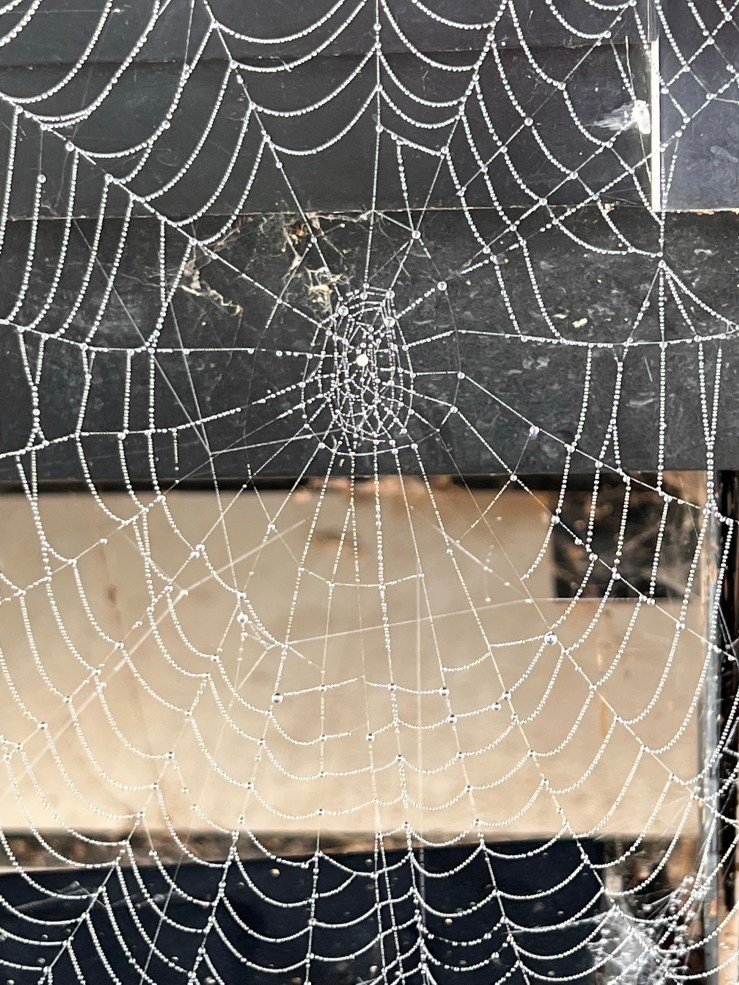
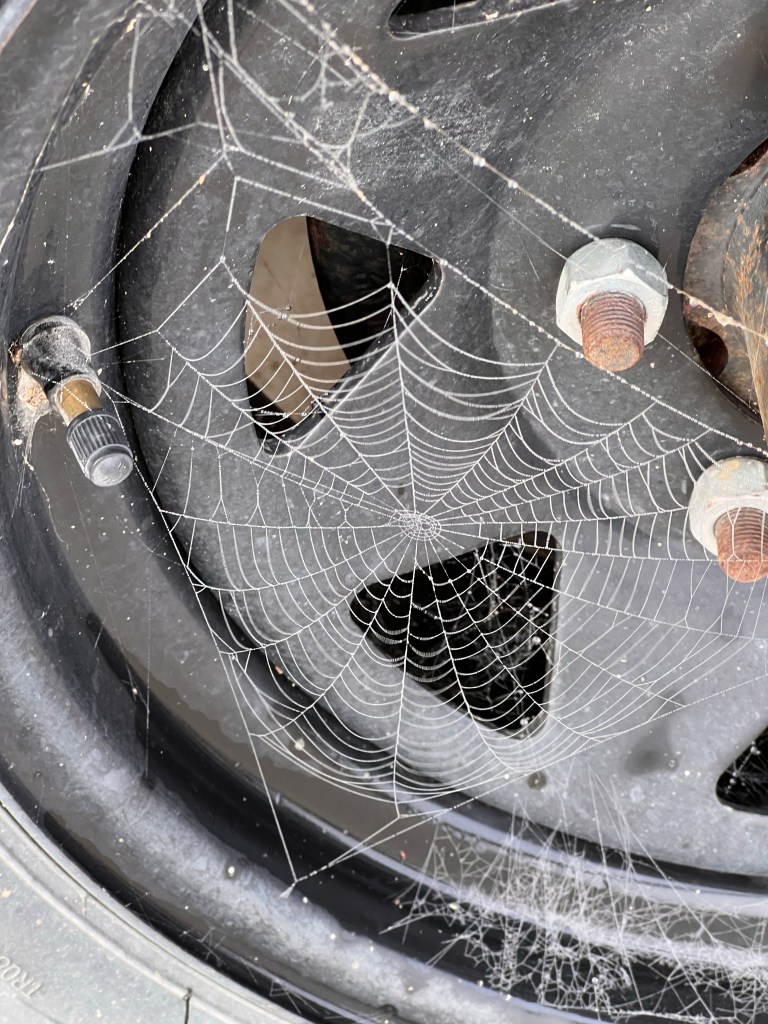
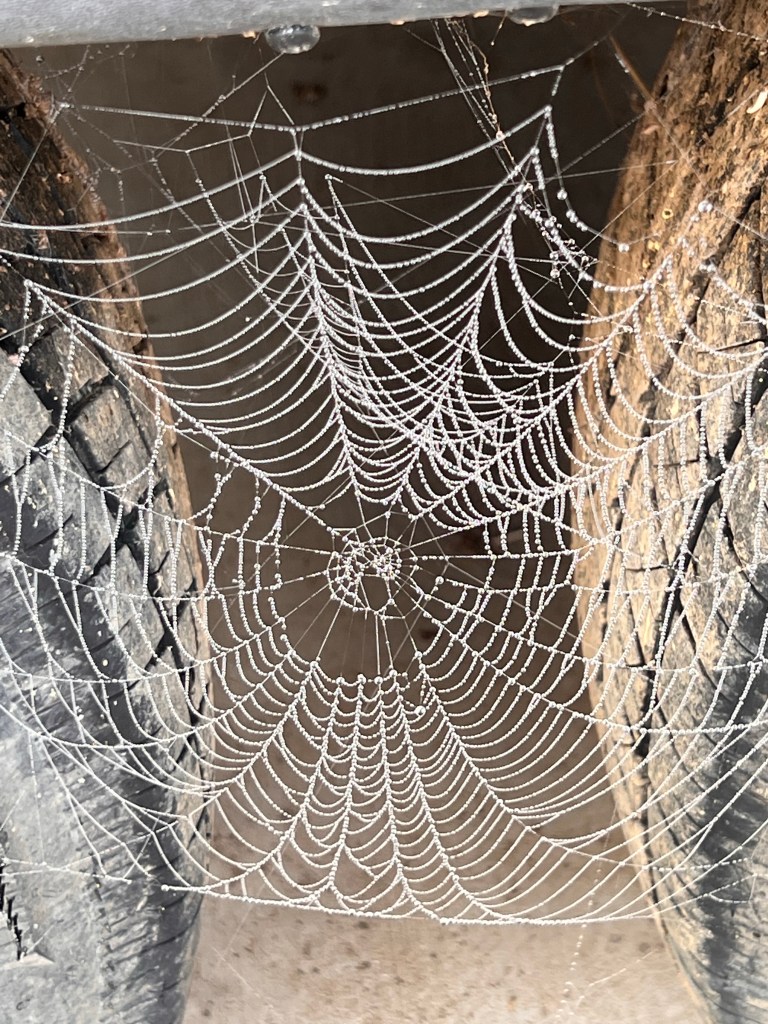
Yesterday morning, it was very foggy at my house. As usual, I stopped to enjoy the droplets of water in the grass and hanging on the chicken wire at the henhouse. On my way back from feeding the chickens, I happened to glance at the steps to the RV that’s parked next to our garage. I was entranced by the jewel-like effect the dew had on the spider webs that are usually just busy trapping flies and other insects.
Arachnid artistry
Yes, spiderwebs have a job to do, but that doesn’t mean one can’t admire their construction and strength. That water had to be heavy, but the webs held up. There was also a light breeze, and I wish I’d thought to take video of the webs as they danced around, still holding on to most of their water droplets.
This one looks extra heavy
I didn’t see any evidence of spiders in any of the webs I saw, including ones around the grounds near my house. They were probably avoiding their webs until it dried off a bit.
You can see how dewy it was in the background grass
I figured most of the webs I saw were woven by an orbweaver, judging from their shape. I know that the yellow garden spiders (Argiope aurantia) are mostly gone, so I ruled them out. But I’ve seen a couple of different orbweavers around this fall and I’m not sure which ones they are, because I haven’t gotten any confirmation from iNaturalist reviewers (follow the link to view and confirm or deny my guesses!). Most appear to have been Western spotted orbweavers (Neoscona oaxacensis) or tuft-legged orbweavers (Mangora placida).
The center of this one is rather wonky but does the job.
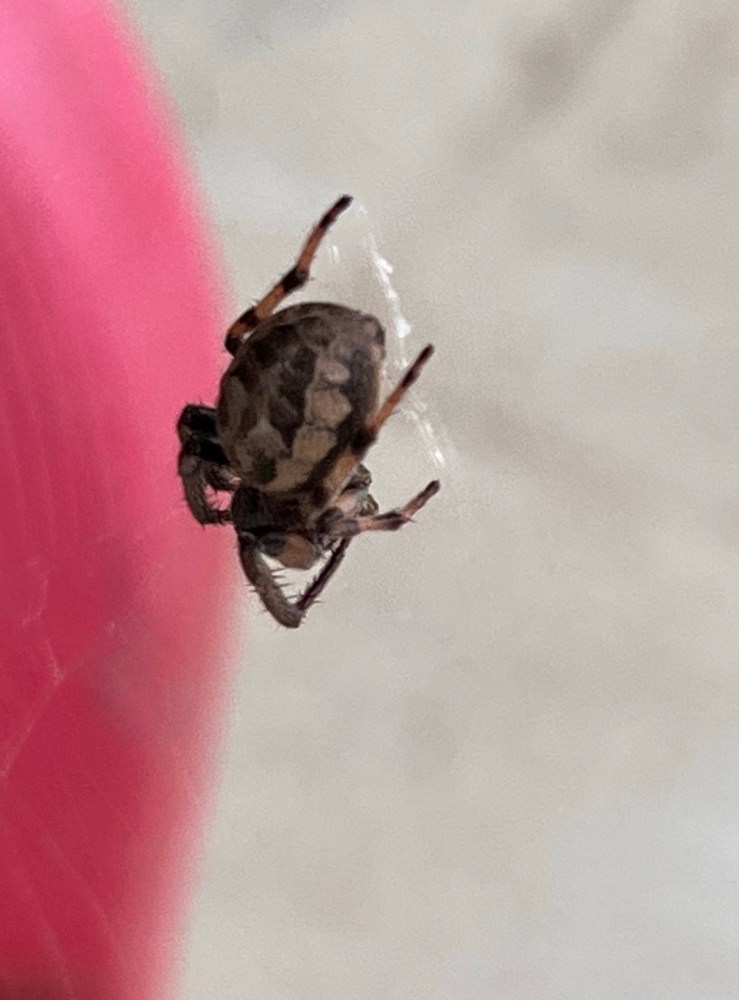
This morning was still damp, but not as foggy, so the webs were back to being almost invisible, but hey, I spotted a brown lump in one of the webs. I found her! The webs by the RV seem to be made by yet another orb weaving friend, the furrow orbweaver (Larinioides cornutus), which I have seen before in Milam County. The pattern is quite different from the others I’d been seeing this summer, so I’m fairly confident, even though no one has confirmed the observation yet (I just put it up a couple of hours ago).
I was happy to be able to know to whom I owed the debt of gratitude for the spectacle of web adornment I got to enjoy yesterday.
I do think maybe one or two of the webs were made by different spiders, especially the one by the front gate, which was made by an old spidey buddy of mine, who, judging by her coloration, is probably the Spotted Orbweaver (Neoscona crucifera). These webs aren’t quite as neat and tidy as the ones by the RV.
The webThe spider
Well, regardless of whether my identifications are right or not, I’ve had fun with the orbweavers in my vicinity, and hope you enjoyed learning a little more about them. Below are some more of my photos of these cool arachnids and their webs.
yellow garden spider (verified)banded garden spider (verified)Western spotted orbweavertuft-legged orbweaver? not sure. not an expert!
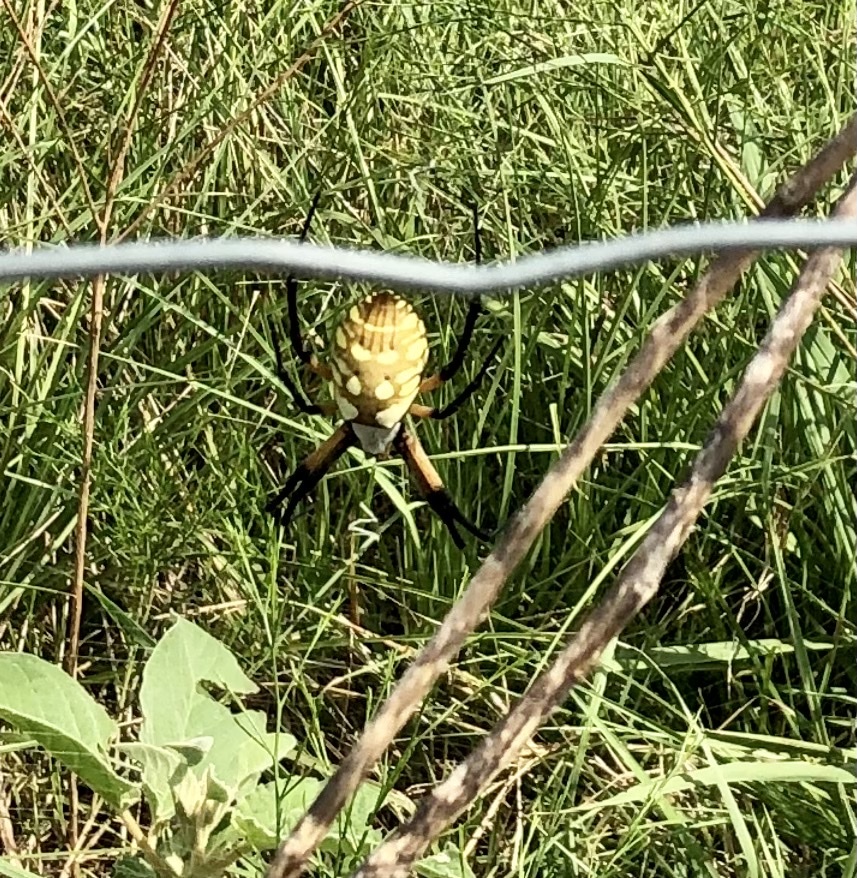
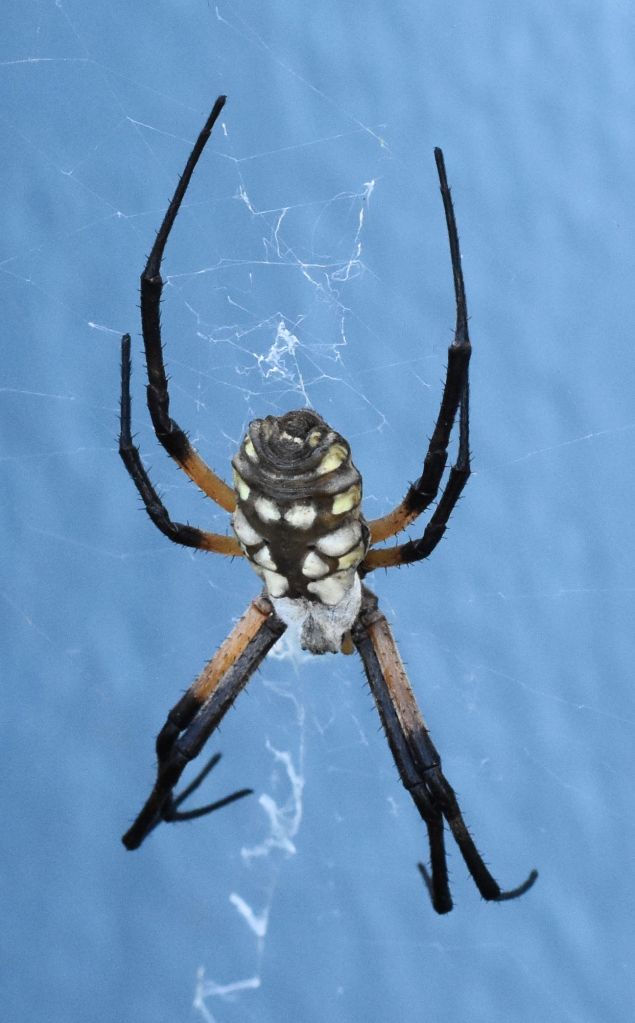
Fall is a sad time of year for some. I had garden spiders arrayed around my house again this year. One picked a low spot between the porch and skirting. It was a good spot at first and she grew quickly. There were lots of suitors while she was the only show in town, including some from the other species.
Argiope aurantia
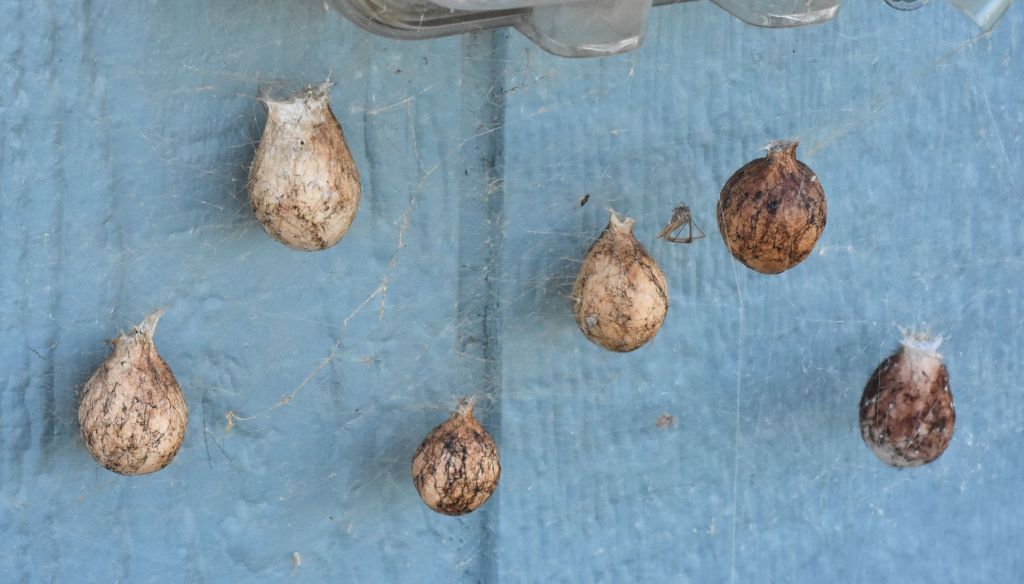
About that time, she wasn’t catching anything and looked like she might be starving to death, so I started throwing differential grasshoppers into her web. After a while she was doing OK on her own, so I stopped. In all she produced six egg sacs. No other spider came close and most never produced a single sac. After the last sac, she caught no more grasshoppers and died about a week after the photo was taken.






 Nature Along the El Camino Real