We have met several times at Bird and Bee Farm to harvest seeds for our newest El Camino Real Master Naturalist project.
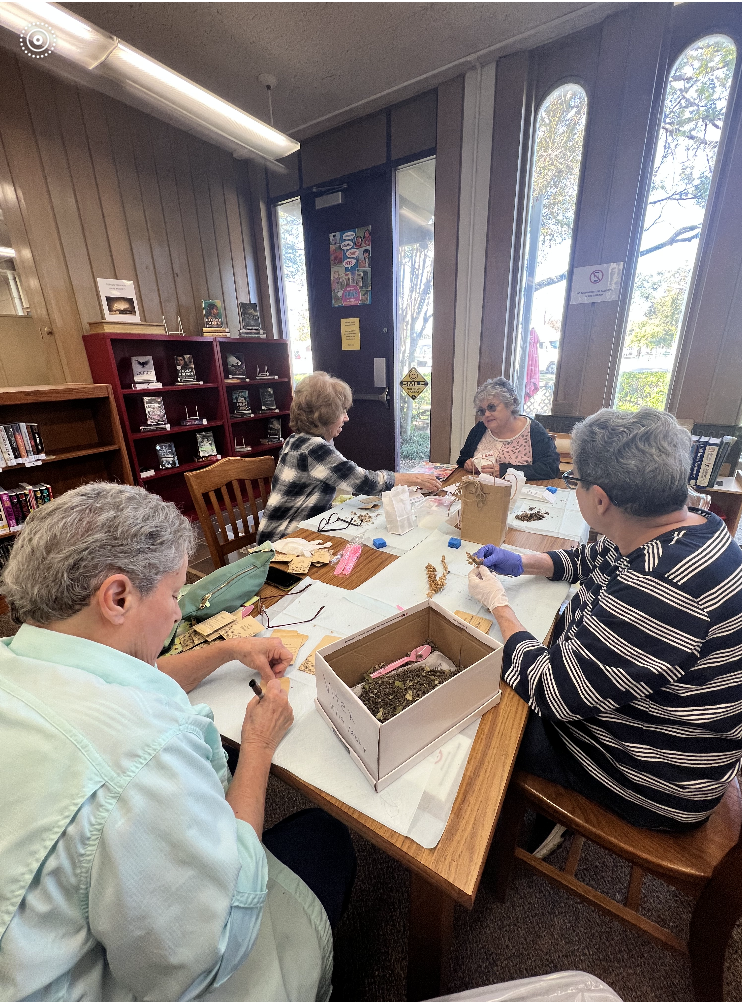
Yesterday, November 26th, we met at the Cameron Public Library to start packaging the seeds. Our project has been embraced by Elena Berkes, the library’s Director. She even joined us yesterday!
Elena is letting us use the beautiful card catalog cabinets at the library to store our seeds and make them available to the public.
We made 275 seed packets yesterday! I was thrilled! I want to thank all the volunteers who have come to harvest seeds and those who came yesterday to package the seeds.
This will be an ongoing project and you will receive volunteer hours under Community Outreach- Indirect, as well as travel time.
I would love for you to collect seeds, native and adapted, to contribute. Just put your seeds in a brown paper bag or envelope, the name of the plant, and the date you collected the seeds.
I would like to say special thanks to Catherine Johnson (an expert in native and adapted plants)! She has helped me immensely.🎉
Come join us at our next gathering to package seeds, which will be on Tuesday, December 17th, at the Cameron Public Library.
[Note: our most popular article on this site is Wolf Spider Identification. This article provides a brief update, plus links to Eric Neubauer’s recent presentation at the 2024 Texas Master Naturalist Annual Meeting.]
This material serves as an introduction to a new wolf spider species that is quite common in Texas and Oklahoma. It is also known in nine other states as far away as North Carolina. There is sufficient information to identify both juveniles and adults in the field as well as learn something about its life cycle. This is a departure from tradition in that a tremendous amount of information is made available to the public before publication in a scientific journal and formal acceptance of the species name.
Hogna incognita
Links to slides and explanatory text in lieu of a speaker follow:
I hope the average amateur naturalist and even professional arachnologist will find this more user friendly than the typical scientific paper.
I’m now waiting to see if any adult females make it into November. There were some with babies out there just a week ago. They outlasted my last Argiope aurantia. Someone needs to compose an “End of the Season Blues.”
Not to worry, some other wolf spider species are nearing maturity including the other undescribed Hogna west of the Edwards Plateau and another unknown I saw three adult males of last winter. I don’t want to say it’s an undescribed species until I see some adult females and do a thorough search of the possibilities. Exciting times!
Hogna incognita postscript
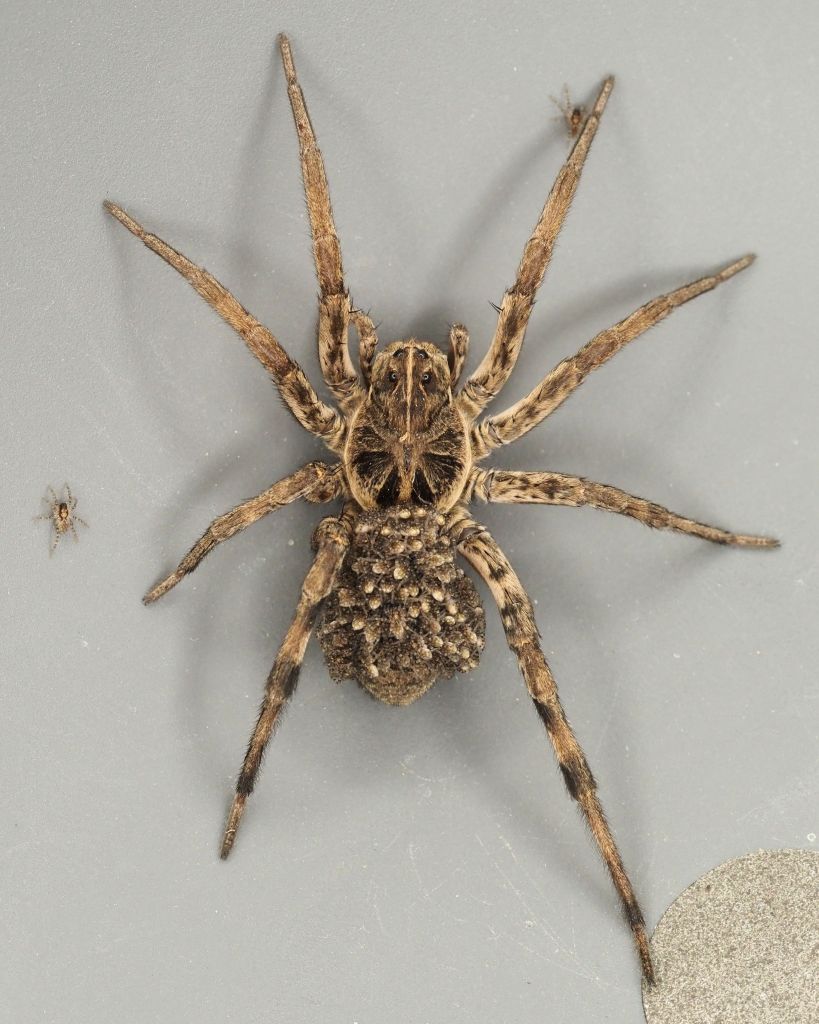
There’s always more to know about a species. Based on last year’s observations, adult females last though October. As the class of 2024 dwindled, it looked like some might make it into November in parts of Texas and Oklahoma. I held my breath and went out with my headlamp on as soon as the sun set on November 1st. I found one fairly quickly in the stubble of the hay field out back. She was away from her burrow and I caught her easily.
JuvenileSpiderlings attached
About a third of her family had already dispersed. Another half dozen or so decided to go off on their own while I did the photography. I collected her and the spiderlings that had disembarked and released them on higher ground next to a crack in the soil for cover if they needed it, and just in case of heavy rain.




 Nature Along the El Camino Real